ei
Page categories
Catalan
Pronunciation
- IPA(key): (Northern) [ˈe̞j]
- IPA(key): (Balearic, Central, Valencia, Northwestern) [ˈej]
Interjection
ei
- hey (exclamation to get attention)
Further reading
- “ei”, in Diccionari de la llengua catalana [Dictionary of the Catalan Language] (in Catalan), second edition, Institute of Catalan Studies [Catalan: Institut d'Estudis Catalans], April 2007
- “ei”, in Gran Diccionari de la Llengua Catalana, Grup Enciclopèdia Catalana, 2026
Classical Nahuatl
Numeral
ei
- obsolete spelling of ēyi
Dutch
Pronunciation
- IPA(key): /ɛi̯/, (Netherlands) [ɛi̯], (East and West Flanders, The Hague) [ɛː]
Audio (Netherlands): (file) Audio (Netherlands): (file) - Hyphenation: ei
- Rhymes: -ɛi̯
- Homophones: ij, IJ, -ij
Etymology 1
From Middle Dutch ei, from Old Dutch *ei, from Proto-West Germanic *aij, from Proto-Germanic *ajją.
Noun
ei n (plural eieren, diminutive eitje n)
- egg
- Ik heb een ei gebakken voor het ontbijt. ― I fried an egg for breakfast.
- Pasen is een feest waarbij veel eieren worden geschilderd. ― Easter is a festival where many eggs are painted.
- In deze doos zitten twaalf eieren. ― In this box, there are twelve eggs.
- female gamete [From 1230]
Derived terms
- blij ei
- de kip met de gouden eieren slachten
- duizendjarig ei
- een appel en een ei
- eendenei
- ei van Columbus
- eicel
- eidooier
- eierbal
- eierdop
- eieren voor zijn geld kiezen
- eiergeel
- eiergerecht
- eierkoek
- eierkoker
- eierkool
- eierlanding
- eierlepel
- eierlopen
- eiermuts
- eiersalade
- eierstok
- eierwarmer
- eigeel
- eigerecht
- eikapsel
- eileg
- eileider
- eisprong
- eitand
- eivorm
- eivormig
- eiwit
- het hele eiereneten
- kievitsei
- kippenei
- koek en ei
- op eieren lopen
- paasei
- struisvogelei
- van die boer geen eieren
- vogelei
- voor een appel en een ei
- windei
Descendants
Etymology 2
From the digraph itself.
Noun
ei m or f (plural ei's, diminutive eitje n or ei'tje n)
Anagrams
Estonian
Etymology
From the Proto-Finno-Ugric negative verb stem *e- ~ *ä- ~ *a-. Cognates include Finnish ei and Northern Sami ii.
Pronunciation
Interjection
ei
Antonyms
Adverb
ei (not comparable)
- don't, doesn't, not: used in negative forms of non-imperative verbs. Ma ei tea. I don't know. (Compare: Ma tean. I know.)
Usage notes
The verb follows the word ei.
In the present tense indicative, the form of the verb coincides with the imperative of the second person singular. In past tenses indicative, the form of the verb is active past participle. In the conditional mood, the form of the verb coincides with third person singular conditional in the present tense or the past tense. In the indirect mood, the form of the verb is the indirect form.
Derived terms
Fala
Etymology
From Old Galician-Portuguese eu, from Inherited from Late Latin eo, from Classical Latin egō̆.
Pronunciation
- IPA(key): /ˈei̯/
- Rhymes: -ei̯
- Syllabification: ei
Pronoun
ei m sg or f sg
- First person singular nominative pronoun; I
See also
| nominative | dative | accusative | disjunctive | |||
|---|---|---|---|---|---|---|
| singular | first person | ei | me, -mi | mi | ||
| second person | tú | te, -ti | ti | |||
| third person |
m | el | le, -li | uLV, oM | el | |
| f | ela | a | ela | |||
| plural | first person |
common | nos | musL nusLV nos, -nusM |
nos | |
| m | noshotrusM | noshotrusM | ||||
| f | noshotrasM | noshotrasM | ||||
| second person |
common | vos | vusLV vos, -vusM |
vos | ||
| m | voshotrusM | voshotrusM | ||||
| f | voshotrasM | voshotrasM | ||||
| third person |
m | elis | le, -li | usLV, osM | elis | |
| f | elas | as | elas | |||
| third person reflexive | — | se, -si | sí | |||
Dialects: L Lagarteiru M Mañegu V Valverdeñu
References
- Valeš, Miroslav (2021), Diccionariu de A Fala: lagarteiru, mañegu, valverdeñu (web), 2nd edition, Minde, Portugal: CIDLeS, published 2022, →ISBN, page 121
Faroese
Etymology
Pronunciation
- IPA(key): [ai]
Adverb
ei
Finnish
Etymology
The indicative forms are from Proto-Finnic *e-,[1] from Proto-Uralic *e- (negative verb stem).[2][3] The imperative forms are from Proto-Finnic *älä-, from the Proto-Finno-Ugric negative imperative verb stem *älä- ~ *elä-.[4]
Noteworthy forms include eivät (replacing earlier evät by influence from the third-person singular ei). For more forms, see the Proto-Finnic and Proto-Uralic pages.
Cognates for the indicative forms include Estonian ei, Karelian ei, Livonian ä’b, Veps ei, Northern Sami ii, Skolt Sami ij, Erzya а- (a-), э- (e-), и- (i-), Eastern Mari ы- (y-), Udmurt уг (ug), Komi-Zyrian оз (oz), Northern Mansi [script needed] (ä-), Forest Enets [script needed] (i-), Northern Selkup [script needed] (aša) (Taz) and Kamassian ей (ej). Cognates for the imperative forms include Estonian ära, Northern Sami ale, Kildin Sami ель (jel’), Erzya иля (iľa).
Not related to Swedish ej, Icelandic ei, Old Norse eigi, despite the similarity; the Finnic and Norse terms are false cognates.
Pronunciation
- IPA(key): /ˈei̯/, [ˈe̞i̯]
Audio: (file) Audio: (file) Audio: (file) - Rhymes: -ei
- Syllabification(key): ei
- Hyphenation(key): ei
Verb
ei (third-person singular indicative)
- (auxiliary) The negative verb or negation verb; not, be not, do not, etc. [with connegative]
- En ole käynyt siellä. ― I have not been there.
- Hän ei ole kotona. ― She isn't home.
- Etkö tiedä? ― Don't you know?
- Älä koske siihen! ― Don't touch that!
Usage notes
- With certain conjunctions, contractions may be used (e.g. miksi + ei → miksei). In some cases, like ellei and jollei, the independent conjunction has fallen out of use, but the contractions still remain in use. For other cases, the contractions are optional, but commonly used. When the contraction is used, the negative verb may effectively shift ahead in the clause:
- En tiedä, miksi hän ei tullut. → En tiedä, miksei hän tullut.
- I don't know why he didn't come.
- The negation verb is used with the connegative form of the main verb.
- In the active voice, the verb ei is inflected in person and mood (only for the imperative, in all other moods the indicative forms are used).
- In the indicative mood and present tense (including for the auxiliary olla in the perfect tense), the connegative form is identical to the second-person singular imperative.
- In the indicative mood and past tense (including for the auxiliary olla in the pluperfect tense and the main verb in the perfect and pluperfect tenses), the connegative form is the past active participle (-nut / -nyt).
- In the conditional and potential moods, the connegative ends with the mood markers -isi- and -ne- (without the personal ending), respectively.
- In the imperative mood, the connegative form is the same as the affirmative form for the second-person singular, while for the other forms a form ending in -ko / -kö is used.
- In the passive voice, the third-person singular ei (or älköön for the imperative mood) is used.
- In the present tense, the connegative form is the impersonal or passive form without the final -an / -än (indicative), -in (conditional), -en (potential) and -on / -ön (imperative).
- In the past tense (including the perfect and pluperfect tenses), the connegative form is the past passive participle (-ttu / -tty).
- The total object in the negative is always in the partitive case, not the accusative case (whether that be the nominative, genitive or a special form):
- Näen koiran. → En näe koiraa. ― I see a dog. → I don't see a dog. (accusative → partitive)
- Näen naiset. → En näe naisia. ― I see the women. → I don't see the women. (accusative → partitive)
- Näen sinut. → En näe sinua. ― I (can) see you. → I don't see you. (accusative → partitive)
- Indicative:
- Hän näkee. → Hän ei näe.
- He sees. / He does see. → He doesn't see.
- Hän näki. → Hän ei nähnyt.
- He saw. / He did see. → He didn't see.
- Hän on nähnyt. → Hän ei ole nähnyt.
- He has seen. → He hasn't seen.
- Hän oli nähnyt. → Hän ei ollut nähnyt.
- He had seen. → He hadn't seen.
- Conditional:
- Hän näkisi. → Hän ei näkisi.
- He would see. → He wouldn't see.
- Hän olisi nähnyt. → Hän ei olisi nähnyt.
- He would have seen. → He wouldn't have seen.
- Imperative:
- Näe! → Älä näe!
- See! → Don't see!
- Potential:
- Hän nähnee. → Hän ei nähne.
- He probably sees. → He probably doesn't see.
- Hän lienee nähnyt. → Hän ei liene nähnyt.
- He probably has seen. → He probably hasn't seen.
- Indicative:
- Hänet nähdään. → Häntä ei nähdä.
- He is seen. → He isn't seen.
- Hänet nähtiin. → Häntä ei nähty.
- He was seen. → He wasn't seen.
- Hänet on nähty. → Häntä ei ole nähty.
- He has been seen. → He hasn't been seen.
- Hänet oli nähty. → Häntä ei ollut nähty.
- He had been seen. → He hadn't been seen.
- Conditional:
- Hänet nähtäisiin. → Häntä ei nähtäisi.
- He would be seen. → He wouldn't be seen.
- Hänet olisi nähty. → Häntä ei olisi nähty.
- He would have been seen. → He wouldn't have been seen.
- Imperative (the second form, perfect imperative, is rare):
- Nähtäköön! → Älköön nähtäkö!
- Let (it) be seen! → Don't let (it) be seen!
- Oltakoon nähty! → Älköön oltako nähty.
- Let (it) have been seen! → Don't let (it) have been seen!
- Potential:
- Hänet nähtäneen. → Häntä ei nähtäne.
- He probably is seen. → He probably isn't seen.
- Hänet lienee nähty. → Häntä ei liene nähty.
- He probably has been seen. → He probably hasn't been seen.
Conjugation
- The negation verb has no infinitive form.
- Indicative, conditional and potential moods use the indicative forms (stem e-), for which the verb is conjugated only in person (the moods are distinguished by the connegative form used).
- In the imperative mood the negation verb has the stem äl-. As with all verbs, the first-person plural imperative is formal or dated, while the third-person imperative (both singular and plural) is dated.
- An archaic optative mood exists and is used mainly in poetry.
| Inflection of ei | |||
|---|---|---|---|
| person | indicative mood | imperative mood | optative mood |
| 1st sing. | en | — | — |
| 2nd sing. | et | älä | (ällös) |
| 3rd sing. | ei | älköön | (älköön) |
| 1st plur. | emme | älkäämme | (älköömme) |
| 2nd plur. | ette | älkää | (älköötte) |
| 3rd plur. | eivät | älkööt | (älkööt) |
Derived terms
Related terms
Interjection
ei
- no (used to show disagreement, negation, denial, refusal, or prohibition)
- Onko hauki lintu? Ei, se on kala.
- Is a pike a bird? No, it is a fish.
- Haluaisitko lisää? — Ei, en halua.
- Would you like some more? — No, I do not.
Usage notes
- When used as a response on its own, the interjection is inflected for person just like the verb. However, if it is used as an emphatic preceding an inflected negative verb, it may be left as ei (as seen in the usage example above).
- In computing, ei is ubiquitous as the usual translation for English no (e.g. as a dialog button), as most computer systems do not provide the option for a separate translation for each query. This is relevant for dialogs that e.g. use second-person singular personal forms ("do you want to..." = haluatko...), which grammatically speaking should use en (“I do not”), but often just use ei.
Antonyms
- (echo answer; using the verb in the positive)
- kyllä
- (colloquial) joo, juu
Noun
ei
Usage notes
- (NOT): Often spelled in capital letters (EI).
Declension
- (a no):
| Inflection of ei (Kotus type 18/maa, no gradation) | |||
|---|---|---|---|
| nominative | ei | eit | |
| genitive | ein | eiden eitten | |
| partitive | eitä | eitä | |
| illative | eihin | eihin | |
| singular | plural | ||
| nominative | ei | eit | |
| accusative | nom. | ei | eit |
| gen. | ein | ||
| genitive | ein | eiden eitten | |
| partitive | eitä | eitä | |
| inessive | eissä | eissä | |
| elative | eistä | eistä | |
| illative | eihin | eihin | |
| adessive | eillä | eillä | |
| ablative | eiltä | eiltä | |
| allative | eille | eille | |
| essive | einä | einä | |
| translative | eiksi | eiksi | |
| abessive | eittä | eittä | |
| instructive | — | ein | |
| comitative | See the possessive forms below. | ||
| Possessive forms of ei (Kotus type 18/maa, no gradation) | ||||||||||||||||||||||||||||||||||||||||||||||||||||||||||||||||||||||||||||||||||||||||||||||||||||||||||||||||||||||||||||||||||||||||||||||||||||||||||||||||||||||||||||||||||||||||||||||||||||||||||||||||||||||||||||||||||||||||||||||||||||||||||||||||||||||||||||||||||||||||||||||||||||||||||||||||||||||||||||||||||||||||||||||||||||||||||||||
|---|---|---|---|---|---|---|---|---|---|---|---|---|---|---|---|---|---|---|---|---|---|---|---|---|---|---|---|---|---|---|---|---|---|---|---|---|---|---|---|---|---|---|---|---|---|---|---|---|---|---|---|---|---|---|---|---|---|---|---|---|---|---|---|---|---|---|---|---|---|---|---|---|---|---|---|---|---|---|---|---|---|---|---|---|---|---|---|---|---|---|---|---|---|---|---|---|---|---|---|---|---|---|---|---|---|---|---|---|---|---|---|---|---|---|---|---|---|---|---|---|---|---|---|---|---|---|---|---|---|---|---|---|---|---|---|---|---|---|---|---|---|---|---|---|---|---|---|---|---|---|---|---|---|---|---|---|---|---|---|---|---|---|---|---|---|---|---|---|---|---|---|---|---|---|---|---|---|---|---|---|---|---|---|---|---|---|---|---|---|---|---|---|---|---|---|---|---|---|---|---|---|---|---|---|---|---|---|---|---|---|---|---|---|---|---|---|---|---|---|---|---|---|---|---|---|---|---|---|---|---|---|---|---|---|---|---|---|---|---|---|---|---|---|---|---|---|---|---|---|---|---|---|---|---|---|---|---|---|---|---|---|---|---|---|---|---|---|---|---|---|---|---|---|---|---|---|---|---|---|---|---|---|---|---|---|---|---|---|---|---|---|---|---|---|---|---|---|---|---|---|---|---|---|---|---|---|---|---|---|---|---|---|---|---|---|---|---|---|---|---|---|---|---|---|---|---|---|---|---|---|---|---|---|---|---|---|---|---|---|---|---|---|---|---|---|---|---|---|---|---|
| ||||||||||||||||||||||||||||||||||||||||||||||||||||||||||||||||||||||||||||||||||||||||||||||||||||||||||||||||||||||||||||||||||||||||||||||||||||||||||||||||||||||||||||||||||||||||||||||||||||||||||||||||||||||||||||||||||||||||||||||||||||||||||||||||||||||||||||||||||||||||||||||||||||||||||||||||||||||||||||||||||||||||||||||||||||||||||||||
- (NOT): Not inflected. If inflection is necessary, it is used as the first component in a compound, such as EI-portti (“NOT gate”), and portti is then inflected.
References
- ^ Kallio, Petri (2020–), “*e-pä”, in Yhteissuomalainen sanasto [Common Finnic Vocabulary][1] (in Finnish)
- ^ Ante Aikio (24 March 2022), “Proto-Uralic”, in Marianne Bakró-Nagy, Johanna Laakso, Elena Skribnik, editors, The Oxford Guide to the Uralic Languages, Oxford University Press, →ISBN, page 10 of 3–27
- ^ Erkki Itkonen, Ulla-Maija Kulonen, editors (1992–2000), Suomen sanojen alkuperä [The Origin of Finnish Words][2] (in Finnish) (online version; note: also includes other etymological sources; this source is labeled "SSA 1992–2000"), Helsinki: Institute for the Languages of Finland/Finnish Literature Society, →ISBN
- ^ Ante Aikio (24 March 2022), “Proto-Uralic”, in Marianne Bakró-Nagy, Johanna Laakso, Elena Skribnik, editors, The Oxford Guide to the Uralic Languages, Oxford University Press, →ISBN, page 13 of 3–27
Further reading
- “ei”, in Kielitoimiston sanakirja [Dictionary of Contemporary Finnish][6] (in Finnish) (online dictionary, continuously updated), Kotimaisten kielten keskuksen verkkojulkaisuja 35, Helsinki: Kotimaisten kielten tutkimuskeskus (Institute for the Languages of Finland), 2004–, retrieved 2 July 2023
Galician
Pronunciation
- IPA(key): [ˈej]
Interjection
ei
References
- Antón Santamarina, editor (2006–2013), “ei”, in Dicionario de Dicionarios da lingua galega [Dictionary of Dictionaries of the Galician language] (in Galician), Santiago de Compostela: Instituto da Lingua Galega
- Antón Santamarina, Ernesto X. González Seoane, María Álvarez de la Granja, editors (2003–2018), “ei”, in Tesouro informatizado da lingua galega (in Galician), Santiago de Compostela: Instituto da Lingua Galega
- Rosario Álvarez Blanco, editor (2014–2024), “ei”, in Tesouro do léxico patrimonial galego e portugués (in Galician), Santiago de Compostela: Instituto da Lingua Galega, →ISSN
German
Etymology
For the “caressing” sense compare Dutch aaien.
Pronunciation
- IPA(key): /aɪ̯/
Interjection
ei
- whoa, hey (expression of surprise)
- (childish, parentese, often reduplicated as ei ei) said when patting or caressing a person or animal
Derived terms
- ei machen, ei ei machen (“to pat, caress”)
Gothic
Romanization
ei
- romanization of 𐌴𐌹
Icelandic
Etymology 1
From Old Norse ei. A clipping of eigi, from Proto-Germanic *ni aiw-gin (“never”), from *ne, *ni (“not”) + *aiw (“always, for ever”) + *-gin. Not related to Finnish ei (“no”).
Pronunciation
- IPA(key): [ˈeiː]
- Rhymes: -eiː
- Homophones: ey, Ey
Adverb
ei
- (archaic, poetic) not
- Synonyms: eigi, ekki
- Örvæntið ei!
- Despair not!
- Ég veit ei hvað skal segja.
- I know not what to say.
Derived terms
- eður ei
- gleym-mér-ei
Etymology 2
See e.
Pronunciation
- IPA(key): [ˈɛːɪ]
- Rhymes: -ɛːɪ
Noun
ei
- dative singular indefinite of e
References
- Ásgeir Blöndal Magnússon (1989), “ei”, in Íslensk orðsifjabók, Reykjavík: Árni Magnússon Institute for Icelandic Studies, →ISBN (Available at Málið.is under the “Eldri orðabækur” tab.)
Ingrian
Etymology
From Proto-Finnic *e-, from the Proto-Uralic *e-. Cognates include Finnish ei and Estonian ei.
Pronunciation
- (Ala-Laukaa) IPA(key): /ˈei̯/, [ˈe̞i̯]
- (Soikkola) IPA(key): /ˈei̯/, [ˈe̞i̯]
- (Hevaha) IPA(key): /ˈei̯/, [ˈe̞i̯]
- Rhymes: -ei̯
- Hyphenation: ei
Particle
ei
Antonyms
Verb
ei
- not
- 1936, N. A. Iljin and V. I. Junus, Bukvari iƶoroin șkouluja vart, Leningrad: Riikin Ucebno-pedagogiceskoi Izdateljstva, page 63:
- Linnuil ono nälkä, evät rooka saa.
- The birds are hungry, they don't get food.
Usage notes
- ei is a defective verb: It is only inflected for person, and has a distinct imperative series.
- In the indicative, conditional, imperative and potential used with a connegative form of the main verb:
- In the present indicative the connegative is formally identical to the imperative singular:
- hää ei taho ― she doesn't want
- höö evät taho ― they don't want
- In the imperfect indicative, the connegative is formally identical to the past active participle (placed in the nominative singular in the singular, nominative plural in the plural):
- hää ei tahtont ― she didn't want
- höö evät tahtoneet ― they didn't want
- In the conditional the connegative is formally identical to the third-person singular conditional form:
- hää ei tahtois ― she wouldn't want
- höö evät tahtois ― they wouldn't want
- In the imperative, the connegative is formed by replacing the imperative endings of the verb by the element -ko:
- hää elköö tahtoko! ― may she not want!
- höö elkööt tahtoko! ― may they not want!
- The second-person singular of the imperative takes a distinct connegative, which is formally identical to the present indicative connegative:
- elä taho! ― do not want!
- In the potential, the connegative is formed by replacing the connegative endings of the verb by the element -ne:
- hää ei tahtone ― she probably won't want
- höö evät tahtone ― they probably won't want
- In the present indicative the connegative is formally identical to the imperative singular:
- For the impersonal forms, the third-person singular (ei / elköö) is used together with an impersonal connegative:
- ei tahota ― it isn't wanted
- ei tahottu ― it wasn't wanted
- ei tahottais ― it woudn't be wanted
- elköö tahottako ― may it not be wanted
- ei tahottane ― it probably won't be wanted
- When used to negate an infinitive, adverb, noun, etc., the negative verb agrees with the subject of the sentence:
- hää herviijaa ei ehtiä ― he is afraid to not make it in time
- höö herviijaat evät ehtiä ― they are afraid to not make it in time
Conjugation
| Inflection of ei | |||
|---|---|---|---|
| indicative | imperative | ||
| 1st singular | en | - | |
| 2nd singular | et | elä | |
| 3rd singular | ei | elköö | |
| 1st plural | emmä | - | |
| 2nd plural | että | elkää | |
| 3rd plural | evät | elkööt | |
| impersonal | ei | elköö | |
| *) The interrogative is formed by adding the suffix -k (-kä?) or -kse to the indicative. | |||
References
- V. I. Junus (1936), Iƶoran Keelen Grammatikka[7], Leningrad: Riikin Ucebno-pedagogiceskoi Izdateljstva, page 128
- Ruben E. Nirvi (1971), Inkeroismurteiden Sanakirja, Helsinki: Suomalais-Ugrilainen Seura, page 29
- Arvo Laanest (1997), Isuri keele Hevaha murde sõnastik, Eesti Keele Instituut, page 24
- Olga I. Konkova; Nikita A. Dyachkov (2014), Inkeroin Keel: Пособие по Ижорскому Языку[8], →ISBN, page 15
Italian
Etymology 1
Syncopated form of elli (“he”), from Vulgar Latin *illi, from Latin ille (“that”).
Alternative forms
Pronunciation
Pronoun
ei m
- (poetic, archaic, after the verb) alternative form of egli
Etymology 2
Syncopated form of elli (“they”), from Latin illī (“those”).
Alternative forms
Pronunciation
Pronoun
ei m pl
- (archaic) alternative form of elli
Etymology 3
Pronunciation
- IPA(key): /ˈɛ.i/[2]
- Rhymes: -ɛi
- Hyphenation: è‧i
Verb
ei
- (archaic) alternative form of ebbi: first-person singular past historic of avere
- 1300s–1310s, Dante Alighieri, “Canto I”, in Inferno [Hell], lines 28–30; republished as Giorgio Petrocchi, editor, La Commedia secondo l'antica vulgata [The Commedia according to the ancient vulgate], 2nd revised edition, Florence: publ. Le Lettere, 1994:
References
- ↑ 1.0 1.1 1.2 1.3 “ei” in Bruno Migliorini et al., Dizionario d'ortografia e di pronunzia, Rai Eri, 2025
- ^ “ei” in Bruno Migliorini et al., Dizionario d'ortografia e di pronunzia, Rai Eri, 2025
Japanese
Romanization
ei
Karelian
| North Karelian (Viena) |
ei |
|---|---|
| South Karelian (Tver) |
ei |
Etymology
From Proto-Finnic *e-. Cognates include Finnish ei and Veps ei.
Pronunciation
- IPA(key): /ˈei̯/
- Hyphenation: ei
Verb
ei
Conjugation
This entry needs an inflection-table template.
References
- A. V. Punzhina (1994), “ei”, in Словарь карельского языка (тверские говоры) [Dictionary of the Karelian language (Tver dialects)], →ISBN
- P. Zaykov; L. Rugoyeva (1999), “ei”, in Карельско-Русский словарь (Северно-Карельские диалекты) [Karelian-Russian dictionary (North Karelian dialects)], Petrozavodsk, →ISBN
Kott
Etymology 1
Inherited from Proto-Yeniseian *ej (“pine tree”).[1][2]
Pronunciation
- IPA(key): /ɛj/ ~ /ej/
Noun
ei (plural en)
Etymology 2
CHYD lists this term as inherited from Proto-Yeniseian *ɯj (“cry, voice, call; call, shout”, noun, infinitive verb);[3] while SLDB lists it under Proto-Yeniseian *ej (“tongue”).[4]
Pronunciation
- IPA(key): /ɛj/ ~ /ej/
Noun
ei (plural êjaŋ)
References
- ^ https://starlingdb.org/cgi-bin/response.cgi?single=1&basename=%2fDATA%2fYENISEY%2fYENET&text_number=52&root=config
- ^ Vajda, Edward; Werner, Heinrich (2022), Comparative-Historical Yeniseian Dictionary (Languages of the World/Dictionaries; 79, 80), Muenchen: LINCOM GmbH, →ISBN, page 269
- ^ Vajda, Edward; Werner, Heinrich (2022), Comparative-Historical Yeniseian Dictionary (Languages of the World/Dictionaries; 79, 80), Muenchen: LINCOM GmbH, →ISBN
- ^ https://starlingdb.org/cgi-bin/response.cgi?single=1&basename=%2fDATA%2fYENISEY%2fYENET&text_number=53&root=config
Further reading
- Matthias Alexander Castrén, Versuch Einer Jenissei-Ostjakischen Und Kottischen Sprachlehre: Nebst Aus Den Genannten Sprachen, St. Petersburg: Leopold Voss Publisher, 1858, page 199
- Werner, Heinrich (2002), Vergleichendes Wörterbuch der Jenissej-Sprachen, volume 1, Wiesbaden: Harrassowitz Verlag, →ISBN, pages 261, 272
- Werner, Heinrich K. (2003), Röhrborn, Klaus, Schellbach-Kopra, Ingrid, editors, M. A. Castrén und die Jenissejistik: Die Jennisej-Sprachen des 19. Jahrhunderts (Veröffentlichungen des Societas Uralo-Altaica; 62) (in German), Wiesbaden: Harrassowitz Verlag, →ISBN, pages 123, 165
Latin
Etymology 1
See the etymology of the corresponding lemma form.
Pronunciation
- (Classical Latin) IPA(key): [ˈɛi̯]
- (modern Italianate Ecclesiastical) IPA(key): [ˈɛi̯]
Interjection
ei
- alternative form of hei (“expression of grief or fear”)
Etymology 2
See the etymology of the corresponding lemma form.
Pronunciation
- eī̆:
- (Classical Latin) IPA(key): [ˈe.iː], [ˈe.ɪ]
- (modern Italianate Ecclesiastical) IPA(key): [ˈɛː.i]
- ēi:
- (Classical Latin) IPA(key): [ˈeːj]
- (modern Italianate Ecclesiastical) IPA(key): [ˈɛj]
Pronoun
eī̆ or ēi
- inflection of is:
- dative masculine/feminine/neuter singular
- nominative masculine plural
Alternative forms
- aeī (Merovingian, hypercorrection)
Latvian
Interjection
ei
- used to stimulate somebody's attention
- used to express pleasure, surprise or admiration
Limburgish
Alternative forms
Etymology
From Middle Dutch ei, from Old Dutch *ei, from Proto-West Germanic *aij, from Proto-Germanic *ajją, from Proto-Indo-European *h₂ōwyóm.
Pronunciation
- IPA(key): /ɛi̯/, [ɛːi̯]
- Hyphenation: ei
- Rhymes: -ɛi̯
Noun
ei n
Livonian
Verb
ei
- first/third-person singular past indicative of īedõ
Livvi
Etymology
From Proto-Finnic *ei. Cognates include Finnish ei and Estonian ei.
Pronunciation
- IPA(key): /ˈei̯/
- Hyphenation: ei
- Rhymes: -ei̯
Verb
ei
Conjugation
| Inflection of ei | |||
|---|---|---|---|
| indicative | imperative | ||
| 1st singular | en | - | |
| 2nd singular | et | älä | |
| 3rd singular | ei | älgäh | |
| 1st plural | emmo | älgiämmö | |
| 2nd plural | etto | älgiä | |
| 3rd plural | ei | äldähes | |
References
- N. Gilojeva; S. Rudakova (2009), Karjalan kielen Livvin murdehen algukursu [Beginners' course of Karelian language's Livvi dialect][9] (in Livvi), Petrozavodsk, →ISBN, page 20
- Tatjana Boiko (2019), “ei”, in Suuri Karjal-Venʹalaine Sanakniigu (livvin murreh) [The Big Karelian-Russian dictionary (Livvi dialect)], 2nd edition, →ISBN, page 38
Malasanga
Noun
ei
Further reading
- Ross, Malcolm (1988), Proto Oceanic and the Austronesian Languages of Western Melanesia (Pacific Linguistics; C-98)[10], Canberra, ACT: Pacific Linguistics, Research School of Pacific and Asian Studies, Australian National University
Mandarin
Romanization
ei
Usage notes
- Transcriptions of Mandarin into the Latin script often do not distinguish between the critical tonal differences employed in the Mandarin language, using words such as this one without indication of tone.
Mbya Guarani
Noun
ei
Middle Dutch
Alternative forms
Etymology
From Old Dutch *ei, from Proto-West Germanic *aij, from Proto-Germanic *ajją, from Proto-Indo-European *h₂ōwyóm.
Noun
ei n
Inflection
| singular | plural | |
|---|---|---|
| nominative | ei | eier, eiere |
| accusative | ei | eier, eiere |
| genitive | eis | eier, eiere |
| dative | eie | eieren |
Descendants
Further reading
- “ei”, in Vroegmiddelnederlands Woordenboek, 2000
- Verwijs, E.; Verdam, J. (1885–1929), “ei”, in Middelnederlandsch Woordenboek, The Hague: Martinus Nijhoff, →ISBN
Middle English
Noun
ei
- alternative form of ey (“egg”)
Noun
ei
- alternative form of eye (“eye”)
Determiner
ei
- (dialectal, West Midlands) alternative form of eni (“any”)
Alternative forms
References
- “ei, pron.”, in MED Online, Ann Arbor, Mich.: University of Michigan, 2007, retrieved 20 March 2026.
Middle High German
Etymology
Inherited from Old High German ei, from Proto-West Germanic *aij, from Proto-Germanic *ajją, from Proto-Indo-European *h₂ōwyóm.
Pronunciation
- IPA(key): (before 13th CE) /ˈei̯/
Noun
ei n
Declension
Descendants
- Alemannic German:
- Swabian: Oi
- Bavarian: Oa
- Mòcheno: oi
- Central Franconian: Ei, Ää, Aai
- Luxembourgish: Ee
- German: Ei
- Vilamovian: e
- Yiddish: איי (ey)
References
- Benecke, Georg Friedrich; Müller, Wilhelm; Zarncke, Friedrich (1863), “ei”, in Mittelhochdeutsches Wörterbuch: mit Benutzung des Nachlasses von Benecke, Stuttgart: S. Hirzel.
Middle Scots
Noun
ei
- alternative form of ee (“eye”)
Mizo
Etymology
From Proto-Kuki-Chin *ʔay.
Verb
ei
- to eat
Further reading
- Lorrain, J. Herbert (1940), “ei”, in Dictionary of the Lushai language, Calcutta: Asiatic Society
Murui Huitoto
| ei | |
|---|---|
| Root | Classifier |
| ei- | — |
Etymology
Cognate with Minica Huitoto ei.
Pronunciation
- IPA(key): [ˈɛi̯]
- Hyphenation: ei
Root
ei
Noun
ei
- synonym of eiño
- 2008 [1978], Huitoto Murui Bible, 2nd edition, Mateo 1:3, page 5:
- Iaɨmaiaɨ mɨcorɨ eidɨ Tamar mɨcorɨ.
- The mother of the late two of them was the late Tamara.
- vocative of eiño
Declension
| singular | plural | kinship plural | |
|---|---|---|---|
| absolutive | ei | eiyaɨ | eitɨaɨ |
| nominative | eidɨ | eiyaɨdɨ | eitɨaɨdɨ |
| accusative | eina | eiyaɨna | eitɨaɨna |
| dative/locative | eimo | eiyaɨmo | eitɨaɨmo |
| ablative | eimona | eiyaɨmona | eitɨaɨmona |
| instrumental | eido | eiyaɨdo | eitɨaɨdo |
| causal | eiri | eiyaɨri | eitɨaɨri |
| privative | einino | eiyaɨnino | eitɨaɨnino |
| sequential | einona | eiyaɨnona | eitɨaɨnona |
Derived terms
References
- Shirley Burtch (1983), Diccionario Huitoto Murui (Tomo I) (Linguistica Peruana No. 20)[11] (in Spanish), Yarinacocha, Peru: Instituto Lingüístico de Verano, page 75
- Katarzyna Izabela Wojtylak (2017), A grammar of Murui (Bue): a Witotoan language of Northwest Amazonia.[12], Townsville: James Cook University press (PhD thesis), page 125
North Frisian
Alternative forms
Etymology
Adverb
ei
Norwegian Bokmål
Pronunciation
- (stressed) IPA(key): /¹æɪ/, [ˈæ̀ɪ̯]
- (unstressed) IPA(key): /æɪ/, [æɪ̯]
- Rhymes: -æɪ
- Homophone: (when stressed) éi
- Hyphenation: ei
Etymology 1
See the etymology of the corresponding lemma form.
The feminine form continues ein, feminine of einn (“one”).
Article
ei f
Usage notes
Ei is the feminine indefinite article. With nouns admitting both feminine and masculine inflection, en is also possible. The combinations ei bok – boka, en bok – boka and en bok – boken are accepted; ei bok – boken is not recommended.[1]
Numeral
| 10 | ||||
| ← 0 | 1 | 2 → | 10 → | |
|---|---|---|---|---|
| Cardinal: en/én, ei/éi, et/ett Ordinal: første Ordinal abbreviation: 1. Latinate ordinal: primær Reverse ordinal: sist Adverbial: én gang Multiplier: enkel Distributive: enkeltvis Nominal: ener, ettall Fractional: hel, heil Combining form: ene- Latin cardinal prefix: uni- Greek cardinal prefix: mono-, mon- Greek ordinal prefix: proto-, prot- Grammatical number: entall, singularis Greek collective: monade Birth term: enling Bridge holding: singleton Musical terms: solo, (interval) prim Period in years: år | ||||
ei f
Alternative forms
- éi (optionally accented to mark stress)
Pronoun
ei f
- feminine singular of en (“one”) (used independently, with reference to a feminine noun)
- Jeg trenger ei ny jakke, men finner ikke ei jeg liker. ― I need a new jacket, but cannot find one I like.
Etymology 2
Inherited from Old Norse eigi (“not”), originally in the combination né eigi (“not at any time”), with né (“not”). Eigi consists of ei (“ever”) and the particle -gi; its negative meaning developed through use with né, which was subsequently dropped.[2] The first element continues an adverbial form of Proto-Germanic *aiwaz (“age; eternity”), from Proto-Indo-European *h₂óyu (“lifetime”), belonging to the root *h₂ey- (“life; age; eternity”).[3] The particle continues Proto-Germanic *-gin.
Cognate with Norwegian Nynorsk ei, Danish ej, Swedish ej, Icelandic eigi and Faroese ei, all meaning “not”.
Alternative forms
- ej (obsolete spelling)
Adverb
ei
- (archaic or poetic, outside fixed expressions) not
- Synonym: ikke
- 1852, Henrik Wergeland, Henrik Wergelands Samlede Skrifter[13], volume II, page 101:
- mon ei folk paa gaarden er
- might there not be people at the farm?
- 1906, Johan Sebastian Welhaven, Samlede Digterverker[14], volume I, page 17:
- hvor gjerne saae jeg ei, at Norges jord frembragte ædel frugt
- how gladly I would see Norway’s soil yield noble fruit
- 1873, Henrik Ibsen, Kejser og Galilæer[15], page 98:
- frygt ej for Deres ven og for hans lykke
- do not fear for your friend and his happiness
- 1874, Henrik Ibsen, Peer Gynt[16], page 115:
- vil I skænke mig, taer jeg tiltakke; hvis ej, går jeg lige-nøjd bort
- if you will pour me a drink, I shall gladly accept; if not, I shall leave just as content
- 1926, Bjørnstjerne Bjørnson, Samlede digte[17], volume II, page 169:
- [ungdommen] længter mod det æn ej vundne
- [young people] long for what has not yet been attained
- 1908, Hans E. Kinck, Driftekaren[18], page 156:
- det er for skymt, nu ser vi ei til heien
- it is too dark; now we cannot see as far as the moor
- 1919, Nils Collett Vogt, Digte i utvalg[19], page 112:
- forglem os ei!
- forget us not!
- 1907, Bjørnstjerne Bjørnson, “En glad gut”, in Bjørnstjerne Bjørnsons Fortællinger[20], page 290:
- ej heller ved jeg, når de kjører mig bort, hvem som skal kjøre ind
- nor do I know, when they carry me away, who will move in
- 1882, Alexander L. Kielland, Skipper Worse[21], page 113:
- der var i byen nogle andre som aldrig drak ei heller satte sin fod i klubben
- there were some others in the town who never drank and never set foot in the club either
- 1874, Henrik Ibsen, Peer Gynt[22], page 210:
- han var ej rig, og heller ej forstandig
- he was not rich, nor was he wise
- eller ei — or not.
- være med skal du, enten du vil eller ei ― you are coming along, whether you want to or not
- 1874, Henrik Ibsen, Fru Inger til Østråt[23], page 45:
- hvad enten vi støtter det [dvs. Norge] eller ej
- whether we support it [i.e. Norway] or not
- 1918, Gunnar Heiberg, Samlede dramatiske verker[24], volume III, page 45:
- jeg skal ikke uttale mig om hvorvidt der […] er adgang til […] at fremsætte forslag eller ei
- I shall not comment on whether it is […] permissible to […] submit proposals or not
- (men) den gang ei — (but) that did not happen; (but) that was not so; no such luck.
- vi hadde gledet oss til en rolig lørdagskveld, men den gang ei ― we had been looking forward to a quiet Saturday evening, but no such luck
- 2008 July 12, Elmo, “Omregistreringsavgift”, in Elbilforum[25]:
- Det er jo ikke vegavgift på elbil, og jeg trodde at og omregistrering også er gratis, men dengang ei.
- There is no road tax on electric cars, and I thought re-registration was free too, but no such luck.
- «Dengang ei,» sa Tordenskiold (chiefly colloquial) — no such luck; not so fast (used when an expectation is thwarted).
- (colloquial) not (emphatically reinforcing a preceding negative).
Usage notes
Outside fixed expressions, ei is chiefly archaic or poetic. Expressions such as enten … eller ei and (men) den gang ei remain in ordinary use.
Etymology 3
Inherited from Old Norse ei, an interjection. Compare Danish ej and Latin ei, hei (“alas!, ah!”).
Alternative forms
- ej (obsolete spelling)
Interjection
ei
- (obsolete) oh, ah; used to express surprise or wonder, whether pleased or annoyed
- 1853, Henrik Wergeland, Henrik Wergelands Samlede Skrifter[28], volume III, page 449:
- Ej! jeg tænkte – Ej, for Fanden!
- Oh! I thought—Oh, damn it!
- 1873, Henrik Ibsen, Kejser og Galilæer[29], page 171:
- Ej, ej, du ser med venskabets øje
- Oh, oh, you see through the eyes of friendship
- 1874, Henrik Ibsen, De unges forbund[30], 3rd edition, page 15:
- Ej, det er en vidtløftig historie
- Oh, that is a long story
- 1874, Henrik Ibsen, Fru Inger til Østråt[31], page 110:
- Ei, – begynder I nu med det igen?
- Oh—are you starting that again?
- 1883, Jonas Lie, Familjen paa Gilje[32], page 165:
- Ej da, jeg havde jo nær glemt det!
- Oh dear, I had almost forgotten it!
- 1866, P. Chr. Asbjørnsen, Jørgen Moe, Norske Folke-Eventyr[33], 3rd edition, page 311:
- Eia mei da, Bamse, sidder du ogsaa i Stuen din Mærreflaaer?
- Oh my, Bruin, are you in the pit too, you mare-skinner?
- 1882, Jonas Lie, Gaa paa![34], page 168:
- Ejamej! nu gaar han der saa stursk og bidsk
- Oh dear! Now he is walking about so surly and snappish
- 1882, Jonas Lie, Gaa paa![35], page 314:
- Eja mej da! – det er Regnskaben!
- Oh dear!—it is the accounts!
Etymology 4
Nominalization of ei, the interjection (see above).
Noun
ei n (definite singular eiet, indefinite plural ei, definite plural eia or eiene)
- (dialectal) sound, utterance
- Synonym: lyd
- 1905, Regine Normann, Krabvaag[36], page 88:
- hele kvelden fremefter sad han uden maal og mæle, hverken ord eller ei var det i ham
- for the rest of the evening he sat without speaking; not a word or a sound came from him
- (dialectal) lamentation; a cry of pain
- Synonyms: jamring, skrik
Usage notes
The inflected forms shown follow the regular neuter pattern. The cited dictionary records the gender but does not supply a full inflectional paradigm.
Etymology 5
See the etymology of the corresponding lemma form.
Verb
ei
- imperative of eie (“to own; possess”)
References
- ^ “En øy – øya?”, in Språkrådet[3], 1 January 2024, retrieved 27 October 2026
- ^ Otto Jespersen (1917), Negation in English and Other Languages[4], Copenhagen: Andr. Fred. Høst & Søn, pages 8, 17
- ^ Guus Kroonen (2013), Etymological Dictionary of Proto-Germanic, Leiden, Boston: Brill, →ISBN, page 16
- “ei” in Norwegian Academy Dictionary (NAOB).
- “en” in The Bokmål Dictionary.
- “eie” in The Bokmål Dictionary.
Norwegian Nynorsk
Pronunciation
- IPA(key): [ɛ̝ɪ̯ː]
Etymology 1
Article
ei f (masculine ein, neuter eit)
- a, an (indefinite article)
- Ei ny bok.
- A new book.
Pronoun
ei
- feminine singular of ein
Etymology 2
From Middle Norwegian eigh, from Old Norse eigi.
Adverb
ei
References
- “ei” in The Nynorsk Dictionary.
- “ei”, in Norsk Ordbok: Ordbok over det Norske Folkemålet og det Nynorske Skriftmålet (in Norwegian Nynorsk), Oslo: Det Norske Samlaget, 1950–2016, →ISBN.
Old Galician-Portuguese
Etymology
Uncertain. Possibilities include:
- Borrowed from Arabic هَا (hā, dialectally hê).[1][2]
- Inherited from Latin ex.[2][3]
- Inherited from Latin ecce.[4]
Pronunciation
- IPA(key): /ˈej/
- Rhymes: -ej
Adverb
ei
- here is, here are
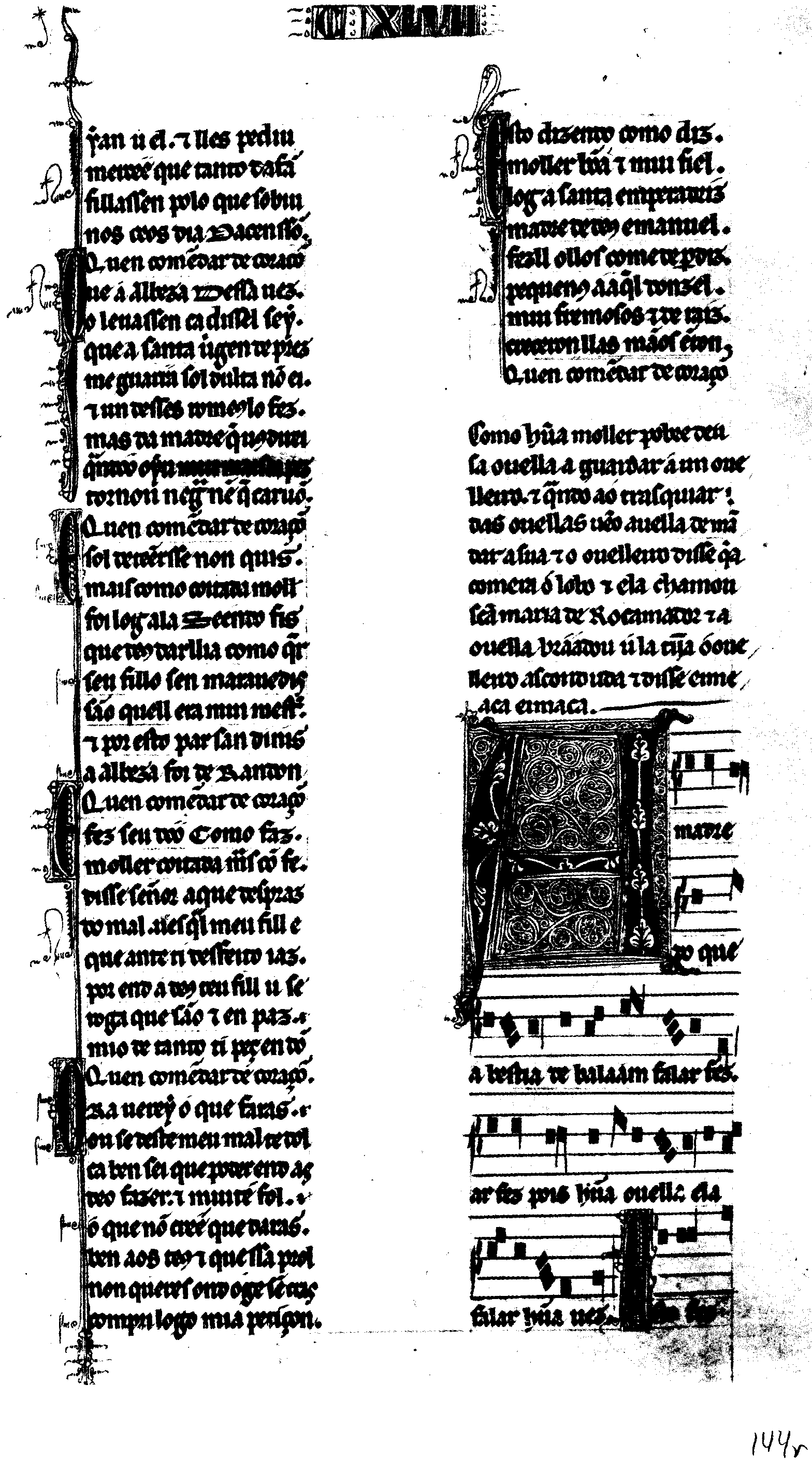
- a. 1284, Alfonso X of Castile, Cantigas de Santa Maria, Códice de los músicos, cantiga 147 (facsimile):
- eimeaca eimaca
- «ei-me aca; ei-m'aca!»
- "Here I am, here I am!"
Descendants
References
- ^ Coromines, Joan; Pascual, José Antonio (1984), “he”, in Diccionario crítico etimológico castellano e hispánico [Critical Castilian and Hispanic etymological dictionary][5] (in Spanish), volume III (G–Ma), Madrid: Gredos, →ISBN, page 335
- ↑ 2.0 2.1 “eis”, in Dicionário da Língua Portuguesa (in Portuguese), Lisboa: Academia das Ciências de Lisboa, 2001–2026
- ^ “eis”, in Dicionário Infopédia da Língua Portuguesa (in Portuguese), Porto: Porto Editora, 2003–2026
- ^ “eis”, in Michaelis Dicionário Brasileiro da Língua Portuguesa (in Portuguese), São Paulo: Editora Melhoramentos, 2015–2026, →ISBN
Old High German
Etymology
Inherited from Proto-West Germanic *aij, from Proto-Germanic *ajją, from Proto-Indo-European *h₂ōwyóm. Akin to Old English ǣġ, Old Norse egg.
Further Indo-European cognates include Latin ōvum and Ancient Greek ᾠόν (ōión)
Noun
ei n
Descendants
- Middle High German: ei
Old Saxon
Alternative forms
Etymology
From Proto-West Germanic *aij, from Proto-Germanic *ajją, from Proto-Indo-European *h₂ōwyóm.
Noun
ei n
Declension
| singular | plural | |
|---|---|---|
| nominative | ei | ei |
| accusative | ei | ei |
| genitive | eies | eiō |
| dative | eie | eium |
| instrumental | — | — |
Descendants
Papiamentu
Etymology
Derived from Portuguese eis.
Pronoun
ei
Portuguese
Pronunciation
- (Brazil) IPA(key): /ˈej/ [ˈeɪ̯]
- (Portugal) IPA(key): /ˈɐj/
- (Northern Portugal) IPA(key): /ˈej/
- (Central Portugal) IPA(key): /ˈej/
- (Southern Portugal) IPA(key): /ˈe/
Etymology 1
Adverb
ei (not comparable)
Etymology 2
Interjection
ei!
- hey (exclamation to get attention)
Further reading
- “ei”, in Dicionário Aulete Digital (in Portuguese), Rio de Janeiro: Lexikon Editora Digital, 2008–2026
- “ei”, in Dicionário Priberam da Língua Portuguesa (in Portuguese), Lisbon: Priberam, 2008–2026
Romanian
Pronunciation
- IPA(key): /ˈjej/
- Rhymes: -ej
- Hyphenation: ei
Audio: (file)
Etymology 1
Inherited from Latin illī, nominative masculine plural of ille.
Pronoun
ei m pl (third-person plural, feminine equivalent ele)
Declension
| stressed | unstressed | |||||||||||||||||||||||||||||||||||||||||||||||||||||||||||||||||||||||||||||||||||||||||||||||||||||||||||||||||||||||||||||||||||||||||||||||||||||||||||||||||||||||||||||||||||||||||||||||||||||||||||||||||||||||||||||||||||||||||||||||||||||||||||||||||||||||||||||||||||||||||||||||||||||||||||||||||||||||||||||||||||||||||||||||||||||||||||||||||||||||||||||||||||||||||||||||||||||||||||||||||||||||||||||||||||||||||||||||||||||||||||||||||||||||||||||||||||||||||||||||||||||||||||||||||||||||||||||||||||||||||||||||||||||||||||||||||||||||||||||||||||||||||||||||||||||||||||||||||||||||||||||||||||||||||||||||||||||||||||||||||||||||||||||||||||||||||||||||||||||||||||||||||||||||||||||||||||||||||||||||||||||||||||||||||||||||||||||||||||||||||||||||||||||||||||||||||||||||||||||||||||||||||||||||||||||||||||||||||||||||||||||||||||||||||||||||||||||||||||||||||||||||||||||||||||||||||||||||||||||||||||||||||||||||||||||||||||||||||||||||||||||||||||||||||||||||||||||||||||||
|---|---|---|---|---|---|---|---|---|---|---|---|---|---|---|---|---|---|---|---|---|---|---|---|---|---|---|---|---|---|---|---|---|---|---|---|---|---|---|---|---|---|---|---|---|---|---|---|---|---|---|---|---|---|---|---|---|---|---|---|---|---|---|---|---|---|---|---|---|---|---|---|---|---|---|---|---|---|---|---|---|---|---|---|---|---|---|---|---|---|---|---|---|---|---|---|---|---|---|---|---|---|---|---|---|---|---|---|---|---|---|---|---|---|---|---|---|---|---|---|---|---|---|---|---|---|---|---|---|---|---|---|---|---|---|---|---|---|---|---|---|---|---|---|---|---|---|---|---|---|---|---|---|---|---|---|---|---|---|---|---|---|---|---|---|---|---|---|---|---|---|---|---|---|---|---|---|---|---|---|---|---|---|---|---|---|---|---|---|---|---|---|---|---|---|---|---|---|---|---|---|---|---|---|---|---|---|---|---|---|---|---|---|---|---|---|---|---|---|---|---|---|---|---|---|---|---|---|---|---|---|---|---|---|---|---|---|---|---|---|---|---|---|---|---|---|---|---|---|---|---|---|---|---|---|---|---|---|---|---|---|---|---|---|---|---|---|---|---|---|---|---|---|---|---|---|---|---|---|---|---|---|---|---|---|---|---|---|---|---|---|---|---|---|---|---|---|---|---|---|---|---|---|---|---|---|---|---|---|---|---|---|---|---|---|---|---|---|---|---|---|---|---|---|---|---|---|---|---|---|---|---|---|---|---|---|---|---|---|---|---|---|---|---|---|---|---|---|---|---|---|---|---|---|---|---|---|---|---|---|---|---|---|---|---|---|---|---|---|---|---|---|---|---|---|---|---|---|---|---|---|---|---|---|---|---|---|---|---|---|---|---|---|---|---|---|---|---|---|---|---|---|---|---|---|---|---|---|---|---|---|---|---|---|---|---|---|---|---|---|---|---|---|---|---|---|---|---|---|---|---|---|---|---|---|---|---|---|---|---|---|---|---|---|---|---|---|---|---|---|---|---|---|---|---|---|---|---|---|---|---|---|---|---|---|---|---|---|---|---|---|---|---|---|---|---|---|---|---|---|---|---|---|---|---|---|---|---|---|---|---|---|---|---|---|---|---|---|---|---|---|---|---|---|---|---|---|---|---|---|---|---|---|---|---|---|---|---|---|---|---|---|---|---|---|---|---|---|---|---|---|---|---|---|---|---|---|---|---|---|---|---|---|---|---|---|---|---|---|---|---|---|---|---|---|---|---|---|---|---|---|---|---|---|---|---|---|---|---|---|---|---|---|---|---|---|---|---|---|---|---|---|---|---|---|---|---|---|---|---|---|---|---|---|---|---|---|---|---|---|---|---|---|---|---|---|---|---|---|---|---|---|---|---|---|---|---|---|---|---|---|---|---|---|---|---|---|---|---|---|---|---|---|---|---|---|---|---|---|---|---|---|---|---|---|---|---|---|---|---|---|---|---|---|---|---|---|---|---|---|---|---|---|---|---|---|---|---|---|---|---|---|---|---|---|---|---|---|---|---|---|---|---|---|---|---|---|---|---|---|---|---|---|---|---|---|---|---|---|---|---|---|---|---|---|---|---|---|---|---|---|---|---|---|---|---|---|---|---|---|---|---|---|---|---|---|---|---|---|---|---|---|---|---|---|---|---|---|---|---|---|---|---|---|---|---|---|---|---|---|---|---|---|---|---|---|---|---|---|---|---|---|---|---|---|---|---|---|---|---|---|---|---|---|---|---|---|---|---|---|---|---|---|---|---|---|---|---|---|---|---|---|---|---|---|---|---|---|---|---|---|---|---|---|---|---|---|---|---|---|---|---|---|---|---|---|---|---|---|---|---|---|---|---|---|---|---|---|---|---|---|---|---|---|---|---|---|---|---|---|---|---|---|---|---|---|---|---|---|---|---|---|---|---|---|---|---|---|---|---|---|---|---|---|---|---|---|---|---|---|---|---|---|---|---|---|---|---|---|---|---|---|---|---|---|---|---|---|---|---|---|---|---|---|---|---|---|---|---|---|---|---|---|---|---|---|---|---|---|---|---|---|---|---|---|---|---|---|---|---|---|---|---|---|---|---|---|---|---|---|---|---|---|---|---|---|---|---|---|---|---|---|---|---|---|---|---|---|---|---|---|---|---|---|---|---|---|---|---|---|---|---|---|---|---|---|---|---|---|---|---|---|---|---|---|---|---|---|---|---|---|---|---|---|---|---|---|---|---|---|---|---|---|---|---|---|---|---|---|
| nominative | ei | |||||||||||||||||||||||||||||||||||||||||||||||||||||||||||||||||||||||||||||||||||||||||||||||||||||||||||||||||||||||||||||||||||||||||||||||||||||||||||||||||||||||||||||||||||||||||||||||||||||||||||||||||||||||||||||||||||||||||||||||||||||||||||||||||||||||||||||||||||||||||||||||||||||||||||||||||||||||||||||||||||||||||||||||||||||||||||||||||||||||||||||||||||||||||||||||||||||||||||||||||||||||||||||||||||||||||||||||||||||||||||||||||||||||||||||||||||||||||||||||||||||||||||||||||||||||||||||||||||||||||||||||||||||||||||||||||||||||||||||||||||||||||||||||||||||||||||||||||||||||||||||||||||||||||||||||||||||||||||||||||||||||||||||||||||||||||||||||||||||||||||||||||||||||||||||||||||||||||||||||||||||||||||||||||||||||||||||||||||||||||||||||||||||||||||||||||||||||||||||||||||||||||||||||||||||||||||||||||||||||||||||||||||||||||||||||||||||||||||||||||||||||||||||||||||||||||||||||||||||||||||||||||||||||||||||||||||||||||||||||||||||||||||||||||||||||||||||||||||||
| accusative | ei | îi | ||||||||||||||||||||||||||||||||||||||||||||||||||||||||||||||||||||||||||||||||||||||||||||||||||||||||||||||||||||||||||||||||||||||||||||||||||||||||||||||||||||||||||||||||||||||||||||||||||||||||||||||||||||||||||||||||||||||||||||||||||||||||||||||||||||||||||||||||||||||||||||||||||||||||||||||||||||||||||||||||||||||||||||||||||||||||||||||||||||||||||||||||||||||||||||||||||||||||||||||||||||||||||||||||||||||||||||||||||||||||||||||||||||||||||||||||||||||||||||||||||||||||||||||||||||||||||||||||||||||||||||||||||||||||||||||||||||||||||||||||||||||||||||||||||||||||||||||||||||||||||||||||||||||||||||||||||||||||||||||||||||||||||||||||||||||||||||||||||||||||||||||||||||||||||||||||||||||||||||||||||||||||||||||||||||||||||||||||||||||||||||||||||||||||||||||||||||||||||||||||||||||||||||||||||||||||||||||||||||||||||||||||||||||||||||||||||||||||||||||||||||||||||||||||||||||||||||||||||||||||||||||||||||||||||||||||||||||||||||||||||||||||||||||||||||||||||||||||||||
| dative | lor | le | ||||||||||||||||||||||||||||||||||||||||||||||||||||||||||||||||||||||||||||||||||||||||||||||||||||||||||||||||||||||||||||||||||||||||||||||||||||||||||||||||||||||||||||||||||||||||||||||||||||||||||||||||||||||||||||||||||||||||||||||||||||||||||||||||||||||||||||||||||||||||||||||||||||||||||||||||||||||||||||||||||||||||||||||||||||||||||||||||||||||||||||||||||||||||||||||||||||||||||||||||||||||||||||||||||||||||||||||||||||||||||||||||||||||||||||||||||||||||||||||||||||||||||||||||||||||||||||||||||||||||||||||||||||||||||||||||||||||||||||||||||||||||||||||||||||||||||||||||||||||||||||||||||||||||||||||||||||||||||||||||||||||||||||||||||||||||||||||||||||||||||||||||||||||||||||||||||||||||||||||||||||||||||||||||||||||||||||||||||||||||||||||||||||||||||||||||||||||||||||||||||||||||||||||||||||||||||||||||||||||||||||||||||||||||||||||||||||||||||||||||||||||||||||||||||||||||||||||||||||||||||||||||||||||||||||||||||||||||||||||||||||||||||||||||||||||||||||||||||||
| genitive | lor | |||||||||||||||||||||||||||||||||||||||||||||||||||||||||||||||||||||||||||||||||||||||||||||||||||||||||||||||||||||||||||||||||||||||||||||||||||||||||||||||||||||||||||||||||||||||||||||||||||||||||||||||||||||||||||||||||||||||||||||||||||||||||||||||||||||||||||||||||||||||||||||||||||||||||||||||||||||||||||||||||||||||||||||||||||||||||||||||||||||||||||||||||||||||||||||||||||||||||||||||||||||||||||||||||||||||||||||||||||||||||||||||||||||||||||||||||||||||||||||||||||||||||||||||||||||||||||||||||||||||||||||||||||||||||||||||||||||||||||||||||||||||||||||||||||||||||||||||||||||||||||||||||||||||||||||||||||||||||||||||||||||||||||||||||||||||||||||||||||||||||||||||||||||||||||||||||||||||||||||||||||||||||||||||||||||||||||||||||||||||||||||||||||||||||||||||||||||||||||||||||||||||||||||||||||||||||||||||||||||||||||||||||||||||||||||||||||||||||||||||||||||||||||||||||||||||||||||||||||||||||||||||||||||||||||||||||||||||||||||||||||||||||||||||||||||||||||||||||||||
| possessive forms | ||||||||||||||||||||||||||||||||||||||||||||||||||||||||||||||||||||||||||||||||||||||||||||||||||||||||||||||||||||||||||||||||||||||||||||||||||||||||||||||||||||||||||||||||||||||||||||||||||||||||||||||||||||||||||||||||||||||||||||||||||||||||||||||||||||||||||||||||||||||||||||||||||||||||||||||||||||||||||||||||||||||||||||||||||||||||||||||||||||||||||||||||||||||||||||||||||||||||||||||||||||||||||||||||||||||||||||||||||||||||||||||||||||||||||||||||||||||||||||||||||||||||||||||||||||||||||||||||||||||||||||||||||||||||||||||||||||||||||||||||||||||||||||||||||||||||||||||||||||||||||||||||||||||||||||||||||||||||||||||||||||||||||||||||||||||||||||||||||||||||||||||||||||||||||||||||||||||||||||||||||||||||||||||||||||||||||||||||||||||||||||||||||||||||||||||||||||||||||||||||||||||||||||||||||||||||||||||||||||||||||||||||||||||||||||||||||||||||||||||||||||||||||||||||||||||||||||||||||||||||||||||||||||||||||||||||||||||||||||||||||||||||||||||||||||||||||||||||||||||
| singular | plural | |||||||||||||||||||||||||||||||||||||||||||||||||||||||||||||||||||||||||||||||||||||||||||||||||||||||||||||||||||||||||||||||||||||||||||||||||||||||||||||||||||||||||||||||||||||||||||||||||||||||||||||||||||||||||||||||||||||||||||||||||||||||||||||||||||||||||||||||||||||||||||||||||||||||||||||||||||||||||||||||||||||||||||||||||||||||||||||||||||||||||||||||||||||||||||||||||||||||||||||||||||||||||||||||||||||||||||||||||||||||||||||||||||||||||||||||||||||||||||||||||||||||||||||||||||||||||||||||||||||||||||||||||||||||||||||||||||||||||||||||||||||||||||||||||||||||||||||||||||||||||||||||||||||||||||||||||||||||||||||||||||||||||||||||||||||||||||||||||||||||||||||||||||||||||||||||||||||||||||||||||||||||||||||||||||||||||||||||||||||||||||||||||||||||||||||||||||||||||||||||||||||||||||||||||||||||||||||||||||||||||||||||||||||||||||||||||||||||||||||||||||||||||||||||||||||||||||||||||||||||||||||||||||||||||||||||||||||||||||||||||||||||||||||||||||||||||||||||||||||
| masculine | lor | lor | ||||||||||||||||||||||||||||||||||||||||||||||||||||||||||||||||||||||||||||||||||||||||||||||||||||||||||||||||||||||||||||||||||||||||||||||||||||||||||||||||||||||||||||||||||||||||||||||||||||||||||||||||||||||||||||||||||||||||||||||||||||||||||||||||||||||||||||||||||||||||||||||||||||||||||||||||||||||||||||||||||||||||||||||||||||||||||||||||||||||||||||||||||||||||||||||||||||||||||||||||||||||||||||||||||||||||||||||||||||||||||||||||||||||||||||||||||||||||||||||||||||||||||||||||||||||||||||||||||||||||||||||||||||||||||||||||||||||||||||||||||||||||||||||||||||||||||||||||||||||||||||||||||||||||||||||||||||||||||||||||||||||||||||||||||||||||||||||||||||||||||||||||||||||||||||||||||||||||||||||||||||||||||||||||||||||||||||||||||||||||||||||||||||||||||||||||||||||||||||||||||||||||||||||||||||||||||||||||||||||||||||||||||||||||||||||||||||||||||||||||||||||||||||||||||||||||||||||||||||||||||||||||||||||||||||||||||||||||||||||||||||||||||||||||||||||||||||||||||||
| neuter | lor | |||||||||||||||||||||||||||||||||||||||||||||||||||||||||||||||||||||||||||||||||||||||||||||||||||||||||||||||||||||||||||||||||||||||||||||||||||||||||||||||||||||||||||||||||||||||||||||||||||||||||||||||||||||||||||||||||||||||||||||||||||||||||||||||||||||||||||||||||||||||||||||||||||||||||||||||||||||||||||||||||||||||||||||||||||||||||||||||||||||||||||||||||||||||||||||||||||||||||||||||||||||||||||||||||||||||||||||||||||||||||||||||||||||||||||||||||||||||||||||||||||||||||||||||||||||||||||||||||||||||||||||||||||||||||||||||||||||||||||||||||||||||||||||||||||||||||||||||||||||||||||||||||||||||||||||||||||||||||||||||||||||||||||||||||||||||||||||||||||||||||||||||||||||||||||||||||||||||||||||||||||||||||||||||||||||||||||||||||||||||||||||||||||||||||||||||||||||||||||||||||||||||||||||||||||||||||||||||||||||||||||||||||||||||||||||||||||||||||||||||||||||||||||||||||||||||||||||||||||||||||||||||||||||||||||||||||||||||||||||||||||||||||||||||||||||||||||||||||||||
| feminine | lor | |||||||||||||||||||||||||||||||||||||||||||||||||||||||||||||||||||||||||||||||||||||||||||||||||||||||||||||||||||||||||||||||||||||||||||||||||||||||||||||||||||||||||||||||||||||||||||||||||||||||||||||||||||||||||||||||||||||||||||||||||||||||||||||||||||||||||||||||||||||||||||||||||||||||||||||||||||||||||||||||||||||||||||||||||||||||||||||||||||||||||||||||||||||||||||||||||||||||||||||||||||||||||||||||||||||||||||||||||||||||||||||||||||||||||||||||||||||||||||||||||||||||||||||||||||||||||||||||||||||||||||||||||||||||||||||||||||||||||||||||||||||||||||||||||||||||||||||||||||||||||||||||||||||||||||||||||||||||||||||||||||||||||||||||||||||||||||||||||||||||||||||||||||||||||||||||||||||||||||||||||||||||||||||||||||||||||||||||||||||||||||||||||||||||||||||||||||||||||||||||||||||||||||||||||||||||||||||||||||||||||||||||||||||||||||||||||||||||||||||||||||||||||||||||||||||||||||||||||||||||||||||||||||||||||||||||||||||||||||||||||||||||||||||||||||||||||||||||||||||
| reflexive forms | ||||||||||||||||||||||||||||||||||||||||||||||||||||||||||||||||||||||||||||||||||||||||||||||||||||||||||||||||||||||||||||||||||||||||||||||||||||||||||||||||||||||||||||||||||||||||||||||||||||||||||||||||||||||||||||||||||||||||||||||||||||||||||||||||||||||||||||||||||||||||||||||||||||||||||||||||||||||||||||||||||||||||||||||||||||||||||||||||||||||||||||||||||||||||||||||||||||||||||||||||||||||||||||||||||||||||||||||||||||||||||||||||||||||||||||||||||||||||||||||||||||||||||||||||||||||||||||||||||||||||||||||||||||||||||||||||||||||||||||||||||||||||||||||||||||||||||||||||||||||||||||||||||||||||||||||||||||||||||||||||||||||||||||||||||||||||||||||||||||||||||||||||||||||||||||||||||||||||||||||||||||||||||||||||||||||||||||||||||||||||||||||||||||||||||||||||||||||||||||||||||||||||||||||||||||||||||||||||||||||||||||||||||||||||||||||||||||||||||||||||||||||||||||||||||||||||||||||||||||||||||||||||||||||||||||||||||||||||||||||||||||||||||||||||||||||||||||||||||||||
| stressed | unstressed | |||||||||||||||||||||||||||||||||||||||||||||||||||||||||||||||||||||||||||||||||||||||||||||||||||||||||||||||||||||||||||||||||||||||||||||||||||||||||||||||||||||||||||||||||||||||||||||||||||||||||||||||||||||||||||||||||||||||||||||||||||||||||||||||||||||||||||||||||||||||||||||||||||||||||||||||||||||||||||||||||||||||||||||||||||||||||||||||||||||||||||||||||||||||||||||||||||||||||||||||||||||||||||||||||||||||||||||||||||||||||||||||||||||||||||||||||||||||||||||||||||||||||||||||||||||||||||||||||||||||||||||||||||||||||||||||||||||||||||||||||||||||||||||||||||||||||||||||||||||||||||||||||||||||||||||||||||||||||||||||||||||||||||||||||||||||||||||||||||||||||||||||||||||||||||||||||||||||||||||||||||||||||||||||||||||||||||||||||||||||||||||||||||||||||||||||||||||||||||||||||||||||||||||||||||||||||||||||||||||||||||||||||||||||||||||||||||||||||||||||||||||||||||||||||||||||||||||||||||||||||||||||||||||||||||||||||||||||||||||||||||||||||||||||||||||||||||||||||||||
| accusative | sine | se | ||||||||||||||||||||||||||||||||||||||||||||||||||||||||||||||||||||||||||||||||||||||||||||||||||||||||||||||||||||||||||||||||||||||||||||||||||||||||||||||||||||||||||||||||||||||||||||||||||||||||||||||||||||||||||||||||||||||||||||||||||||||||||||||||||||||||||||||||||||||||||||||||||||||||||||||||||||||||||||||||||||||||||||||||||||||||||||||||||||||||||||||||||||||||||||||||||||||||||||||||||||||||||||||||||||||||||||||||||||||||||||||||||||||||||||||||||||||||||||||||||||||||||||||||||||||||||||||||||||||||||||||||||||||||||||||||||||||||||||||||||||||||||||||||||||||||||||||||||||||||||||||||||||||||||||||||||||||||||||||||||||||||||||||||||||||||||||||||||||||||||||||||||||||||||||||||||||||||||||||||||||||||||||||||||||||||||||||||||||||||||||||||||||||||||||||||||||||||||||||||||||||||||||||||||||||||||||||||||||||||||||||||||||||||||||||||||||||||||||||||||||||||||||||||||||||||||||||||||||||||||||||||||||||||||||||||||||||||||||||||||||||||||||||||||||||||||||||||||||
| dative | sieși | își | ||||||||||||||||||||||||||||||||||||||||||||||||||||||||||||||||||||||||||||||||||||||||||||||||||||||||||||||||||||||||||||||||||||||||||||||||||||||||||||||||||||||||||||||||||||||||||||||||||||||||||||||||||||||||||||||||||||||||||||||||||||||||||||||||||||||||||||||||||||||||||||||||||||||||||||||||||||||||||||||||||||||||||||||||||||||||||||||||||||||||||||||||||||||||||||||||||||||||||||||||||||||||||||||||||||||||||||||||||||||||||||||||||||||||||||||||||||||||||||||||||||||||||||||||||||||||||||||||||||||||||||||||||||||||||||||||||||||||||||||||||||||||||||||||||||||||||||||||||||||||||||||||||||||||||||||||||||||||||||||||||||||||||||||||||||||||||||||||||||||||||||||||||||||||||||||||||||||||||||||||||||||||||||||||||||||||||||||||||||||||||||||||||||||||||||||||||||||||||||||||||||||||||||||||||||||||||||||||||||||||||||||||||||||||||||||||||||||||||||||||||||||||||||||||||||||||||||||||||||||||||||||||||||||||||||||||||||||||||||||||||||||||||||||||||||||||||||||||||||
Pronoun
ei m (stressed accusative form of ei)
- (direct object, preceded by preposition, such as "pe", "cu", "la", or "pentru") them (all-male or mixed-sex group)
Related terms
- el (third-person masculine singular)
- ea (third-person feminine singular)
- ele (third-person feminine plural)
See also
| number | person | nominative | stressed | unstressed | ||||
|---|---|---|---|---|---|---|---|---|
| accusative | dative | accusative | dative | |||||
| singular | ||||||||
| 1st | eu | mine | mie | mă | îmi | |||
| 2nd | plain | tu | tine | ție | te | îți | ||
| semi-polite | dumneata | dumitale | ||||||
| polite | dumneavoastră | vă | ||||||
| 3rd | plain | m | el | e | lui | îl | îi | |
| f | ea | ei | o | |||||
| polite | m | dumnealui | îl | |||||
| f | dumneaei | o | ||||||
| plural | ||||||||
| 1st | noi | nouă | ne | |||||
| 2nd | plain | voi | vouă | vă | ||||
| polite | dumneavoastră | |||||||
| 3rd | plain | m | ei | lor | îi | le | ||
| f | ele | le | ||||||
| polite | m | dumnealor | îi | |||||
| f | le | |||||||
Etymology 2
Pronoun
ei f (genitive form of ea, masculine equivalent lui, plural lor)
Declension
When it means her, ei is invariable – it stays the same no matter the gender, number (singular/plural) or case of the thing that is possessed.
Pronoun
ei f (stressed dative form of ea, masculine equivalent lui, plural lor)
Sabu

Etymology
From Proto-Central-Eastern Malayo-Polynesian *waiʀ, from Proto-Malayo-Polynesian *wahiʀ.
Noun
ei
- water (clear liquid H₂O)
References
- ABVD
- Comparative Austronesian Dictionary
Sardinian
Pronunciation
- (standard) IPA(key): /ei/
Adverb
ei
References
- “ei”, in Ditzionàriu in línia de sa limba e de sa cultura sarda [Online Dictionary of the Sardinian Language and Culture] (in Sardinian, Italian, and English), Autonomous Region of Sardinia [Sardinian: Regione Autonoma della Sardegna]
Scots
Noun
ei (plural een)
- (Southern Scots) an eye.
Pronoun
ei
- (Southern Scots, personal) he (alternative form of hei)
Tedim Chin
Pronoun
ei
References
- Zomi Ordbog based on the work of D.L. Haokip
Tlingit
Pronunciation
- IPA(key): /eː/
Letter
ei (upper case Ei)
See also
- Canada:
- (Latin-script letters) A a, Á á, À à, Â â, Ch ch, Chʼ chʼ, D d, Dł dł, Dz dz, E e, É é, È è, Ê ê, G g, Gw gw, Gh gh, Ghw ghw, H h, I i, Í í, Ì ì, Î î, J j, K k, Kw kw, Kʼ kʼ, Kʼw kʼw, Kh kh, Khw khw, Khʼ khʼ, Khʼw khʼw (L l), Ł ł, Łʼ łʼ (M m), N n (O o), S s, Sʼ sʼ, Sh sh, T t, Tʼ tʼ, Tl tl, Tlʼ tlʼ, Ts ts, Tsʼ tsʼ, U u, Ú ú, Ù ù, Û û, W w, X x, Xw xw, Xʼ xʼ, Xʼw xʼw, Xh xh, Xhw xhw, Xhʼ xhʼ, Xhʼw xhʼw, Y y (Ÿ ÿ), ․
- US:
- (Latin-script letters) A a, Á á, Aa aa, Áa áa, Ch ch, Chʼ chʼ, D d, Dl dl, Dz dz, E e, É é, Ee ee, Ée ée, Ei ei, Éi éi, G g, Gw gw, G̱ g̱, G̱w g̱w, H h, I i, Í í, J j, K k, Kw kw, Kʼ kʼ, Kʼw kʼw, Ḵ ḵ, Ḵw ḵw, Ḵʼ ḵʼ, Ḵʼw ḵʼw, L l, Lʼ lʼ (Ḻ ḻ, M m), N n (O o), Oo oo, Óo óo, S s, Sʼ sʼ, Sh sh, T t, Tʼ tʼ, Tl tl, Tlʼ tlʼ, Ts ts, Tsʼ tsʼ, U u, Ú ú, W w, X x, Xw xw, Xʼ xʼ, Xʼw xʼw, X̱ x̱, X̱w x̱w, X̱ʼ x̱ʼ, X̱ʼw x̱ʼw, Y y (Ÿ ÿ, Y̱ y̱), ․
Veps
Etymology
From Proto-Finnic *e-. Cognates include Finnish ei.
Verb
ei
- not; expresses negation.
Inflection
| Inflection of ei | |||
|---|---|---|---|
| indicative | imperative | ||
| 1st singular | en | — | |
| 2nd singular | ed | ala | |
| 3rd singular | ei | algha | |
| 1st plural | em | algam | |
| 2nd plural | et | algat | |
| 3rd plural | ei | algha | |
References
- Zajceva, N. G.; Mullonen, M. I. (2007), “не, ни”, in Uz’ venä-vepsläine vajehnik / Novyj russko-vepsskij slovarʹ [New Russian–Veps Dictionary][37], Petrozavodsk: Periodika
Votic
Etymology
Compare Russian эй (ej), Finnish hei, Ingrian hei.
Pronunciation
- (Luutsa, Liivčülä) IPA(key): /ˈei̯/, [ˈei̯]
- (Jõgõperä) IPA(key): /ˈei̯/, [ˈei̯]
- (Central Votic) IPA(key): /ˈei̯/, [ˈei̯]
- Rhymes: -ei̯
- Hyphenation: ei
Interjection
ei
References
- Hallap, V.; Adler, E.; Grünberg, S.; Leppik, M. (2012), “ei”, in Vadja keele sõnaraamat [A dictionary of the Votic language][38], 2nd edition, Tallinn
Welsh
Etymology 1
From Middle Welsh y, from Proto-Brythonic *eið, from Proto-Celtic *esyo m and *esyās f; compare Old Irish a (“his, her, its, their”) and Sanskrit अ॒स्य (asyá, “his, its”) and अ॒स्यास् (asyā́s, “her”).
Alternative forms
Pronunciation
- (standard) IPA(key): /ei̯/
- (colloquial) IPA(key): /iː/, /ɪ/
- Homophone: eu
- Rhymes: -ei̯
Determiner
ei
- his, its (with reference to a masculine noun; triggers soft mutation of following consonant)
- Gwelir y thema dro ar ôl tro yn ei gerddi a’i emynau.
- The theme is seen repeatedly in his poems and his hymns.
- her, its (with reference to a feminine noun; triggers aspirate mutation of following consonant and h-prothesis of a following vowel)
- Gwelir y thema dro ar ôl tro yn ei cherddi a’i hemynau.
- The theme is seen repeatedly in her poems and her hymns.
Pronoun
ei
- him, it (with reference to masculine nouns; as object of a verbal noun; triggers soft mutation of following consonant)
- 18th century, Wil Hopcyn, “Bugeilio’r gwenith gwyn”:
- Myfi’n bugeilio’r gwenith gwyn,
Ac arall yn ei fedi.- Me watching the white wheat,
And another reaping it.
- Me watching the white wheat,
- 18th century, Wil Hopcyn, “Bugeilio’r gwenith gwyn”:
- her, it (with reference to feminine nouns; as object of a verbal noun; triggers aspirate mutation of following consonant and h-prothesis of a following vowel)
- Traditional, “Milgi, milgi”:
- Ar ben y bryn mae sgwarnog fach, ar hyd y nos mae'n pori
A’i chefen brith a’i bola bola gwyn yn hidio dim am filgi.- On top of the hill there's a little hare, all night long she grazes
With her speckled back and her white white belly without taking any heed of any greyhound.
- On top of the hill there's a little hare, all night long she grazes
- Traditional, “Milgi, milgi”:
Usage notes
- In formal Welsh, masculine ef or feminine hi is added after the noun or verbnoun which ei precedes to indicates emphasis on the determiner or pronoun. In colloquial Welsh, the masculine takes e or o (southern and northern forms respectively) after a consonant and fe or fo (southern and northern) after a vowel, whereas the feminine takes hi, but is not necessarily an indicator of emphasis. Here, it is often included with the determiner and always included with the pronoun. The exception to the latter case is in passive constructions employing cael, where no addition is found.
- In formal Welsh, the contraction 'i is a valid form of ei found after mostly functional vowel-final words. In colloquial Welsh, ei is often contracted to 'i after almost any vowel-final word. The exception is both forms of the language is after the preposition i (“to, for”), after which ei contracts to 'w. (Contraction to 'w after wedi is sometimes encountered but considered non-standard.)
- Pronomial ei and 'i can occur before any verbal noun. Before a verb, pronomial 'i is found only in formal language after certain vowel-final preverbal particles. See entry for 'i for more information.
- The colloquial pronunciation /iː/, /ɪ/ is the original pronunciation, as shown by the Middle Welsh form y. The more careful pronunciation /ei̯/ is a later spelling pronunciation.
Etymology 2
Pronunciation
- IPA(key): /ei̯/
Verb
ei
- second-person singular future of mynd (also present tense in the literary language)
Further reading
- R. J. Thomas, G. A. Bevan, P. J. Donovan, A. Hawke, et al., editors (1950–present), “ei”, in Geiriadur Prifysgol Cymru Online (in Welsh), University of Wales Centre for Advanced Welsh & Celtic Studies
Ye'kwana
| ALIV | ei |
|---|---|
| Brazilian standard | ei |
| New Tribes | ei |
Pronunciation
- IPA(key): [ej]
Etymology 1
Verb
ei
- (intransitive, agentive) to be
Usage notes
Many forms of this verb are irregular. Some are based on a root ei ~ e', some on a ~ aa, some on a'ja, and some on ööne ~ wene:
- ei ~ e' is used with most tense/aspect/mood markers and all adverbial and nominal derivatives of the verb.
- a ~ aa is used for the nonpast form, question forms, and two third-person forms na'ñojo and naichü.
- a'ja is used for past imperfectives.
- ööne ~ wene is used for the permanent aspect; this is the only verb in the language that has such an aspect.
The verb also takes an irregular suffix -ya in place of the ordinary recent/distant past perfective suffix -i. Similarly, the plural form of the same suffix is -yato rather than -icho.
This verb can be used as an auxiliary to form various constructions, making it possible to express tense/aspect/mood for constructions made with non-finite verb forms by putting the relevant markers on the copula instead.
Etymology 2
Verb
ei
References
- Cáceres, Natalia (2011), “a'ja, ei, ka, ma, na, öönene, wa, weneene”, in Grammaire Fonctionnelle-Typologique du Ye’kwana[39], Lyon, pages 215–216, 238–239
- Hall, Katherine (2007), “wenēne”, in Mary Ritchie Key & Bernard Comrie, editors, The Intercontinental Dictionary Series[40], Leipzig: Max Planck Institute for Evolutionary Anthropology, published 2021
- Hall, Katherine (2007), “wenɲə”, in Mary Ritchie Key & Bernard Comrie, editors, The Intercontinental Dictionary Series[41], Leipzig: Max Planck Institute for Evolutionary Anthropology, published 2021
Zou
Etymology 1
Pronunciation
- IPA(key): [ʔéi̯]
- Hyphenation: ei
Pronoun
éi
- we (inclusive)
See also
| singular | plural | ||||||
|---|---|---|---|---|---|---|---|
| I | II | III | I incl. | I excl. | II | III | |
| subject/object | kéi | náng | amà | éi | kóu kóuté |
nóu nóuté |
amóu amàté |
| indirect object | éi | néi | |||||
| verbal concord | ka | na | a | i | ka | na | a |
Etymology 2
Pronunciation
- IPA(key): [ʔéi̯]
- Hyphenation: ei
Particle
éi
- Used to mark polar questions.
Usage notes
- Used when the subject of the sentence is singular. With plural subjects, uói is used instead.
Etymology 3
Pronunciation
- IPA(key): [ʔéi̯]
- Hyphenation: ei
Pronoun
éi
See also
| singular | plural | ||||||
|---|---|---|---|---|---|---|---|
| I | II | III | I incl. | I excl. | II | III | |
| subject/object | kéi | náng | amà | éi | kóu kóuté |
nóu nóuté |
amóu amàté |
| indirect object | éi | néi | |||||
| verbal concord | ka | na | a | i | ka | na | a |
References
- Philip Thangliènmâng (2010), Minimal dictionary and Self-tutor Functional Grammar in Zo-English-Hindi, New Delhi: Zoculsin, →ISBN, page 2
- Lukram Himmat Singh (2013), A Descriptive Grammar of Zou (PhD thesis), Canchipur: Manipur University, page 40
Zyphe
Verb
ei
- to be salty
References
- Samson Alexander Lotven (2021) The Sound Systems of Zophei Dialects and Other Maraic Languages (Dissertation)[42]
- Catalan terms with IPA pronunciation
- Catalan lemmas
- Catalan interjections
- Catalan greetings
- Classical Nahuatl lemmas
- Classical Nahuatl numerals
- Classical Nahuatl obsolete forms
- Dutch terms with IPA pronunciation
- Dutch terms with audio pronunciation
- Rhymes:Dutch/ɛi̯
- Rhymes:Dutch/ɛi̯/1 syllable
- Dutch terms with homophones
- Dutch terms inherited from Middle Dutch
- Dutch terms inherited from Proto-Germanic
- Dutch terms derived from Proto-Germanic
- Dutch terms inherited from Proto-Indo-European
- Dutch terms derived from Proto-West Germanic
- Dutch terms inherited from Old Dutch
- Dutch terms derived from Proto-Indo-European
- Dutch terms derived from Middle Dutch
- Dutch terms derived from the Proto-Indo-European word *h₂ōwyóm
- Dutch terms inherited from Proto-West Germanic
- Dutch terms derived from Old Dutch
- Dutch lemmas
- Dutch nouns
- Dutch nouns with plural in -eren
- Dutch countable nouns
- Dutch neuter nouns
- Dutch terms with usage examples
- Dutch nouns with plural in -s
- Dutch masculine nouns
- Dutch feminine nouns
- Dutch nouns with multiple genders
- nl:Eggs
- nl:Food and drink
- Estonian terms inherited from Proto-Finno-Ugric
- Estonian terms derived from Proto-Finno-Ugric
- Estonian lemmas
- Estonian interjections
- Estonian adverbs
- Fala terms inherited from Old Galician-Portuguese
- Fala terms derived from Old Galician-Portuguese
- Fala terms inherited from Late Latin
- Fala terms derived from Late Latin
- Fala terms inherited from Classical Latin
- Fala terms derived from Classical Latin
- Fala terms with IPA pronunciation
- Rhymes:Fala/ei̯
- Rhymes:Fala/ei̯/1 syllable
- Fala lemmas
- Fala pronouns
- Faroese terms inherited from Old Norse
- Faroese terms derived from Old Norse
- Faroese terms with IPA pronunciation
- Faroese lemmas
- Faroese adverbs
- Faroese terms with collocations
- Finnish terms inherited from Proto-Finnic
- Finnish terms derived from Proto-Finnic
- Finnish terms inherited from Proto-Uralic
- Finnish terms derived from Proto-Uralic
- Finnish terms inherited from Proto-Finno-Ugric
- Finnish terms derived from Proto-Finno-Ugric
- Finnish 1-syllable words
- Finnish terms with IPA pronunciation
- Finnish terms with audio pronunciation
- Rhymes:Finnish/ei
- Rhymes:Finnish/ei/1 syllable
- Finnish verbs
- Finnish lemmas
- Finnish auxiliary verbs
- Finnish terms with usage examples
- Finnish interjections
- Finnish nouns
- Finnish maa-type nominals
- Finnish 2-letter words
- Galician terms with IPA pronunciation
- Galician lemmas
- Galician interjections
- Galician greetings
- German 1-syllable words
- German terms with IPA pronunciation
- German lemmas
- German interjections
- German childish terms
- Gothic non-lemma forms
- Gothic romanizations
- Icelandic terms inherited from Old Norse
- Icelandic terms derived from Old Norse
- Icelandic terms inherited from Proto-Germanic
- Icelandic terms derived from Proto-Germanic
- Icelandic 1-syllable words
- Icelandic terms with IPA pronunciation
- Rhymes:Icelandic/eiː
- Rhymes:Icelandic/eiː/1 syllable
- Icelandic terms with homophones
- Icelandic lemmas
- Icelandic adverbs
- Icelandic terms with archaic senses
- Icelandic poetic terms
- Icelandic terms with usage examples
- Icelandic 2-syllable words
- Rhymes:Icelandic/ɛːɪ
- Rhymes:Icelandic/ɛːɪ/2 syllables
- Icelandic non-lemma forms
- Icelandic noun forms
- Ingrian terms inherited from Proto-Finnic
- Ingrian terms derived from Proto-Finnic
- Ingrian terms inherited from Proto-Uralic
- Ingrian terms derived from Proto-Uralic
- Ingrian terms with IPA pronunciation
- Rhymes:Ingrian/ei̯
- Rhymes:Ingrian/ei̯/1 syllable
- Ingrian lemmas
- Ingrian particles
- Ingrian verbs
- Ingrian terms with quotations
- Ingrian terms with usage examples
- Italian terms derived from Vulgar Latin
- Italian terms derived from Latin
- Italian 2-syllable words
- Italian terms with IPA pronunciation
- Rhymes:Italian/ei
- Rhymes:Italian/ei/2 syllables
- Italian lemmas
- Italian pronouns
- Italian poetic terms
- Italian terms with archaic senses
- Italian terms inherited from Latin
- Rhymes:Italian/ɛi
- Rhymes:Italian/ɛi/2 syllables
- Italian non-lemma forms
- Italian verb forms
- Italian terms with quotations
- Japanese non-lemma forms
- Japanese romanizations
- Karelian terms derived from Proto-Uralic
- Karelian terms inherited from Proto-Uralic
- Karelian terms inherited from Proto-Finnic
- Karelian terms derived from Proto-Finnic
- Karelian terms with IPA pronunciation
- Karelian lemmas
- Karelian verbs
- Kott terms inherited from Proto-Yeniseian
- Kott terms derived from Proto-Yeniseian
- Kott terms with IPA pronunciation
- Kott lemmas
- Kott nouns
- Latin 1-syllable words
- Latin terms with IPA pronunciation
- Latin lemmas
- Latin interjections
- Latin 2-syllable words
- Latin non-lemma forms
- Latin pronoun forms
- Latvian lemmas
- Latvian interjections
- Latvian greetings
- Limburgish terms inherited from Middle Dutch
- Limburgish terms derived from Middle Dutch
- Limburgish terms inherited from Old Dutch
- Limburgish terms derived from Old Dutch
- Limburgish terms inherited from Proto-West Germanic
- Limburgish terms derived from Proto-West Germanic
- Limburgish terms inherited from Proto-Germanic
- Limburgish terms derived from Proto-Germanic
- Limburgish terms derived from Proto-Indo-European
- Limburgish terms with IPA pronunciation
- Rhymes:Limburgish/ɛi̯
- Rhymes:Limburgish/ɛi̯/1 syllable
- Limburgish lemmas
- Limburgish nouns
- Limburgish neuter nouns
- li:Eggs
- Livonian non-lemma forms
- Livonian verb forms
- Livvi terms derived from Proto-Uralic
- Livvi terms inherited from Proto-Uralic
- Livvi terms inherited from Proto-Finnic
- Livvi terms derived from Proto-Finnic
- Livvi terms with IPA pronunciation
- Rhymes:Livvi/ei̯
- Rhymes:Livvi/ei̯/1 syllable
- Livvi lemmas
- Livvi verbs
- Malasanga lemmas
- Malasanga nouns
- Hanyu Pinyin
- Mandarin non-lemma forms
- Mandarin nonstandard forms
- Mbya Guarani lemmas
- Mbya Guarani nouns
- Middle Dutch terms inherited from Old Dutch
- Middle Dutch terms derived from Old Dutch
- Middle Dutch terms inherited from Proto-West Germanic
- Middle Dutch terms derived from Proto-West Germanic
- Middle Dutch terms inherited from Proto-Germanic
- Middle Dutch terms derived from Proto-Germanic
- Middle Dutch terms derived from Proto-Indo-European
- Middle Dutch lemmas
- Middle Dutch nouns
- Middle Dutch neuter nouns
- Middle Dutch strong neuter nouns
- Middle Dutch nouns with plural in -er
- Middle English variant lemmas
- Middle English lemmas
- Middle English determiners
- Middle English dialectal terms
- Middle High German terms inherited from Proto-West Germanic
- Middle High German terms derived from Proto-Germanic
- Middle High German terms inherited from Proto-Indo-European
- Middle High German terms derived from Old High German
- Middle High German terms derived from Proto-West Germanic
- Middle High German terms derived from the Proto-Indo-European word *h₂ōwyóm
- Middle High German terms derived from Proto-Indo-European
- Middle High German terms inherited from Proto-Germanic
- Middle High German terms inherited from Old High German
- Middle High German terms with IPA pronunciation
- Middle High German lemmas
- Middle High German nouns
- Middle High German neuter nouns
- Middle High German strong neuter nouns with plural in -er
- Middle Scots variant lemmas
- Mizo terms inherited from Proto-Kuki-Chin
- Mizo terms derived from Proto-Kuki-Chin
- Mizo lemmas
- Mizo verbs
- Murui Huitoto terms with IPA pronunciation
- Murui Huitoto lemmas
- Murui Huitoto roots
- Murui Huitoto nouns
- Murui Huitoto non-lemma forms
- Murui Huitoto noun forms
- Murui Huitoto terms with quotations
- North Frisian terms derived from Old Norse
- North Frisian lemmas
- North Frisian adverbs
- Föhr-Amrum North Frisian
- Norwegian Bokmål terms with IPA pronunciation
- Rhymes:Norwegian Bokmål/æɪ
- Rhymes:Norwegian Bokmål/æɪ/1 syllable
- Norwegian Bokmål terms with homophones
- Norwegian Bokmål non-lemma forms
- Norwegian Bokmål article forms
- Norwegian Bokmål terms with usage examples
- Norwegian Bokmål numeral forms
- Norwegian Bokmål pronoun forms
- Norwegian Bokmål terms derived from Proto-Indo-European
- Norwegian Bokmål terms derived from the Proto-Indo-European root *h₂ey- (life)
- Norwegian Bokmål terms inherited from Old Norse
- Norwegian Bokmål terms derived from Old Norse
- Norwegian Bokmål terms derived from Proto-Germanic
- Norwegian Bokmål lemmas
- Norwegian Bokmål adverbs
- Norwegian Bokmål terms with archaic senses
- Norwegian Bokmål poetic terms
- Norwegian Bokmål terms with quotations
- Norwegian Bokmål colloquialisms
- Norwegian Bokmål interjections
- Norwegian Bokmål terms with obsolete senses
- Norwegian Bokmål nominalizations
- Norwegian Bokmål nouns
- Norwegian Bokmål neuter nouns
- Norwegian Bokmål dialectal terms
- Norwegian Bokmål verb forms
- Norwegian Nynorsk terms with IPA pronunciation
- Norwegian Nynorsk terms inherited from Old Norse
- Norwegian Nynorsk terms derived from Old Norse
- Norwegian Nynorsk lemmas
- Norwegian Nynorsk articles
- Norwegian Nynorsk terms with usage examples
- Norwegian Nynorsk non-lemma forms
- Norwegian Nynorsk pronoun forms
- Norwegian Nynorsk terms inherited from Middle Norwegian
- Norwegian Nynorsk terms derived from Middle Norwegian
- Norwegian Nynorsk adverbs
- Old Galician-Portuguese terms with unknown etymologies
- Old Galician-Portuguese terms borrowed from Arabic
- Old Galician-Portuguese terms derived from Arabic
- Old Galician-Portuguese terms inherited from Latin
- Old Galician-Portuguese terms derived from Latin
- Old Galician-Portuguese terms with IPA pronunciation
- Rhymes:Old Galician-Portuguese/ej
- Rhymes:Old Galician-Portuguese/ej/1 syllable
- Old Galician-Portuguese lemmas
- Old Galician-Portuguese adverbs
- Old Galician-Portuguese terms with quotations
- Old High German terms derived from Proto-Germanic
- Old High German terms derived from the Proto-Indo-European word *h₂ōwyóm
- Old High German terms inherited from Proto-West Germanic
- Old High German terms derived from Proto-West Germanic
- Old High German terms derived from Proto-Indo-European
- Old High German terms inherited from Proto-Indo-European
- Old High German terms inherited from Proto-Germanic
- Old High German lemmas
- Old High German nouns
- Old High German neuter nouns
- goh:Zoology
- Old Saxon terms inherited from Proto-West Germanic
- Old Saxon terms derived from Proto-West Germanic
- Old Saxon terms inherited from Proto-Germanic
- Old Saxon terms derived from Proto-Germanic
- Old Saxon terms inherited from Proto-Indo-European
- Old Saxon terms derived from Proto-Indo-European
- Old Saxon lemmas
- Old Saxon nouns
- Old Saxon neuter nouns
- Old Saxon ja-stem nouns
- Papiamentu terms derived from Portuguese
- Papiamentu lemmas
- Papiamentu pronouns
- Portuguese 1-syllable words
- Portuguese terms with IPA pronunciation
- Portuguese terms with audio pronunciation
- Portuguese lemmas
- Portuguese adverbs
- Portuguese uncomparable adverbs
- Portuguese apocopic forms
- Portuguese interjections
- Portuguese greetings
- Romanian terms with IPA pronunciation
- Rhymes:Romanian/ej
- Rhymes:Romanian/ej/1 syllable
- Romanian terms with audio pronunciation
- Romanian terms inherited from Latin
- Romanian terms derived from Latin
- Romanian lemmas
- Romanian pronouns
- Romanian personal pronouns
- Romanian terms with usage examples
- Sabu terms inherited from Proto-Central-Eastern Malayo-Polynesian
- Sabu terms derived from Proto-Central-Eastern Malayo-Polynesian
- Sabu terms inherited from Proto-Malayo-Polynesian
- Sabu terms derived from Proto-Malayo-Polynesian
- Sabu lemmas
- Sabu nouns
- hvn:Water
- Sardinian terms with IPA pronunciation
- Sardinian lemmas
- Sardinian adverbs
- Scots lemmas
- Scots nouns
- Southern Scots
- Scots pronouns
- Tedim Chin lemmas
- Tedim Chin pronouns
- Tlingit terms with IPA pronunciation
- Tlingit lemmas
- Tlingit letters
- American Tlingit
- Veps terms inherited from Proto-Finnic
- Veps terms derived from Proto-Finnic
- Veps lemmas
- Veps verbs
- Votic terms with IPA pronunciation
- Rhymes:Votic/ei̯
- Rhymes:Votic/ei̯/1 syllable
- Votic interjections
- Votic lemmas
- Votic greetings
- Welsh terms inherited from Middle Welsh
- Welsh terms derived from Middle Welsh
- Welsh terms inherited from Proto-Brythonic
- Welsh terms derived from Proto-Brythonic
- Welsh terms inherited from Proto-Celtic
- Welsh terms derived from Proto-Celtic
- Welsh terms with IPA pronunciation
- Welsh terms with homophones
- Rhymes:Welsh/ei̯
- Rhymes:Welsh/ei̯/1 syllable
- Welsh lemmas
- Welsh determiners
- Welsh possessive determiners
- Welsh terms with usage examples
- Welsh pronouns
- Welsh personal pronouns
- Welsh terms with quotations
- Welsh non-lemma forms
- Welsh verb forms
- Ye'kwana terms with IPA pronunciation
- Ye'kwana lemmas
- Ye'kwana verbs
- Ye'kwana intransitive verbs
- Ye'kwana transitive verbs
- Zou terms with IPA pronunciation
- Zou lemmas
- Zou pronouns
- Zou personal pronouns
- Zou particles
- Zyphe lemmas
- Zyphe verbs