mei
Äiwoo • Atong (India) • Bavarian • Chuukese • Dutch • East Central German • Fala • Friulian • Italian • Japanese • Latin • Ligurian • Limburgish • Mandarin • Meyah • Mizo • Murui Huitoto • North Frisian • Norwegian Bokmål • Norwegian Nynorsk • Old French • Palauan • Papiamentu • Pennsylvania German • Romanian • Sassarese • Scots • Tongan • West Frisian • Zou
Page categories
Translingual
Symbol
mei
See also
Äiwoo
Verb
mei
- to sleep
References
- Næss, Åshild (2017), “mei”, in A short dictionary of Äiwoo (Studies in the Languages of Island Melanesia; A-PL 35)[1], Canberra, ACT: Asia-Pacific Linguistics, College of Asia and the Pacific, Australian National University, page 65
- Ross, Malcolm; Næss, Åshild (December 2007), “An Oceanic origin for Äiwoo, the language of the Reef Islands?”, in Oceanic Linguistics[2], volume 46, number 2, Honolulu, HI: University of Hawaii Press, , pages 456–98
Atong (India)
Alternative forms
Etymology
Pronunciation
- IPA(key): /mej/
Noun
mei (Bengali script মেয় or মেই)
Synonyms
References
- van Breugel, Seino. 2015. Atong-English dictionary, second edition. Available online: https://www.academia.edu/487044/Atong_English_Dictionary.
Bavarian
Etymology
From Middle High German mīn, from Old High German mīn, from Proto-West Germanic *mīn, from Proto-Germanic *mīnaz, from Proto-Indo-European *méynos. Cognates include German mein, Yiddish מײַן (mayn), Dutch mijn, English mine and my, Old Norse mínn, Gothic 𐌼𐌴𐌹𐌽𐍃 (meins).
Pronunciation
Determiner
mei
- (possessive) my
Declension
| singular | plural | |||
|---|---|---|---|---|
| masculine | feminine | neuter | ||
| nominative | mei | mei | mei | meine |
| dative | meim | meiner | meim | meine |
| accusative | mein | mei | mei | meine |
Derived terms
See also
| attributive (nominative case) |
independent | ||||
|---|---|---|---|---|---|
| singular | plural | ||||
| singular | 1st person | mei | meine | meins | |
| 2nd person | informal | dei | deine | deins | |
| formal | Eahna | Eahnare | Eahnas | ||
| 3rd person | m, n | sei | seine | seins | |
| f | ihr | ihre | ihrs | ||
| plural | 1st person | unsa | unsare | unsas | |
| 2nd person | eia | eire | eias | ||
| 3rd person | eahna | eahnare | eahnas | ||
Chuukese
Verb
mei
- (transitive, copulative) alternative form of mi (“to be”)
Dutch
Etymology
From Middle Dutch meye, from Latin Māius.
Pronunciation
- IPA(key): /mɛi̯/
Audio: (file) - Homophone: mij
Noun
mei m (uncountable, no diminutive)
- May
- Synonym: (archaic) bloeimaand
Derived terms
Descendants
- Afrikaans: Mei
- Jersey Dutch: Māi
- Negerhollands: maj
- → Caribbean Hindustani: mai
- → Malay: Mei
- Indonesian: Mei
- → Papiamentu: mei
- → Trió: mei
See also
Anagrams
East Central German
Etymology
Pronoun
mei
Declension
Breslauisch:
| Masculine Singular | Feminine Singular | Neuter Singular | Plural of all Genders | |
|---|---|---|---|---|
| Nominative | mei, mei' | meine | mei, mei' | meine |
| Genitive | meines | meines | meiner | |
| Dative | meinem, me'm | meiner | meinem, me'm | meinen |
| Accusative | meinen, me'n | meine | mei, mei' | meine |
Gebirgsschlesisch:
| Masculine Singular | Feminine Singular | Neuter Singular | Plural of all Genders | |
|---|---|---|---|---|
| Nominative | mei | meine | mei | meine |
| Dative | memm mem |
menner | memm mem |
men'n menn men |
| Accusative | men'n menn men |
meine | mei | meine |
See also
- ihch/iech; ich (1st ps. sg. personal pronoun)
- dei & Dei (2nd ps. sg.); sei (3rd ps. sg. m. & n.), ihr (3rd ps. sg. f.); insa / inser (1st ps. pl.)
Fala
Etymology
Inherited from Old Galician-Portuguese *mei, from Latin meum.
Pronunciation
- IPA(key): /ˈmei̯/
- Rhymes: -ei̯
- Syllabification: mei
Determiner
mei m sg (feminine miña, masculine plural meis, feminine plural miñas)
- First-person singular possessive determiner; my
Pronoun
mei m sg (feminine miña, masculine plural meis, feminine plural miñas)
- First-person singular possessive pronoun; mine
See also
| possessee | ||||||
|---|---|---|---|---|---|---|
| singular | plural | |||||
| masculine | feminine | masculine | feminine | |||
| possessor | first person | singular | mei | miña | meis | miñas |
| plural | nosu | nosa | nosus | nosas | ||
| second person | singular | tei | túa, tu1 | teis | túas, tus1 | |
| plural | vosu | vosa | vosus | vosas | ||
| third person | sei | súa, su1 | seis | súas, sus1 | ||
1 Determiner forms used in Lagarteiru before a noun.
References
- Valeš, Miroslav (2021), Diccionariu de A Fala: lagarteiru, mañegu, valverdeñu (web), 2nd edition, Minde, Portugal: CIDLeS, published 2022, →ISBN, page 198
Friulian
Etymology
From Latin milium. Compare Italian miglio, Venetan méjo, Romanian mei, Dalmatian mail, Catalan mill, Spanish mijo.
Noun
mei m (plural mei)
Italian
Etymology 1
See the etymology of the corresponding lemma form.
Pronunciation
- IPA(key): /ˈmɛ.i/
- Rhymes: -ɛi
- Hyphenation: mè‧i
Adjective
mei
- masculine plural of meo
Etymology 2
See the etymology of the corresponding lemma form.
Pronunciation
- IPA(key): /ˈmɛ.i/
- Rhymes: -ɛi
- Hyphenation: mè‧i
Verb
mei
- inflection of meare:
- second-person singular present indicative
- first/second/third-person singular present subjunctive
- third-person singular imperative
Etymology 3
Pronunciation
- IPA(key): /ˈmɛj/[1]
- Rhymes: -ɛj
- Hyphenation: mèi
Adjective
mei (invariable)
- (archaic) alternative form of meglio
Adverb
mei
- (archaic) alternative form of meglio
Etymology 4
Pronunciation
- IPA(key): /ˈmɛj/[2]
- Rhymes: -ɛj
- Hyphenation: mèi
Noun
mei m (invariable)
- (archaic) alternative form of mezzo
References
Anagrams
Japanese
Romanization
mei
Latin
Pronunciation
- (Classical Latin) IPA(key): [ˈme.iː]
- (modern Italianate Ecclesiastical) IPA(key): [ˈmɛː.i]
Pronoun
meī
- genitive singular of egō̆
Determiner
meī
- inflection of meus:
- nominative/vocative masculine plural
- genitive/locative masculine/neuter singular
Ligurian
Noun
mei ? (please provide plural)
Limburgish
Alternative forms
Noun
mei
- May (month)
See also
 mei on the Limburgish Wikipedia.Wikipedia li
Mandarin
Romanization
mei
Usage notes
- Transcriptions of Mandarin into the Latin script often do not distinguish between the critical tonal differences employed in the Mandarin language, using words such as this one without indication of tone.
Meyah
Noun
mei
References
- Gravelle, Gilles (2001), Daftar kata Meyah-Indonesia dan kebalikan Indonesia-Meyah [A Meyah-Indonesian Lexicon][3] (in Indonesian), Manokwari, Irian Jaya, Indonesia: Yayasan Pengembangan Masyarakat Arfak (YPMA), pages 30–1
- G. P. Reesink, Languages of the Eastern Bird's Head (2002), page 5: 'water': Meyah mei
Mizo
Etymology 1
From Proto-Kuki-Chin *maj (“fire”), from Proto-Sino-Tibetan *məj (“fire”).
Noun
mei
Derived terms
Etymology 2
From Proto-Kuki-Chin *C-maj (“tail”), from Proto-Sino-Tibetan *lməj (“tail; penis”).
Noun
mei
References
- Lorrain, J. Herbert (1940), “mei”, in Dictionary of the Lushai language, Calcutta: Asiatic Society
Murui Huitoto
Pronunciation
- IPA(key): [ˈmɛi̯]
- Hyphenation: mei
Etymology 1
Cognates include Minica Huitoto mei and Nüpode Huitoto mei.
Adverb
mei
Postposition
mei
- after
- 2008 [1978], Huitoto Murui Bible, 2nd edition, Mateo 1:6, page 5:
- Jobaimemo naimɨe fiodaiya mei, naiñaiñona ote.
- After that man died in the war, he got her.
Etymology 2
(This etymology is missing or incomplete. Please add to it, or discuss it at the Etymology scriptorium.)
Root
mei
References
- Shirley Burtch (1983), Diccionario Huitoto Murui (Tomo I) (Linguistica Peruana No. 20)[4] (in Spanish), Yarinacocha, Peru: Instituto Lingüístico de Verano, page 175
- Katarzyna Izabela Wojtylak (2017), A grammar of Murui (Bue): a Witotoan language of Northwest Amazonia.[5], Townsville: James Cook University press (PhD thesis), pages 82, 177
North Frisian
Etymology 1
From Proto-Germanic *maganą.
Verb
mei
- (Föhr-Amrum) would, would like to, like to
- Meest mi gau ens halep?
- Would you help me real quick?
Conjugation
| infinitive I | mei | |
|---|---|---|
| infinitive II | (tu) meien | |
| past participle | maaden | |
| imperative singular | — | |
| imperative plural | — | |
| present | past | |
| 1st singular | mei | maad |
| 2nd singular | meest | maadst |
| 3rd singular | mei | maad |
| plural | mei | maad |
| perfect | pluperfect | |
| 1st singular | haa maaden | hed maaden |
| 2nd singular | heest maaden | hedst maaden |
| 3rd singular | hee maaden | hed maaden |
| plural | haa maaden | hed maaden |
| future (skel) | future (wel) | |
| 1st singular | skal mei | wal mei |
| 2nd singular | skääl mei | wääl mei |
| 3rd singular | skal mei | wal mei |
| plural | skel mei | wel mei |
Alternative forms
Etymology 2
Noun
mei m
Alternative forms
See also
- Months of the year in Föhr-Amrum Frisian: janewoore, febrewoore, marts, april, mei, jüüne, jüüle, august, september, oktuuber, nofember, deetsember
Norwegian Bokmål
Noun
mei m (definite singular meien, indefinite plural meier, definite plural meiene)
- alternative form of meie
Norwegian Nynorsk
Alternative forms
Etymology
Pronunciation
- IPA(key): /mɛɪː/
Noun
mei m (definite singular meien, indefinite plural meiar, definite plural meiane)
References
- “mei” in The Nynorsk Dictionary.
- “mei”, in Norsk Ordbok: Ordbok over det Norske Folkemålet og det Nynorske Skriftmålet (in Norwegian Nynorsk), Oslo: Det Norske Samlaget, 1950–2016, →ISBN.
- “Meid” in Ivar Aasen (1873) Norsk Ordbog med dansk Forklaring
Anagrams
Old French
Pronoun
mei
- (Anglo-Norman) alternative form of moi
Palauan
Pronunciation
- IPA(key): /mɛi/
Verb
mei
References
- mei in Palauan Language Online: Palauan-English Dictionary, at tekinged.com.
- mei in Palauan-English Dictionary, at trussel2.com.
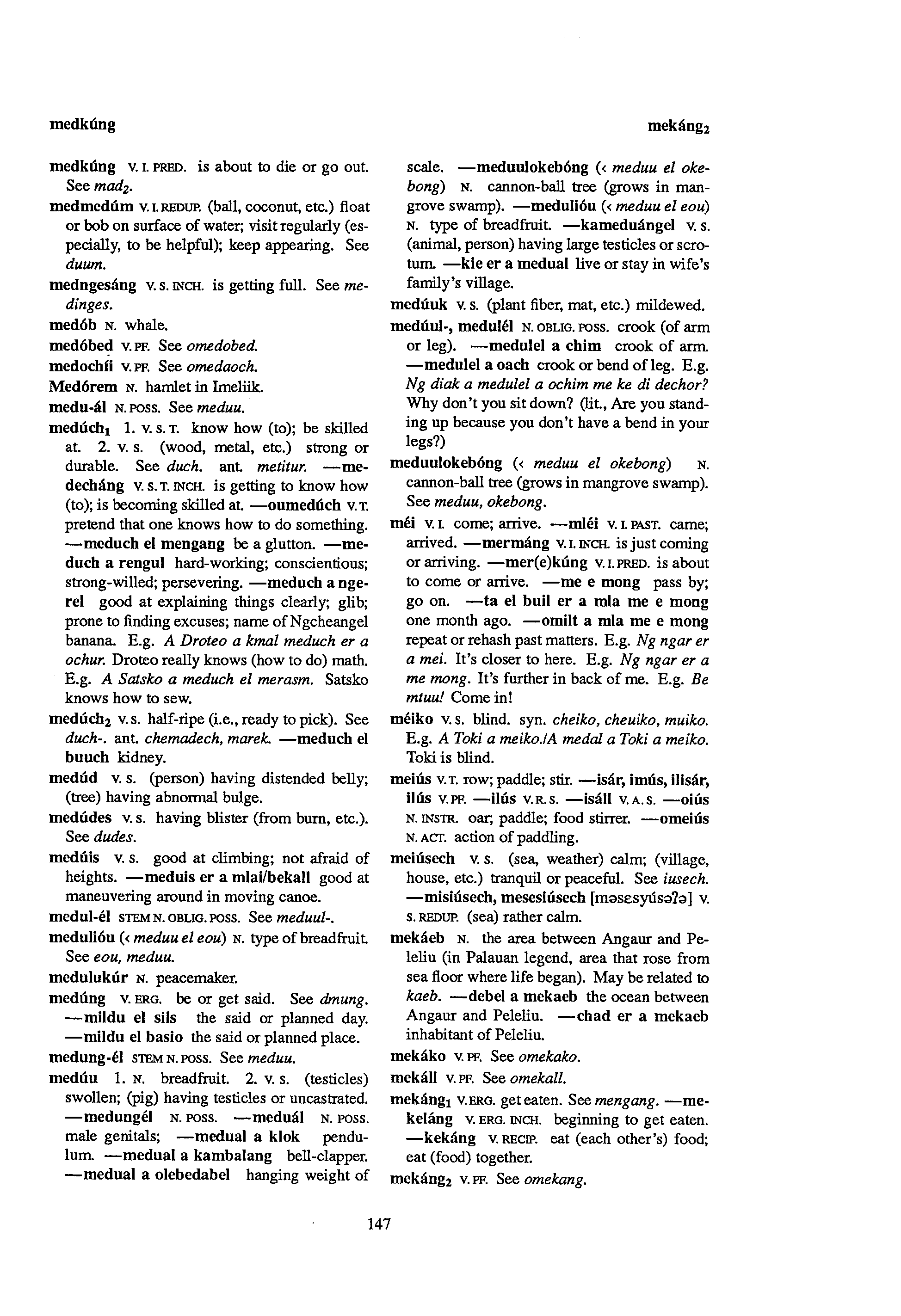
- mei in Lewis S. Josephs; Edwin G. McManus; Masa-aki Emesiochel (1977), Palauan-English Dictionary, University Press of Hawaii, →ISBN, page 147.
Papiamentu
Etymology 1
Derived from Portuguese meio and Kabuverdianu meiu.
Adjective
mei
Etymology 2
Noun
mei
See also
Months of the year: yanüari (“January”), febrüari (“February”), mart (“March”), aprel (“April”), mei (“May”), yüni (“June”), yüli (“July”), ougùstùs (“August”), sèptèmber (“September”), oktober (“October”), novèmber (“November”), desèmber (“December”).
Pennsylvania German
Etymology
Compare German mein, Dutch mijn, English my.
Determiner
mei
- (possessive) my
Declension
| singular | plural | ||||
|---|---|---|---|---|---|
| m | f | n | |||
| nominative | mei | mei | mei | mei | |
| dative | meim | meinre | meim | meine | |
| accusative | mei | mei | mei | mei | |
Romanian
Etymology 1
Inherited from Latin meī, masculine plural of meus.
Pronunciation
- IPA(key): [mej]
- Rhymes: -ej
Determiner
mei
- masculine plural of meu
Etymology 2
Inherited from Latin milium, ultimately from Proto-Indo-European *melh₂- (“to grind, crush”).
Pronunciation
- IPA(key): /mej/
Noun
mei n (plural meiuri)
Declension
| singular | plural | |||
|---|---|---|---|---|
| indefinite | definite | indefinite | definite | |
| nominative-accusative | mei | meiul | meiuri | meiurile |
| genitive-dative | mei | meiului | meiuri | meiurilor |
| vocative | meiule | meiurilor | ||
See also
| number | person | nominative | stressed | unstressed | ||||
|---|---|---|---|---|---|---|---|---|
| accusative | dative | accusative | dative | |||||
| singular | ||||||||
| 1st | eu | mine | mie | mă | îmi | |||
| 2nd | plain | tu | tine | ție | te | îți | ||
| semi-polite | dumneata | dumitale | ||||||
| polite | dumneavoastră | vă | ||||||
| 3rd | plain | m | el | e | lui | îl | îi | |
| f | ea | ei | o | |||||
| polite | m | dumnealui | îl | |||||
| f | dumneaei | o | ||||||
| plural | ||||||||
| 1st | noi | nouă | ne | |||||
| 2nd | plain | voi | vouă | vă | ||||
| polite | dumneavoastră | |||||||
| 3rd | plain | m | ei | lor | îi | le | ||
| f | ele | le | ||||||
| polite | m | dumnealor | îi | |||||
| f | le | |||||||
Sassarese
Pronunciation
- IPA(key): /ˈmei/
Adjective
mei
Pronoun
mei m pl or f pl
Scots
Determiner
mei
- alternative form of my
References
- “my, possess. pron.”, in The Dictionary of the Scots Language, Edinburgh: Scottish Language Dictionaries, 2004–present, →OCLC, retrieved 23 May 2024, reproduced from William A[lexander] Craigie, A[dam] J[ack] Aitken [et al.], editors, A Dictionary of the Older Scottish Tongue: […], Oxford, Oxfordshire: Oxford University Press, 1931–2002, →OCLC.
Tongan
Pronunciation
- IPA(key): /me.i/
Noun
mei
Preposition
mei
West Frisian
Etymology
From Old Frisian mith, mit, mei, mithi, mithe, methe (“with”), from Proto-Germanic *midi (“with”), from Proto-Indo-European *médʰi, *meta (“with”).
Pronunciation
Preposition
mei
- with
- kontakt mei oare talen ― contact with other languages
Further reading
- “mei”, in Wurdboek fan de Fryske taal (in Dutch), 2011
Zou
Etymology 1

From Proto-Kuki-Chin *may, from Proto-Sino-Tibetan *məj.
Pronunciation
- IPA(key): [méi̯]
- Hyphenation: mei
Noun
méi
Derived terms
Etymology 2
From Proto-Kuki-Chin *may.
Pronunciation
- IPA(key): [méi̯]
- Hyphenation: mei
Noun
méi
Derived terms
References
- Philip Thangliènmâng (2010), Minimal dictionary and Self-tutor Functional Grammar in Zo-English-Hindi, New Delhi: Zoculsin, →ISBN, pages 16, 32
- Lukram Himmat Singh (2013), A Descriptive Grammar of Zou (PhD thesis), Canchipur: Manipur University, page 64
- Translingual lemmas
- Translingual symbols
- ISO 639-3
- Äiwoo lemmas
- Äiwoo verbs
- nfl:Sleep
- Atong (India) terms borrowed from English
- Atong (India) terms derived from English
- Atong (India) terms with IPA pronunciation
- Atong (India) lemmas
- Atong (India) nouns
- Atong (India) nouns in Latin script
- Bavarian terms inherited from Middle High German
- Bavarian terms derived from Middle High German
- Bavarian terms inherited from Old High German
- Bavarian terms derived from Old High German
- Bavarian terms inherited from Proto-West Germanic
- Bavarian terms derived from Proto-West Germanic
- Bavarian terms inherited from Proto-Germanic
- Bavarian terms derived from Proto-Germanic
- Bavarian terms inherited from Proto-Indo-European
- Bavarian terms derived from Proto-Indo-European
- Bavarian terms with IPA pronunciation
- Rhymes:Bavarian/ai̯
- Bavarian lemmas
- Bavarian determiners
- Bavarian possessive determiners
- Bavarian personal pronouns
- Chuukese lemmas
- Chuukese verbs
- Chuukese transitive verbs
- Chuukese copulative verbs
- Dutch terms inherited from Middle Dutch
- Dutch terms derived from Middle Dutch
- Dutch terms derived from Latin
- Dutch terms with IPA pronunciation
- Dutch terms with audio pronunciation
- Dutch terms with homophones
- Dutch lemmas
- Dutch nouns
- Dutch uncountable nouns
- Dutch masculine nouns
- nl:Gregorian calendar months
- East Central German lemmas
- East Central German pronouns
- Silesian East Central German
- Fala terms derived from the Proto-Indo-European word *éǵh₂
- Fala terms derived from Proto-Italic
- Fala terms inherited from Latin
- Fala terms inherited from Archaic Latin
- Fala terms inherited from Old Galician-Portuguese
- Fala terms derived from Latin
- Fala terms derived from Old Galician-Portuguese
- Fala terms inherited from Proto-Italic
- Fala terms derived from Proto-Indo-European
- Fala terms derived from Archaic Latin
- Fala terms with IPA pronunciation
- Rhymes:Fala/ei̯
- Rhymes:Fala/ei̯/1 syllable
- Fala lemmas
- Fala determiners
- Fala pronouns
- Friulian terms inherited from Latin
- Friulian terms derived from Latin
- Friulian lemmas
- Friulian nouns
- Friulian masculine nouns
- Italian 2-syllable words
- Italian terms with IPA pronunciation
- Rhymes:Italian/ɛi
- Rhymes:Italian/ɛi/2 syllables
- Italian non-lemma forms
- Italian adjective forms
- Italian verb forms
- Italian 1-syllable words
- Rhymes:Italian/ɛj
- Rhymes:Italian/ɛj/1 syllable
- Italian lemmas
- Italian adjectives
- Italian indeclinable adjectives
- Italian archaic terms
- Italian adverbs
- Italian nouns
- Italian countable nouns
- Italian indeclinable nouns
- Italian masculine nouns
- Japanese non-lemma forms
- Japanese romanizations
- Latin 2-syllable words
- Latin terms with IPA pronunciation
- Latin non-lemma forms
- Latin pronoun forms
- Latin determiner forms
- Ligurian lemmas
- Ligurian nouns
- Limburgish lemmas
- Limburgish nouns
- li:Months
- Hanyu Pinyin
- Mandarin non-lemma forms
- Mandarin nonstandard forms
- Meyah lemmas
- Meyah nouns
- mej:Water
- Mizo terms inherited from Proto-Kuki-Chin
- Mizo terms derived from Proto-Kuki-Chin
- Mizo terms inherited from Proto-Sino-Tibetan
- Mizo terms derived from Proto-Sino-Tibetan
- Mizo lemmas
- Mizo nouns
- lus:Fire
- Murui Huitoto terms with IPA pronunciation
- Murui Huitoto lemmas
- Murui Huitoto adverbs
- Murui Huitoto postpositions
- Murui Huitoto terms with quotations
- Murui Huitoto roots
- North Frisian terms inherited from Proto-Germanic
- North Frisian terms derived from Proto-Germanic
- North Frisian lemmas
- North Frisian verbs
- Föhr-Amrum North Frisian
- North Frisian terms with usage examples
- North Frisian terms derived from Latin
- North Frisian nouns
- North Frisian masculine nouns
- frr:Months
- frr:Time
- Norwegian Bokmål lemmas
- Norwegian Bokmål nouns
- Norwegian Bokmål masculine nouns
- Norwegian Nynorsk terms inherited from Old Norse
- Norwegian Nynorsk terms derived from Old Norse
- Norwegian Nynorsk terms with IPA pronunciation
- Norwegian Nynorsk lemmas
- Norwegian Nynorsk nouns
- Norwegian Nynorsk masculine nouns
- Old French lemmas
- Old French pronouns
- Anglo-Norman
- Palauan terms with IPA pronunciation
- Palauan lemmas
- Palauan verbs
- Palauan intransitive verbs
- Papiamentu terms derived from Portuguese
- Papiamentu terms derived from Kabuverdianu
- Papiamentu lemmas
- Papiamentu adjectives
- Papiamentu terms derived from Dutch
- Papiamentu nouns
- pap:Months
- Pennsylvania German lemmas
- Pennsylvania German determiners
- Pennsylvania German possessive determiners
- Romanian terms inherited from Latin
- Romanian terms derived from Latin
- Romanian terms with IPA pronunciation
- Rhymes:Romanian/ej
- Rhymes:Romanian/ej/1 syllable
- Romanian non-lemma forms
- Romanian determiner forms
- Romanian terms derived from Proto-Indo-European
- Romanian lemmas
- Romanian nouns
- Romanian countable nouns
- Romanian neuter nouns
- Sassarese terms with IPA pronunciation
- Sassarese non-lemma forms
- Sassarese adjective forms
- Sassarese pronoun forms
- Scots lemmas
- Scots determiners
- Tongan terms with IPA pronunciation
- Tongan lemmas
- Tongan nouns
- Tongan prepositions
- to:Mulberry family plants
- to:Polynesian canoe plants
- West Frisian terms inherited from Old Frisian
- West Frisian terms derived from Old Frisian
- West Frisian terms inherited from Proto-Germanic
- West Frisian terms derived from Proto-Germanic
- West Frisian terms derived from Proto-Indo-European
- West Frisian terms with IPA pronunciation
- West Frisian lemmas
- West Frisian prepositions
- West Frisian terms with usage examples
- Zou terms inherited from Proto-Kuki-Chin
- Zou terms derived from Proto-Kuki-Chin
- Zou terms inherited from Proto-Sino-Tibetan
- Zou terms derived from Proto-Sino-Tibetan
- Zou terms with IPA pronunciation
- Zou lemmas
- Zou nouns
- zom:Animal body parts