four
Translingual

|
|---|

|
| Signal flag for the digit 4 |
Alternative forms
- Four, FOUR
Etymology
Borrowed from English four. Doublet of vier.
Pronunciation
- IPA(key): [ˈfoa], like lower (non-rhotic)[1]
Noun
four
- (international standards) NATO & ICAO radiotelephony clear code (spelling-alphabet name) for the digit 4.
- Synonym: kartefour (ITU/IMO)
References
- ^ Annex 10 to the Convention on International Civil Aviation: Aeronautical Telecommunications; Volume II Communication Procedures including those with PANS status[1], 6th edition, International Civil Aviation Organization, October 2001, archived from the original on 31 March 2019, page §5.2.1.4.3.1
English
| 40 | ||
| ← 3 | 4 | 5 → |
|---|---|---|
| Cardinal: four Ordinal: fourth Abbreviated ordinal: 4th Latinate ordinal: quartary, quaternary Latinate reverse order ordinal: preantepenultimate Adverbial: four times Multiplier: fourfold Latinate multiplier: quadruple Distributive: quadruply Germanic collective: foursome Collective of n parts: quadruplet Greek or Latinate collective: tetrad Greek collective prefix: tetra-, tessera- Latinate collective prefix: quadri- Fractional: quarter, fourth Elemental: quadruplet Greek prefix: tetarto- Number of musicians: quartet Number of years: quadrennium, olympiad Quantile: quartile | ||
Alternative forms
Etymology
| PIE word |
|---|
| *kʷetwóres |
From Middle English four, from Old English fēower, from Proto-West Germanic *feuwar, from Proto-Germanic *fedwōr, from previous pre-Grimm *petwṓr, from Proto-Indo-European *kʷetwṓr, the neuter form of *kʷetwóres. Doublet of cuatro and quatre.
Cognates include Scots fower, Saterland Frisian fjauer, West Frisian fjouwer, Dutch vier, German Low German veer, German vier, Norwegian Bokmål and Danish fire, Swedish fyra, Gothic 𐍆𐌹𐌳𐍅𐍉𐍂 (fidwōr) and, more distantly, Latin quattuor (whence Spanish cuatro, French quatre), Ancient Greek τέσσαρες (téssares), Irish ceathair, Welsh pedwar, Armenian չորս (čʻors), Lithuanian keturi, Albanian katër, Sanskrit चतुर् (catur).
Pronunciation
- IPA(key): /foɹ/
- (rhotic, horse–hoarse merger)
- Homophone: for
Audio (US, horse–hoarse merger): (file)
- Homophone: for
- (rhotic, without the horse–hoarse merger)
- IPA(key): [foːɾ] (Scotland, South Asia)
Audio (US, without the horse–hoarse merger): (file)
- IPA(key): [foːɾ] (Scotland, South Asia)
- (non-rhotic, horse–hoarse merger)
- Homophones: for, faugh
- IPA(key): [fɔː] (Received Pronunciation)
- IPA(key): [foː] (Standard Southern British, Australia, New Zealand)
Audio (Australia): (file)
- (non-rhotic, without the horse–hoarse merger)
- IPA(key): [foə] (US, non-rhotic)
- (non-rhotic, without the horse–hoarse merger but with dough–door merger)
- Homophones: foe, faux
- IPA(key): [foʊ] (African-American Vernacular)
- IPA(key): [foː] (South Asia, non-rhotic)
- Homophones: for (horse–hoarse merger); Thor (th-fronting, horse–hoarse merger); thaw (non-rhotic, th-fronting, horse–hoarse merger)
- Rhymes: -ɔː(ɹ)
Numeral
four
- A numerical value equal to 4; the number following three and preceding five.
- There are four seasons: spring, summer, autumn and winter.
- 1912 January, Zane Grey, chapter 8, in Riders of the Purple Sage […], New York, N.Y.; London: Harper & Brothers Publishers, →OCLC:
- Venters began to count them—one—two—three—four—on up to sixteen.
- 2019 May 2, Nina Avramova, “When you should use self-help programs and when to skip them”, in CNN[3], Atlanta, Ga.: Warner Bros. Discovery, archived from the original on 13 June 2025:
- Redding’s study asked four psychologists with expertise in anxiety and depressive disorders to rate each self-help book on five criteria: […]
- Describing a set or group with four elements.
Derived terms
- all fours
- all-fours
- all-run four
- back four
- be lost to the four winds
- between you and me and these four walls
- boundary four
- chaise and four
- clue-by-four
- clue by four
- coach and four
- coxless four
- cul-de-four
- figure four
- finger-four
- flat back four
- four-acceleration
- Fouracre
- four-ale
- four ale
- four-ale bar
- four-and-nine
- four and twenty
- four-and-twenty
- Four Ashes
- four-bagger
- fourball
- four-ball
- four-belt
- four-by-four, 4X4
- four by two
- four-by-two
- four color
- four-color, four-colour
- four color problem
- four color theorem
- four corners
- Four Crosses
- four-current
- four-cycle
- four-day week
- four-day weekend
- four-dimensional
- four-dimensional chess
- four-dimensionalism
- four-dimensionality
- four-dimensionally
- four-door
- four door house
- four-eyed
- four-eyed fish
- four-eye principle
- four-eyes
- four eyes
- four-fifths
- four figures
- four fingers
- four flat
- Four Floors of Whores
- four flush
- four-flush
- four-flusher
- four-fold
- fourfold
- four-foot
- four foot
- fourfooted, four-footed
- four-force
- four-four time
- four F's
- fourgie
- fourgon
- fourgram
- four-half
- four-handed
- fourhanded
- four-hankie
- four horsemen
- four hundred
- four-in-hand
- fourish
- four L
- Four Lane Ends
- four-leaf
- four-leaf clover
- four-leafed clover
- four-leaved clover
- four-legged
- four-legged emmet
- four-legged friend
- four-letter
- four-letter man
- four-letter word
- four-lined wave
- fourling
- Four Marks
- four-master
- Four Mile Creek
- four-minute warning
- four-momentum
- four more years
- fourness
- Four Oaks
- four-o'clock
- four o'clock
- four-o'clock flower
- four o'clock flower
- four of a kind
- four-of-a-kind
- four oh four
- four one one
- four-on-the-floor
- four on the floor
- fourpartite
- fourpeat
- four-peat
- fourpence
- fourpenny
- four penny nail
- four-penny nail
- fourpiece
- four pips
- fourplay
- fourplex
- four-point
- four-point Calvinist
- four-post bed
- four-poster
- four-poster bed
- four-pounder
- four-quadrant
- fourquel
- four-ring
- Four-Russians
- four-score
- fourscore
- four score
- four score and seven years ago
- four score and ten
- four score seven years ago
- four-seamer
- four-seam fastball
- four-seater
- four-sheet
- four sheets in the wind
- four sheets to the wind
- Four Shire Stone
- four-shooter
- four-sided
- foursies
- foursome
- four-speed
- fourspine
- four-square
- foursquare, four square
- four-stacker
- four-star
- four-string banjo
- four-string guitar
- four-stroke
- four-stroke engine
- four-stroking
- fourteen
- fourth
- four thieves' vinegar
- four thousand
- fourtino
- four-top
- four-to-the-floor
- four-track, four-tracked
- four-tracking
- four treasures of the study
- four-twenty
- four twenty
- four-vector
- four-velocity
- four-wall
- four-waller
- four-walling
- four-way
- four-way cock
- four-way stop
- four-way switch
- four-wheel
- four-wheel drive, four-wheel-drive
- four-wheeled
- four-wheeler
- four-wheeling
- four winds hat
- gang of four
- grade four
- history of the four kings
- last four
- match-four game
- Mother Thumb and her four daughters
- number four
- on all fours
- on fours
- piano four hands
- plus fours
- Power Four
- rare as a four-leaf clover
- rule of four
- stretch four
- sweet four o'clock
- ten-four
- thirty-four
- three-four time
- train-of-four
- twenty-four hour day
- two-by-four
- two by four
- two-four
- two-four time
- vanish to the four winds
- vinegar of the four thieves
- within the four seas
Related terms
Descendants
- Antigua and Barbuda Creole English: fuar, fua
- Aukan: fo
- Australian Kriol: fo
- Belizean Creole: foa, foar
- Bislama: fo
- Cameroon Pidgin: fo̱
- Grenadian Creole English: fo
- Gullah: fo
- Krio: fo
- Nigerian Pidgin: fo̱r
- Pichinglis: fo
- Pijin: foa
- Saramaccan: fɔ́
- Sranan Tongo: fo
- Tok Pisin: foa
- Torres Strait Creole: po
Translations
See also
Noun
four (countable and uncountable, plural fours)
- (countable) The digit or figure 4; an occurrence thereof.
- (countable) Anything measuring four units, as length.
- Do you have any more fours? I want to make this a little taller.
- Four o'clock.
- 1828, Pigot and Co.'s National Commercial Directory for 1828-9, Comprising a Directory of the Merchants, Bankers, Professional Gentleman [...] in the Counties of Cheshire, Cumberland [...][4], London; Manchester: J. Pigot & Co., page 767:
- Letters to Sheffield are despatched every morning at six, and arrive every afternoon at ten minutes past four.
- 1865, Thomas Carlyle, chapter IX, in History of Friedrich II. of Prussia, Called Frederick the Great, volume VI, London: Chapman and Hall, […], →OCLC:
- Frederick, I presume, at this late hour of four, may be snatching a morsel of dinner; […]
- A person who is four years old.
- I'll take the threes, fours and fives and go to the playground.
- (cricket, countable) An event in which the batsmen run four times between the wickets or, more often, a batsman hits a ball which bounces on the ground before passing over a boundary, resulting in an award of 4 runs for the batting team. If the ball does not bounce before passing over the boundary, a six is awarded instead.
- (basketball, countable) A power forward.
- (rowing) Four-man sweep racing shell, with or without a coxswain.
- (obsolete) A four-pennyworth of spirits.
- 1887, Sir Arthur Conan Doyle, A Study in Scarlet, section IV:
- I was a-strollin' down, thinkin' between ourselves how uncommon handy a four of gin hot would be, when suddenly the glint of a light caught my eye in the window of that same house.
Derived terms
- (numeral): rouf (back slang)
Translations
|
|
- The translations below need to be checked and inserted above into the appropriate translation tables. See instructions at Wiktionary:Entry layout § Translations.
See also
English terms starting with “four”
| Playing cards in English · playing cards (layout · text) | ||||||
|---|---|---|---|---|---|---|

|
|
|
|
|
|
|
| ace | deuce, two | three, trey | four, cater | five, cinque | six | seven |

|
|
|
|
|
|

|
| eight | nine | ten | jack, knave | queen | king | joker |
- Arabic numerals: 4
- Chinese numerals: 肆, 四
- Greek numerals: (uppercase) Δ΄, (lowercase) δ΄
- Roman numerals: IV or IIII
Anagrams
French
Etymology
Inherited from Middle French four, from Old French four, forz, forn, from Latin furnus, from Proto-Italic *fornos, from Proto-Indo-European *gʷʰr̥-nós, from *gʷʰer- (“warm, hot”).
Pronunciation
- IPA(key): /fuʁ/
Audio: (file) Audio (France (Agen)): (file) Audio (France (Vosges)): (file) Audio (France (Vosges)): (file) Audio (France (Lyon)): (file) - Rhymes: -uʁ
Noun
four m (plural fours)
Derived terms
Related terms
Descendants
- Louisiana Creole: fou
Further reading
- “four”, in Trésor de la langue française informatisé [Digitized Treasury of the French Language], 2012
Istriot
Etymology
From Latin foris, foras. Compare Italian fuori, Friulian fûr, Dalmatian fure, Venetan fora.
Adverb
four
Preposition
four
Middle English
| 40 | ||
| ← 3 | 4 | 5 → |
|---|---|---|
| Cardinal: four Ordinal: ferthe | ||
Alternative forms
- fore, foure, fower, fowr
- feor, feouwer, feower (Laȝamon's Brut); fowwerr (Ormulum)
- faure, fawre (Northwest Midland); vour (Kent, West Midland)
Etymology
Inherited from Old English feōwer, from Proto-West Germanic *feuwar, from Proto-Germanic *fedwōr, from Proto-Indo-European *kʷetwóres.
Pronunciation
- IPA(key): /fɔu̯r/, /fuːr/[1]
Numeral
four (postpositive foure)
- four[2]
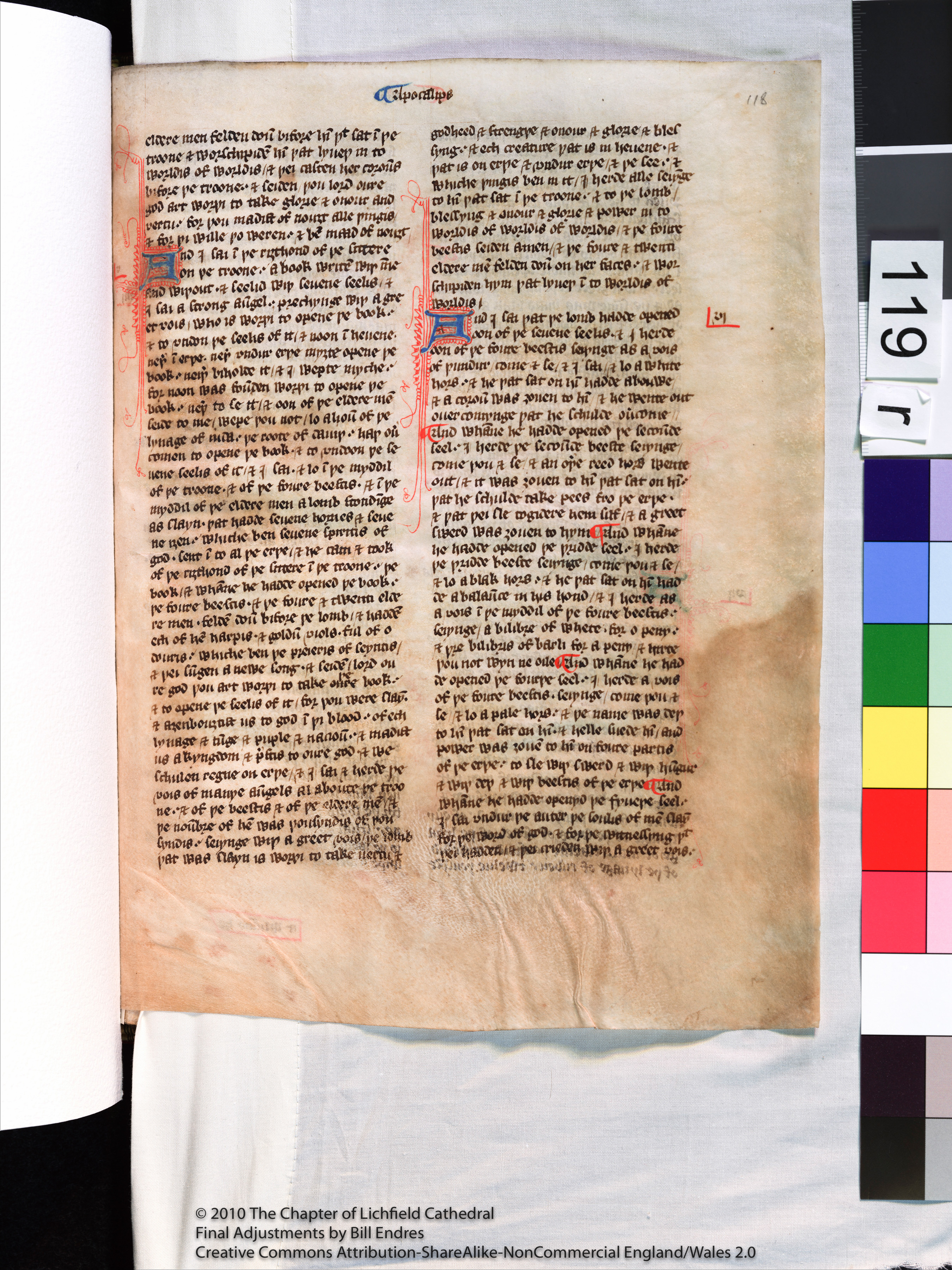
- c. 1395, John Wycliffe, John Purvey [et al.], transl., Bible (Wycliffite Bible (later version), MS Lich 10.)[6], published c. 1410, Apocalips 6:8, folio 119, recto, column 1; republished as Wycliffe's translation of the New Testament, Lichfield: Bill Endres, 2010:
- ⁊ lo a pale hoꝛs .· and þe name was deþ to him þat ſat on hym and helle ſuede him / and power was ȝouen to him on foure partis of þe erþe .· to ſle with ſwerd / ⁊ wiþ hungur / ⁊ wiþ deþ / ⁊ wiþ beeſtis of þe erþe
- And lo! A pale horse, and the name was Death for who that sat on him, and hell trailed him. And power was given to him over four parts of the earth, to slay with sword, and with hunger, and with death, and with the earth's creatures.
Related terms
Descendants
References
- ^ Jordan, Richard (1974), Eugene Crook, transl., Handbook of the Middle English Grammar: Phonology (Janua Linguarum. Series Practica; 218)[2], The Hague: Mouton & Co. N.V., , § 109, page 128.
- ^ “four, num.”, in MED Online, Ann Arbor, Mich.: University of Michigan, 2007.
Norman
Alternative forms
- fou (Jersey)
Etymology
From Old French forn, from Latin furnus.
Noun
four m (plural fours)
Walloon
Pronunciation
- IPA(key): /fuːʀ/
Noun
four m (plural fours)
- Translingual terms derived from Old English
- Translingual terms derived from English
- Translingual terms derived from Proto-West Germanic
- Translingual terms derived from the Proto-Indo-European word *kʷetwóres
- Translingual terms borrowed from English
- Translingual terms derived from Proto-Germanic
- Translingual terms derived from Middle English
- Translingual terms derived from Proto-Indo-European
- Translingual doublets
- Translingual terms with IPA pronunciation
- Translingual lemmas
- Translingual nouns
- ICAO spelling alphabet
- mul:Four
- English terms derived from Proto-Indo-European
- English terms derived from the Proto-Indo-European word *kʷetwóres
- English terms inherited from Proto-West Germanic
- English terms derived from Middle English
- English terms derived from Proto-Germanic
- English terms inherited from Middle English
- English terms derived from Old English
- English terms derived from Proto-West Germanic
- English terms inherited from Proto-Indo-European
- English terms inherited from Proto-Germanic
- English terms inherited from Old English
- English doublets
- English 1-syllable words
- English terms with IPA pronunciation
- English terms with homophones
- English terms with audio pronunciation
- Rhymes:English/ɔː(ɹ)
- Rhymes:English/ɔː(ɹ)/1 syllable
- English lemmas
- English numerals
- English cardinal numbers
- English terms with usage examples
- English terms with quotations
- English nouns
- English uncountable nouns
- English countable nouns
- en:Cricket
- en:Basketball
- en:Rowing
- English colloquialisms
- English terms with obsolete senses
- en:Card games
- en:Four
- French terms derived from Old French
- French terms derived from Proto-Italic
- French terms inherited from Old French
- French terms derived from the Proto-Indo-European root *gʷʰer-
- French terms derived from Latin
- French terms derived from Proto-Indo-European
- French terms inherited from Middle French
- French terms inherited from Proto-Italic
- French terms inherited from Proto-Indo-European
- French terms derived from Middle French
- French terms inherited from Latin
- French 1-syllable words
- French terms with IPA pronunciation
- French terms with audio pronunciation
- Rhymes:French/uʁ
- Rhymes:French/uʁ/1 syllable
- French lemmas
- French nouns
- French countable nouns
- French masculine nouns
- fr:Home appliances
- Istriot terms inherited from Latin
- Istriot terms derived from Latin
- Istriot lemmas
- Istriot adverbs
- Istriot prepositions
- Middle English terms derived from Proto-West Germanic
- Middle English terms inherited from Proto-West Germanic
- Middle English terms inherited from Proto-Germanic
- Middle English terms inherited from Old English
- Middle English terms derived from Proto-Indo-European
- Middle English terms inherited from Proto-Indo-European
- Middle English terms derived from the Proto-Indo-European word *kʷetwóres
- Middle English terms derived from Proto-Germanic
- Middle English terms derived from Old English
- Middle English terms with IPA pronunciation
- Middle English lemmas
- Middle English numerals
- Middle English terms with quotations
- Middle English cardinal numbers
- enm:Four
- Norman terms inherited from Old French
- Norman terms derived from Old French
- Norman terms inherited from Latin
- Norman terms derived from Latin
- Norman lemmas
- Norman nouns
- Norman masculine nouns
- Guernsey Norman
- nrf:Cooking
- Walloon terms with IPA pronunciation
- Walloon lemmas
- Walloon nouns
- Walloon masculine nouns
- wa:Agriculture