Geography (from Ancient Greekγεωγραφίαgeōgraphía; combining gê 'Earth' and gráphō 'write', lit. 'Earth writing') is the study of the lands, features, inhabitants, and phenomena of planet Earth. Geography is an all-encompassing discipline that seeks an understanding of Earth and its human and natural complexities—not merely where objects are, but also how they have changed and come to be. While geography is specific to Earth, many concepts can be applied more broadly to other celestial bodies in the field of planetary science. Geography has been called "a bridge between natural science and social science disciplines."
The history of geography as a discipline spans cultures and millennia, having been independently developed by multiple groups and cross-pollinated through trade between them. Geography as a discipline dates back to the earliest attempts to understand the world spatially, with the earliest example of an attempted world map dating to the 9th century BC in ancient Babylon. Origins of many of the concepts in geography can be traced to Greek Eratosthenes of Cyrene, who may have coined the term "geographia" (c.276 BC– c.195/194 BC). The first recorded use of the word γεωγραφία was as the title of a book by Greek scholar Claudius Ptolemy (100 – 170 AD). During the Middle Ages, geography was influenced by Islamic scholars, such as Muhammad al-Idrisi, producing detailed maps of the world. The Age of Discovery was influential in the development of geography, as European explorers mapped the New World. Modern developments include geomatics and geographic information science.
The core concepts of geography that are consistent across all approaches are space, place, time, and scale. Today, geography is an extremely broad discipline with multiple approaches and modalities. The main branches of geography are physical geography, human geography, and technical geography. Physical geography focuses on the natural environment, human geography on how humans interact with the Earth, and technical geography on developing tools for understanding geography. Techniques employed can generally be broken down into quantitative and qualitative approaches, with many studies taking mixed-methods approaches. Common techniques include cartography, remote sensing, interviews, and surveying. (Full article...)
Featured article -
Featured articles are displayed here, which represent some of the best content on English Wikipedia.
Thessalonica had already been under Ottoman control from 1387 to 1403 before returning to Byzantine rule in the aftermath of the Battle of Ankara. In 1422, after the Byzantines supported Mustafa Çelebi, a rival pretender against him, Murad attacked Thessalonica. Unable to provide manpower or resources for the city's defence, its ruler, Andronikos Palaiologos, handed it over to the Republic of Venice in September 1423. The Venetians attempted to persuade the Sultan to recognise their possession, but failed as Murad considered the city his by right and the Venetians to be interlopers. This impasse led to an Ottoman blockade of Thessalonica, which occasionally flared up with direct attacks on the city. At the same time, the conflict was mostly fought as a series of raids by both sides against the other's territories in the Balkans and the Aegean Islands. The Venetians repeatedly tried to apply pressure by blocking the passage of the Dardanelles at Gallipoli, with little success. (Full article...)
Image 3
Cleopatra Hill and the "J", viewed from Jerome Avenue (State Route 89A)
The town owes its existence mainly to two ore bodies that formed about 1.75billion years ago along a ring fault in the caldera of an undersea volcano. Tectonic plate movements, plate collisions, uplift, deposition, erosion, and other geologic processes eventually exposed the tip of one of the ore bodies and pushed the other close to the surface, both near Jerome. In the late 19th century, the United Verde Mine, developed by William A. Clark, extracted ore bearing copper, gold, silver, and other metals from the larger of the two. The United Verde Extension UVX Mine, owned by James Douglas Jr., depended on the other huge deposit. In total, the copper deposits discovered in Jerome's vicinity were among the richest ever found. (Full article...)
Image 4
Antarctica (/ænˈtɑːrktɪkə/ⓘ) is Earth's southernmost and least-populated continent. Situated almost entirely south of the Antarctic Circle and surrounded by the Southern Ocean (also known as the Antarctic Ocean), it contains the geographic South Pole. Antarctica is the fifth-largest continent, being about 40% larger than Europe, and has an area of 14,200,000km2 (5,500,000sqmi). Most of Antarctica is covered by the Antarctic ice sheet, with an average thickness of 1.9km (1.2mi).
Fram leaves Bergen on 2 July 1893, bound for the Arctic Ocean Nansen's Fram expedition of 1893–1896 was an attempt by the Norwegian explorer Fridtjof Nansen to reach the geographical North Pole by harnessing the natural east–west current of the Arctic Ocean. In the face of much discouragement from other polar explorers, Nansen took his ship Fram to the New Siberian Islands in the eastern Arctic Ocean, froze her into the pack ice, and waited for the drift to carry her towards the pole. Impatient with the slow speed and erratic character of the drift, after 18 months Nansen and a chosen companion, Hjalmar Johansen, left the ship with a team of Samoyed dogs and sledges and made for the pole. They did not reach it, but they achieved a record Farthest North latitude of 86°13.6′N before a long retreat over ice and water to reach safety in Franz Josef Land. Meanwhile, Fram continued to drift westward, finally emerging in the North Atlantic Ocean.
The idea for the expedition had arisen after items from the American vessel Jeannette, which had sunk off the north coast of Siberia in 1881, were discovered three years later off the south-west coast of Greenland. The wreckage had obviously been carried across the polar ocean, perhaps across the pole itself. Based on this and other debris recovered from the Greenland coast, the meteorologist Henrik Mohn developed a theory of transpolar drift, which led Nansen to believe that a specially designed ship could be frozen in the pack ice and follow the same track as Jeannette wreckage, thus reaching the vicinity of the pole. (Full article...)
Occupation and partition of Yugoslavia in 1941. The Hungarian-occupied then annexed areas of Yugoslavia are in the north (Bačka and Baranja) and northwest (Međimurje and Prekmurje).
During World War II, the Kingdom of Hungary engaged in the military occupation, then annexation, of the Bačka, Baranja, Međimurje and Prekmurje regions of the Kingdom of Yugoslavia. These territories had all been under Hungarian rule prior to 1920, and had been transferred to Yugoslavia as part of the post–World War ITreaty of Trianon. They now form part of several states: Yugoslav Bačka is now part of Vojvodina, an autonomous province of Serbia, Yugoslav Baranja and Međimurje are part of modern-day Croatia, and Yugoslav Prekmurje is part of modern-day Slovenia. The occupation began on 11 April 1941 when 80,000 Hungarian troops crossed the Yugoslav border in support of the German-led Axisinvasion of Yugoslavia that had commenced five days earlier. There was some resistance to the Hungarian forces from SerbChetnik irregulars, but the defences of the Royal Yugoslav Army had collapsed by this time. The Hungarian forces were indirectly aided by the local Volksdeutsche, the German minority, which had formed a militia and disarmed around 90,000 Yugoslav troops. Despite only sporadic resistance, Hungarian troops killed many civilians during these initial operations, including some Volksdeutsche. The government of the newly formed Axis puppet state, the Independent State of Croatia, subsequently consented to the Hungarian annexation of the Međimurje area, which dismayed the Croat population of the region.
The occupation authorities immediately classified the population of Bačka and Baranja into those that had lived in those regions when they had last been under Hungarian rule in 1920 and the mostly Serb settlers who had arrived since the areas had been part of Yugoslavia. They then began herding thousands of local Serbs into concentration camps and expelled them to the Independent State of Croatia, Italian-occupied Montenegro, and the German-occupied territory of Serbia. Ultimately, tens of thousands of Serbs were deported from the occupied territories. This was followed by the implementation of a policy of "magyarisation" of the political, social and economic life of the occupied territories, which included the re-settlement of Hungarians and Székelys from other parts of Hungary. "Magyarisation" did not impact the Volksdeutsche, who received special status under Hungarian rule, and in Prekmurje the Hungarian authorities were more permissive towards ethnic Slovenes. (Full article...)
Image 8
Cannon decorate the quayside of Balfour Harbour on Shapinsay, the round tower in the background is The Douche
Shapinsay (/ˈʃæpɪnziː/, Scots: Shapinsee) is one of the Orkney Islands off the north coast of mainland Scotland. With an area of 29.5 square kilometres (11.4sqmi), it is the eighth largest island in the Orkney archipelago. It is low-lying and, with a bedrock formed from Old Red Sandstone overlain by boulder clay, fertile, causing most of the area to be used for farming. Shapinsay has two nature reserves and is notable for its bird life. Balfour Castle, built in the Scottish Baronial style, is one of the island's most prominent features, a reminder of the Balfour family's domination of Shapinsay during the 18th and 19th centuries; the Balfours transformed life on the island by introducing new agricultural techniques. Other landmarks include a standing stone, a broch from the Iron Age, a souterrain and a salt-water shower.
There is one village on the island, Balfour, from which roll-on/roll-off car ferries sail to Kirkwall on the Orkney Mainland. At the 2011 census, Shapinsay had a population of 307. The economy of the island is primarily based on agriculture with the exception of a few small businesses that are largely tourism-related. A community-owned wind turbine was constructed in 2011. The island has a primary school but, in part due to improving transport links with mainland Orkney, no longer has a secondary school. Shapinsay's long history has given rise to various folk tales. (Full article...)
Image 9
Venus is the second planet from the Sun. Similar in size and mass to Earth, Venus has no liquid water, and its atmosphere is far thicker and denser than that of any other rocky body in the Solar System. The atmosphere is composed mostly of carbon dioxide and has a thick cloud layer of sulfuric acid that spans the whole planet. At the mean surface level, the atmosphere reaches a temperature of 737K (464°C; 867°F), making it the hottest planet in the solar system and also a pressure 92 times greater than Earth's at sea level, turning the lowest layer of the atmosphere into a supercritical fluid. From Earth, Venus is visible as a star-like point of light, appearing brighter than any other natural point of light in the sky, as either the brightest "morning star" or "evening star". It was also given the poetic name Ēarendel in Old English, meaning "ray of light" along with the two previous epithets.
Venus orbits closer to the Sun than the Earth does. The orbits of Venus and Earth make the two planets approach each other in synodic periods of 1.6 years. In the course of this, Venus comes closer to Earth than any other planet. In interplanetary spaceflight from Earth, Venus is frequently used as a waypoint for gravity assists, offering a more economical route allowing spacecraft to save fuel. Venus has no moons and a very slow retrograde rotation about its axis, a result of competing forces of solar tidal locking and differential heating of Venus's massive atmosphere. As a result, a Venusian day is 116.75 Earth days long, about half a Venusian solar year, which is 224.7 Earth days long. (Full article...)
Eruptions along the length of the MCVF began between 1.6and 5.3million years ago. At least 23eruptions have occurred throughout its eruptive history. This volcanic activity ranged from effusive to explosive, with magma compositions ranging from basaltic to rhyolitic. Because the MCVF has a high elevation and consists of a cluster of mostly high altitude, non-overlapping volcanoes, subglacial activity is likely to have occurred under less than 800 metres (2,600 feet) of glacial ice. The style of this glaciation promoted meltwater escape during eruptions. The steep profile of the volcanic field and its subglacial landforms support this hypothesis. As a result, volcanic features in the MCVF that interacted with glacial ice lack rocks that display evidence of abundant water during eruption, such as hyaloclastite and pillow lava. (Full article...)
Image 12
Ubinas in August 2015
Ubinas is an active stratovolcano in the Moquegua Region of southern Peru, approximately 60 kilometres (37mi) east of the city of Arequipa. Part of the Central Volcanic Zone of the Andes, it rises 5,672 metres (18,609ft) above sea level. The volcano's summit is cut by a 1.4-kilometre-wide (0.87mi) and 150-metre-deep (490ft) caldera, which itself contains a smaller crater. Below the summit, Ubinas has the shape of an upwards-steepening cone with a prominent notch on the southern side. The gently sloping lower part of the volcano is also known as Ubinas I and the steeper upper part as Ubinas II; they represent different stages in the volcano's geological history.
The most active volcano in Peru, Ubinas has a history of small to moderate explosive eruptions as well as a few larger eruptions, such as in 1667, along with persistent degassing and ash emissions. Activity at the volcano began in the Pleistocene epoch, and led to the growth of the current mountain in two phases. Among the recent eruptions was the 2006–2007 event, which produced eruption columns and led to ash fall in the region, resulting in health issues and evacuations. During the most recent activity, from 2013 to 2017, a lava flow formed inside the crater, and further ash falls led to renewed evacuations of surrounding towns. Ubinas is monitored by the Peruvian geological service INGEMMET, which has published a volcano hazard map for Ubinas and regular volcanic activity reports. (Full article...)
Image 13
Mayan city-states that have existed in Mesoamerica
The Maya civilization developed in the Maya Region, an area that today comprises southeastern Mexico, all of Guatemala and Belize, and the western portions of Honduras and El Salvador. Today, their descendants, known collectively as the Maya, number well over 6 million individuals, speak more than twenty-eight surviving Mayan languages, and reside in nearly the same area. (Full article...)
Image 14
Male in Toronto, Ontario
The peregrine falcon (Falco peregrinus), also referred to simply as the peregrine, is a bird of prey (raptor) in the family Falconidae known for its speed. A large, crow-sized falcon, it has a blue-grey back, barred white underparts and a black head. As is typical for bird-eating (avivore) raptors, peregrine falcons are sexually dimorphic, with females being considerably larger than males. Historically, the bird has also been known as the "black-cheeked falcon" in Australia and the "duck hawk" in North America.
The breeding range includes land regions from the Arctic tundra to the tropics. It can be found nearly everywhere on Earth, except extreme polar regions, very high mountains, and most tropical rainforests. The only major ice-free landmasses from which it is entirely absent are the islands of New Zealand, making it the world's most widespread raptor and one of the most widely found wild bird species. In fact, the only land-based bird species found over a larger geographic area, domestic and feral pigeons, owe their success to human-led introduction. Both are domesticated forms of the rock dove, and are a major prey species for peregrine populations. Due to their greater abundance in cities than most other birds, feral pigeons support many peregrine populations as a staple food source, especially in urban settings. (Full article...)
Image 15
The main hut at Cape Denison The Australasian Antarctic Expedition was a 1911–1914 expedition headed by Douglas Mawson that explored the largely uncharted Antarctic coast due south of Australia. Mawson had been inspired to lead his own venture by his experiences on Ernest Shackleton's Nimrod expedition in 1907–1909. During its time in Antarctica, the expedition's sledging parties covered around 4,180 kilometres (2,600mi) of unexplored territory, while its ship, SYAurora, navigated 2,900 kilometres (1,800mi) of unmapped coastline. Scientific activities included meteorological measurements, magnetic observations, an expansive oceanographic program, and the collection of many biological and geological samples, including the discovery of the first meteorite found in Antarctica. The expedition was the first to establish and maintain wireless contact between Antarctica and Australia. Another planned innovation – the use of an aircraft – was thwarted by an accident before the expedition sailed. The plane's fuselage was adapted to form a motorised sledge or "air-tractor", but it proved to be of very limited usefulness.
The expedition was organised into three bases: one on the sub-Antarctic Macquarie Island and two on the Antarctic mainland. The main base, under Mawson's command, was set up at Cape Denison, about 500 kilometres (300mi) west of Cape Adare, and a western base under Frank Wild was established on the Shackleton Ice Shelf, more than 2,400 kilometres (1,500mi) west of Cape Denison. Activities at both mainland bases were hampered by extreme winds, which often made outside work impossible. (Full article...)
A sea is a large body of salt water. The term has two distinct meanings. The first is the interconnected body of seawater that spans most of Earth, known as the sea or the ocean. The second is a named body of water: usually either a marginal sea (a second-order section of the oceanic sea such as the Mediterranean Sea), or a large, nearly landlocked body of water. (Full article...)
For editor resources and to collaborate with other editors on improving Wikipedia's Geography-related articles, visit WikiProject Geography.
Here are some tasks awaiting attention:
Article requests: See Requested articles/Social sciences/Geography, cities, regions and named places and Missing articles about Locations
Assess: Tag related article talk pages with {{WikiProject Geography}}. To help assess the quality and importance of geography articles, please see: Unassessed geography articles and Unknown-importance geography articles.
Cleanup: See Geography articles needing attention
Deletion sorting: Listed at Geographic related deletion discussions
Geographical coordinates: See Articles missing geocoordinate data by country
Infobox: See Geography articles needing infoboxes
Map: See Wikipedia requested maps
Notability: See Geography articles with topics of unclear notability
Photo: See Wikipedia requested photographs of places
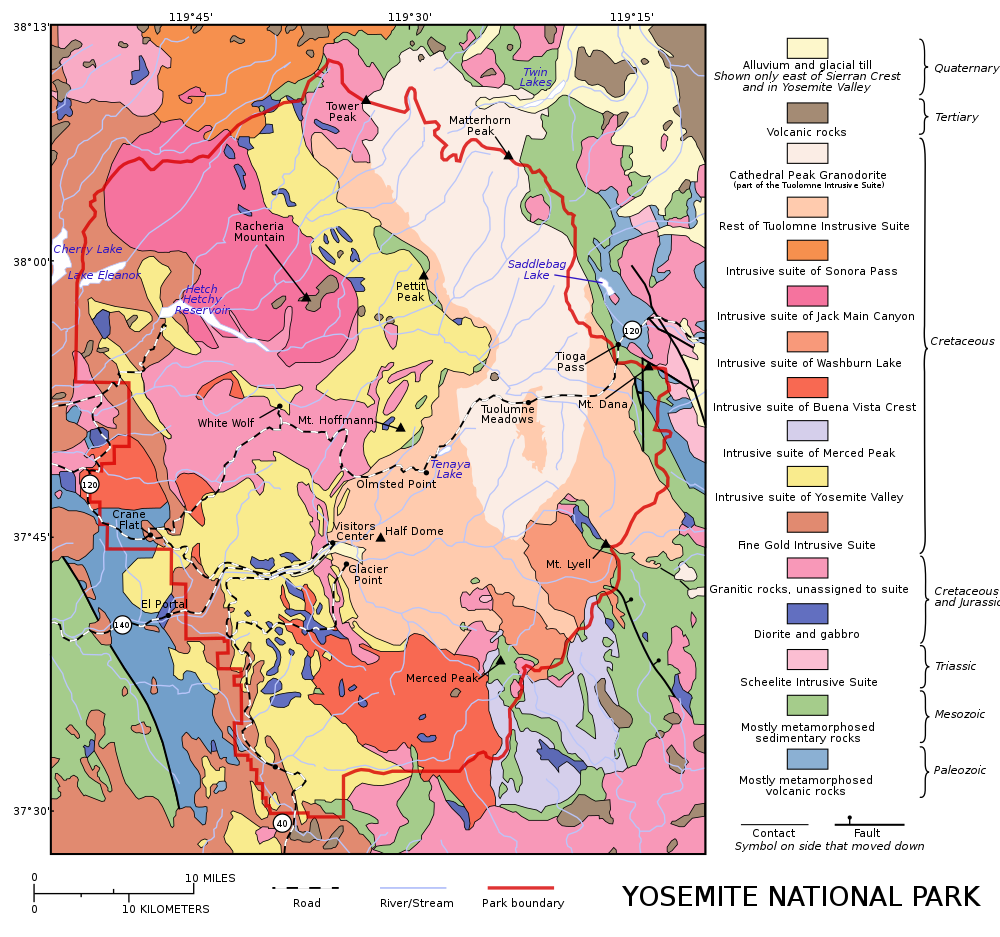
A geological map of Yosemite National Park (full size), showing the Cathedral Peak Granodiorite, the largest unit in the Tuolumne Intrusive Suite, which in turn is the largest granitic suite in the park. Cathedral Peak Granodiorite Rest of the Tuolumne Intrusive Suite
The azimuthal equidistant projection is an azimuthalmap projection in which all points on the map are both proportionately correct distances from the center point and at the correct azimuth (direction) from the center point. Distances and directions to all places, however, are true only from the center point of projection. This projection has been used for the flag of the United Nations, for the USGSNational Atlas of the United States of America, and for large-scale mapping of Micronesia, among others.
Photo: Jeff Schmaltz, MODIS Rapid Response Team, NASA
A satellite photo of Great Britain and part of Ireland showing the extent of snow cover during the winter of 2009–2010, the coldest in Europe since 1981–82. Starting on 16 December 2009 a persistent weather pattern brought cold moist air from the north with systems undergoing cyclogenesis from North American storms moving across the Atlantic Ocean to the west, and saw many parts of Europe experiencing heavy snowfall and record low temperatures.
The Gall–Peters projection, named after James Gall and Arno Peters, is a specialization of a configurable equal-area map projection known as the cylindrical equal-area projection. It achieved considerable notoriety in the late 20th century as the centerpiece of a controversy surrounding the political implications of map design; Peters promoted it as a more faithful representation than the Mercator projection, which inflates the sizes of regions farther from the equator and thus makes the (mostly technologically underdeveloped) equatorial countries appear smaller and therefore, according to Peters, less significant.
A satellite image of the Scandinavian Peninsula in winter. The peninsula, approximately 1,850 kilometers (1,150 miles) long with a width varying between approximately 370–805km (230–500mi), making it the largest in Europe, is located in the northern part of the continent and consists of Norway, Sweden and part of Finland. Much of the population is concentrated in the southern part of the peninsula; Stockholm and Gothenburg, both in Sweden, and Oslo in Norway are the largest cities.
A portolan chart from 1492, the oldest known signed and dated chart of Portuguese origin. Cartography technologies greatly advanced during the Age of Discovery. Iberian mapmakers in particular focused on practical charts to use as navigational aids. Unlike Spanish maps which were regarded as state secrets, Portuguese ones were used by other countries, and Portuguese cartographers drew upon the skill and knowledge of other cultures as well.
The Yukon Delta is a river delta formed by the Yukon River as it drains into the Bering Sea. It is part of the larger Yukon–Kuskokwim Delta, which includes the delta of the Kuskokwim River. The Yukon River rises in British Columbia, Canada, and flows through Yukon before entering the U.S. state of Alaska. This August2017 satellite image of the Yukon Delta shows how the river branches into numerous distributary channels that meander through the low-lying terrain on their way to the sea. The sandy colour of these channels and the coastal water is indicative of the marine sediment the river carries to the sea at this time of year.
The Mercator projection is a cylindrical map projection presented by the Flemish geographer and cartographer Gerardus Mercator in 1569. Because it represents paths of constant course as straight lines, it long served as the standard map projection for nautical purposes. However, it distorts the size of objects as the latitude increases: thus areas in the mid-latitudes appear significantly larger than their actual size relative to those the equator, and those near the poles are even more exaggerated. Most modern atlases no longer use the Mercator projection for world maps or for areas distant from the equator, preferring other cylindrical projections, or forms of equal-area projection.
The Lambert conformal conic projection is a conic map projection used for aeronautical charts, portions of the State Plane Coordinate System, and many national and regional mapping systems. It is one of seven projections introduced by Johann Heinrich Lambert in 1772. Conceptually, the projection seats a cone over the sphere of the Earth and projects the surface conformally onto the cone. The cone is unrolled, and the parallel that was touching the sphere is assigned unit scale. By scaling the resulting map, two parallels can be assigned unit scale, with scale decreasing between them and increasing outside them. Unlike other conic projections, no true secant form of this projection exists.
Featured biography
Featured biography articles in geography
The frontispiece of the 1920 edition of Tod's Annals and Antiquities of Rajast'han
Lieutenant-ColonelJames Tod (20 March 1782– 18 November 1835) was a British army officer and scholar. He combined his official role and his amateur interests to create a series of works about the history and geography of India, and in particular the area then known as Rajputana that corresponds to the present day state of Rajasthan, and which Tod referred to as Rajast'han.
Tod was born in London and educated in Scotland. He joined the East India Company as a military officer and travelled to India in 1799 as a cadet in the Bengal Army. He rose quickly in rank, eventually becoming captain of an escort for an envoy in a Sindian royal court. After the Third Anglo-Maratha War, during which Tod was involved in the intelligence department, he was appointed Political Agent for some areas of Rajputana. His task was to help unify the region under the control of the East India Company. During this period Tod conducted most of the research that he would later publish. Tod was initially successful in his official role, but his methods were questioned by other members of the East India Company. Over time, his work was restricted and his areas of oversight were significantly curtailed. In 1823, owing to declining health and reputation, Tod resigned his post as Political Agent and returned to England. (Full article...)
You can read about interesting Wikipedia articles about places around you.
Special:Nearby
Top 10 WikiProject Geography Popular articles of the month
This following Geography-related articles is a most visited articles of WikiProject Geography, See complete list at Wikipedia:WikiProject Geography/Popular pages.
Venezuela, officially the Bolivarian Republic of Venezuela, is a country on the northern coast of South America, consisting of a continental landmass and various islands and islets in the Caribbean Sea. It comprises an area of 912,050km2 (352,140sqmi), with a population estimated at 31.8 million in 2025. The capital and largest urban agglomeration is Caracas. The continental territory is bordered on the north by the Caribbean Sea and the Atlantic Ocean, on the west by Colombia, on the south by Brazil, on the east by Guyana, and on the northeast by Trinidad and Tobago. Venezuela consists of 23 states, the Capital District, and the Federal Dependencies covering Venezuela's offshore islands. Venezuela is among the most urbanized countries in Latin America, with an estimated urbanization rate of 88.4% in 2022. The vast majority of Venezuelans live in urban areas in the north, including in the capital. (Full article...)
Image 3
Dymaxion map of the world with the 30 largest countries and territories by area
This is a list of the world's countries and their dependencies, ranked by total area, including land and water. (Full article...)
The United Nations uses three definitions for what constitutes a city, as not all cities in all jurisdictions are classified using the same criteria. Cities may be defined as the cities proper, their metropolitan regions, or the extent of their urban area. A complicating factor is that many large cities in the world have not only homeless or the unhoused, but also vast slum communities. This leads to official census data being less accurate in representing the actual number of residents in a given area. (Full article...)


 Featured article -


 Vital article


 Map: Strebe, using GeocartThe Tobler hyperelliptical projection is a family of equal-area pseudocylindrical map projections first described by Waldo R. Tobler in 1973. The imagery used for the map is derived from NASA's Blue Marble summer months composite, with oceans lightened to enhance legibility and contrast.
 Map: Grandiose, based on a map by the United States Geological SurveyA geological map of Yosemite National Park (full size), showing the Cathedral Peak Granodiorite, the largest unit in the Tuolumne Intrusive Suite, which in turn is the largest granitic suite in the park.
 Map: Strebe, using GeocartThe azimuthal equidistant projection is an azimuthal map projection in which all points on the map are both proportionately correct distances from the center point and at the correct azimuth (direction) from the center point. Distances and directions to all places, however, are true only from the center point of projection. This projection has been used for the flag of the United Nations, for the USGS National Atlas of the United States of America, and for large-scale mapping of Micronesia, among others.
 Map: Strebe, using GeocartThe Littrow projection, created by Joseph Johann Littrow in 1838, is a conformal retroazimuthal map projection. It allows direct measurement of the azimuth from any point on the map to the center.
 Photo: Jeff Schmaltz, MODIS Rapid Response Team, NASAA satellite photo of Great Britain and part of Ireland showing the extent of snow cover during the winter of 2009–2010, the coldest in Europe since 1981–82. Starting on 16 December 2009 a persistent weather pattern brought cold moist air from the north with systems undergoing cyclogenesis from North American storms moving across the Atlantic Ocean to the west, and saw many parts of Europe experiencing heavy snowfall and record low temperatures.
 Map: Strebe, using GeocartThe Gall–Peters projection, named after James Gall and Arno Peters, is a specialization of a configurable equal-area map projection known as the cylindrical equal-area projection. It achieved considerable notoriety in the late 20th century as the centerpiece of a controversy surrounding the political implications of map design; Peters promoted it as a more faithful representation than the Mercator projection, which inflates the sizes of regions farther from the equator and thus makes the (mostly technologically underdeveloped) equatorial countries appear smaller and therefore, according to Peters, less significant.
 Map: Diego Gutiérrez and Hieronymus CockAmericae Sive Quartae Orbis Partis Nova Et Exactissima Descriptio is an ornate geographical map of the Americas made in 1562 by Spanish cartographer Diego Gutiérrez and Flemish artist Hieronymus Cock. The map encompasses the eastern coast of North America, the whole of Central and South America, and parts of the western coasts of Europe and Africa. This is the earliest scale wall map of the New World and the first to use the name "California". Two extant copies are known.
 A composite relief satellite image of South America, the fourth-largest continent. South America occupies the southern portion of the landmass in the Western Hemisphere. The continent is generally delimited on the northwest by the Darién watershed along the Colombia–Panama border. Almost all of mainland South America sits on the South American Plate, as do nearby outlying islands.
 A satellite image of the Scandinavian Peninsula in winter. The peninsula, approximately 1,850 kilometers (1,150 miles) long with a width varying between approximately 370–805 km (230–500 mi), making it the largest in Europe, is located in the northern part of the continent and consists of Norway, Sweden and part of Finland. Much of the population is concentrated in the southern part of the peninsula; Stockholm and Gothenburg, both in Sweden, and Oslo in Norway are the largest cities.
 Earth at nightPhoto credit: NASA and NOAAEarth at night.
 Map credit: Heinrich C. BerannYellowstone National Park is an American national park located mostly in Wyoming and extending into Montana and Idaho. It was established by the U.S. Congress and signed into law by President Ulysses S. Grant on March 1, 1872. Yellowstone was the first national park in the U.S. and is also widely held to be the first national park in the world. The park is known for its wildlife and its many geothermal features, especially the Old Faithful geyser, one of its most popular landmarks. It has many types of ecosystems, but the subalpine forest is the most abundant. The park is part of the South Central Rockies forests ecoregion. In 1978, Yellowstone was named a World Heritage Site by UNESCO.
 Map: Jorge de AguiarA portolan chart from 1492, the oldest known signed and dated chart of Portuguese origin. Cartography technologies greatly advanced during the Age of Discovery. Iberian mapmakers in particular focused on practical charts to use as navigational aids. Unlike Spanish maps which were regarded as state secrets, Portuguese ones were used by other countries, and Portuguese cartographers drew upon the skill and knowledge of other cultures as well.
 Photograph credit: European Space Agency / Sentinel-2The Yukon Delta is a river delta formed by the Yukon River as it drains into the Bering Sea. It is part of the larger Yukon–Kuskokwim Delta, which includes the delta of the Kuskokwim River. The Yukon River rises in British Columbia, Canada, and flows through Yukon before entering the U.S. state of Alaska. This August 2017 satellite image of the Yukon Delta shows how the river branches into numerous distributary channels that meander through the low-lying terrain on their way to the sea. The sandy colour of these channels and the coastal water is indicative of the marine sediment the river carries to the sea at this time of year.
 Map: Strebe, using GeocartThe Mercator projection is a cylindrical map projection presented by the Flemish geographer and cartographer Gerardus Mercator in 1569. Because it represents paths of constant course as straight lines, it long served as the standard map projection for nautical purposes. However, it distorts the size of objects as the latitude increases: thus areas in the mid-latitudes appear significantly larger than their actual size relative to those the equator, and those near the poles are even more exaggerated. Most modern atlases no longer use the Mercator projection for world maps or for areas distant from the equator, preferring other cylindrical projections, or forms of equal-area projection.
 Map: Strebe, using GeocartThe Lambert conformal conic projection is a conic map projection used for aeronautical charts, portions of the State Plane Coordinate System, and many national and regional mapping systems. It is one of seven projections introduced by Johann Heinrich Lambert in 1772. Conceptually, the projection seats a cone over the sphere of the Earth and projects the surface conformally onto the cone. The cone is unrolled, and the parallel that was touching the sphere is assigned unit scale. By scaling the resulting map, two parallels can be assigned unit scale, with scale decreasing between them and increasing outside them. Unlike other conic projections, no true secant form of this projection exists.

 This is a list of countries and dependencies by population. It includes sovereign states, inhabited dependent territories and, in some cases, constituent countries of sovereign states, with inclusion within the list being primarily based on the ISO standard ISO 3166-1. For instance, the United Kingdom is considered a single entity, while the constituent countries of the Kingdom of the Netherlands are considered separately. In addition, this list includes certain states with limited recognition not found in ISO 3166-1. Also given in a percentage is each country's population compared with the world population, which the United Nations estimated at 8.232 billion as of 2025. (Full article...)


 The United Nations uses three definitions for what constitutes a city, as not all cities in all jurisdictions are classified using the same criteria. Cities may be defined as the cities proper, their metropolitan regions, or the extent of their urban area. A complicating factor is that many large cities in the world have not only homeless or the unhoused, but also vast slum communities. This leads to official census data being less accurate in representing the actual number of residents in a given area. (Full article...)


 Categories
 Commons
 Wikidata
 Wikiquote
 Wikisource
 Wikiversity
 Wikivoyage
 Wiktionary
 List of all portals


