chai
English
Etymology 1
Borrowed from Romani ćhaj (“Romani girl, daughter”).
Noun
chai (plural chais)
Alternative forms
- chie (obsolete)
Etymology 2
From Hindustani चाय / چائے (cāy, “tea”), from Classical Persian چَای (čāy) (and Turkish çay, and cognates)[1] from Sinitic 茶 (chá).[2] Doublet of cha and tea; see that page for extended history.
Pronunciation
Noun
chai (usually uncountable, plural chais)
- Ellipsis of masala chai, a beverage made with black teas, steamed milk and sweet spices, based loosely on Indian recipes.
- 2023, Santanu Bhattacharya, One Small Voice, Fig Tree, page 350:
- ‘So much for making chai,ʼ she teases, but lets him do the rest of the work. He adds the tea leaves to the boiling milk, then strains the liquid into cups.
- (India) Any tea beverage, but especially milk tea, regardless of whether it is spiced.
- 2010 November 1, Jovan Jones, Dancing with the Avatar, Destiny Image Publishers, →ISBN:
- We were drinking some chai — the ashram version — watered down, boring, no spices, lots of water, just a smidgen of tea and even less milk.
- 2016 July 1, Naeem Inayatullah, Elizabeth Dauphinee, Narrative Global Politics: Theory, History and the Personal in International Relations, Routledge, →ISBN, page 182:
- I fix myself a cup of chai - slightly strong black tea with just a touch of hot milk and no spices... the kind that Babuji would have liked on a morning like this — and sipping my chai, I walk barefoot on the moist grass in the backyard
- 2018 October 9, Manali Singh, Vegetarian Indian Cooking with Your Instant Pot: 75 Traditional Recipes That Are Easier, Quicker and Healthier, Page Street Publishing, →ISBN:
- Everyone has a personal preference when it comes to chai - some people do not like any spices in their chai (just plain milk, water and tea) while others (like me!) cannot have their chai without spices.
Synonyms
Derived terms
Related terms
Translations
Etymology 3

Borrowed from Hebrew חַי (kháy, “alive”).
Pronunciation
- IPA(key): /xaɪ/
Noun
chai
- (Judaism) A Jewish symbol representing life, traditionally worn as an amulet.
- 1995 May 21, Steven Levy, “The Unabomber and David Gelernter”, in The New York Times Magazine[1], New York, N.Y.: The New York Times Company, →ISSN, →OCLC, archived from the original on 6 November 2020:
- Nothing hangs on the walls, though a stained-glass Hebrew chai leans against the window.
- 2011 February 18, Mark Marino, “Kosher beef between two rappers”, in CNN[2], Atlanta, Ga.: Warner Bros. Discovery, archived from the original on 1 February 2023:
- Today, he [Drake] wears a diamond-studded Chai, a symbol of the Jewish word for life, and has his mother pressuring him to marry "a nice Jewish girl," according to Heeb magazine.
- 2024, David Golinkin, quoting David Touboul, “Are Thee Ways Of Hidinng A Mezuzah In Times Of Danger?”, in Responsa in a Moment, volume 4, page 207:
- Here in France, anti-Semitism is on the rise, and many Jews are hiding their identity in public so as not to be harmed. From what I hear and read, men and women are hiding their jewelry such as the Star of David or Chai, they do not speak about Israel loudly in the street, or men hide their kippah with a hat.
Alternative forms
Etymology 4
Borrowed from French chai, from Occitan.
Pronunciation
- IPA(key): /ʃɛ/
Noun
chai (plural chais)
- (wine) A place above ground for storing wine casks.
- 2004, Clive Coates, The Wines of Bordeaux, University of California Press, →ISBN, page 302:
- The Kanon era lasted a mere 10 years, yet he had the château constructed, invested substantially in the vineyard and chais, and established the wine as one of the leading labels in the area.
Translations
|
Etymology 5
From Russian чай (čaj, “tea”). Doublet of cha and tea.
Noun
chai (uncountable)
- (rare) Russian tea.
- 1887 November 27, “Table Gossip”, in The Boston Sunday Globe, volume XXXII, number 150, Boston, Mass., →OCLC, page 13, column 4:
- They say in New York that the aristocracy of the Back Bay can talk nothing but Tolstoi and drink nothing but chai (Russian tea).
- 2004 September 9, Shana Loshbaugh, “Entertaining saga stars Ninilchik elder”, in Homer News, volume 31, number 37, Homer, Alas., →ISSN, →OCLC, page 23A, column 3:
- A reader can imagine sitting at Walter’s kitchen table, a cup of chai (Russian tea) at hand, listening to the white-haired gentleman recalling events.
References
- ^ “chai”, in Merriam-Webster Online, Springfield, Massachusetts: Merriam-Webster, Inc., 1996–present.
- ^ “chai”, in Dictionary.com Unabridged, Dictionary.com, LLC, 1995–present.
Further reading
 chai on Wikipedia.Wikipedia
- chai (symbol) on Wikipedia.Wikipedia
See also
Anagrams
Antigua and Barbuda Creole English
Verb
chai (past min chai, future go chai, completive dun chai, imperfective a chai)
- to try
Caló
Etymology
Noun
chai f (plural chais)
- girl
- (antiphrastic) harlot, prostitute
References
- “chai” in J. Tineo Rebolledo, A Chipicalli (La Llengua Gitana), Granada: Gómez de la Cruz, 1900, →OCLC, page 32.
- Francisco Quindalé (1867), “chai”, in Diccionario gitano[3] (in Spanish), Madrid: Oficina Tipográfica del Hospicio
- “chai” in Vocabulario : Caló - Español, Portal del Flamenco y Universidad.
Cebuano
Noun
chai (Badlit spelling ᜆ᜔ᜐᜁ)
Finnish
Pronunciation
- IPA(key): /ˈtsɑi̯/, [ˈts̠ɑ̝i̯]
- Rhymes: -ɑi
- Syllabification(key): chai
- Hyphenation(key): chai
Noun
chai (colloquial)
- (jargon) clipping of chai latte (“chai latte”)
Declension
| Inflection of chai (Kotus type 18/maa, no gradation) | |||
|---|---|---|---|
| nominative | chai | chait | |
| genitive | chain | chaiden chaitten | |
| partitive | chaita | chaita | |
| illative | chaihin | chaihin | |
| singular | plural | ||
| nominative | chai | chait | |
| accusative | nom. | chai | chait |
| gen. | chain | ||
| genitive | chain | chaiden chaitten | |
| partitive | chaita | chaita | |
| inessive | chaissa | chaissa | |
| elative | chaista | chaista | |
| illative | chaihin | chaihin | |
| adessive | chailla | chailla | |
| ablative | chailta | chailta | |
| allative | chaille | chaille | |
| essive | chaina | chaina | |
| translative | chaiksi | chaiksi | |
| abessive | chaitta | chaitta | |
| instructive | — | chain | |
| comitative | See the possessive forms below. | ||
| Possessive forms of chai (Kotus type 18/maa, no gradation) | ||||||||||||||||||||||||||||||||||||||||||||||||||||||||||||||||||||||||||||||||||||||||||||||||||||||||||||||||||||||||||||||||||||||||||||||||||||||||||||||||||||||||||||||||||||||||||||||||||||||||||||||||||||||||||||||||||||||||||||||||||||||||||||||||||||||||||||||||||||||||||||||||||||||||||||||||||||||||||||||||||||||||||||||||||||||||||||||
|---|---|---|---|---|---|---|---|---|---|---|---|---|---|---|---|---|---|---|---|---|---|---|---|---|---|---|---|---|---|---|---|---|---|---|---|---|---|---|---|---|---|---|---|---|---|---|---|---|---|---|---|---|---|---|---|---|---|---|---|---|---|---|---|---|---|---|---|---|---|---|---|---|---|---|---|---|---|---|---|---|---|---|---|---|---|---|---|---|---|---|---|---|---|---|---|---|---|---|---|---|---|---|---|---|---|---|---|---|---|---|---|---|---|---|---|---|---|---|---|---|---|---|---|---|---|---|---|---|---|---|---|---|---|---|---|---|---|---|---|---|---|---|---|---|---|---|---|---|---|---|---|---|---|---|---|---|---|---|---|---|---|---|---|---|---|---|---|---|---|---|---|---|---|---|---|---|---|---|---|---|---|---|---|---|---|---|---|---|---|---|---|---|---|---|---|---|---|---|---|---|---|---|---|---|---|---|---|---|---|---|---|---|---|---|---|---|---|---|---|---|---|---|---|---|---|---|---|---|---|---|---|---|---|---|---|---|---|---|---|---|---|---|---|---|---|---|---|---|---|---|---|---|---|---|---|---|---|---|---|---|---|---|---|---|---|---|---|---|---|---|---|---|---|---|---|---|---|---|---|---|---|---|---|---|---|---|---|---|---|---|---|---|---|---|---|---|---|---|---|---|---|---|---|---|---|---|---|---|---|---|---|---|---|---|---|---|---|---|---|---|---|---|---|---|---|---|---|---|---|---|---|---|---|---|---|---|---|---|---|---|---|---|---|---|---|---|---|---|---|---|
| ||||||||||||||||||||||||||||||||||||||||||||||||||||||||||||||||||||||||||||||||||||||||||||||||||||||||||||||||||||||||||||||||||||||||||||||||||||||||||||||||||||||||||||||||||||||||||||||||||||||||||||||||||||||||||||||||||||||||||||||||||||||||||||||||||||||||||||||||||||||||||||||||||||||||||||||||||||||||||||||||||||||||||||||||||||||||||||||
French
Etymology 1
Via English chai from Urdu چائے (cāe), Hindi चाय (cāy, “tea”). Doublet of thé.
Alternative forms
- chaï, tchaï
Pronunciation
- IPA(key): /tʃaj/
Noun
chai m (plural chais)
- masala chai (a tea drink)
Etymology 2
Borrowed from Occitan cai, chai (the initial palatalization indicates a northwestern variant), from Latin caium (“storehouse”). Doublet of quai.
Pronunciation
- IPA(key): /ʃɛ/
- Homophone: Chaix
Noun
chai m (plural chais)
- (viticulture) wine cellar
- Synonym: cave à vin
- Mis en bouteille dans nos chais. ― Bottled in our wine cellars.
- 1863, Frédéric Bastiat, “Sophismes économiques”, in Œuvres Complètes de Frédéric Bastiat[4], volume 4:
- —Maudit grognard! Mais enfin, que voulez-vous faire de ce pauvre tonneau, la fleur de mon chai? Tenez, goûtez ce vin. Comme il est moelleux, corsé, étoffé, velouté, rubané!…
- (please add an English translation of this quotation)
Further reading
- “chai”, in Trésor de la langue française informatisé [Digitized Treasury of the French Language], 2012
Hokkien
| For pronunciation and definitions of chai – see 知 (“to know; to understand; to comprehend; to cause to know; to tell; to inform; etc.”). (This term is the pe̍h-ōe-jī form of 知). |
Mandarin
Romanization
chai
- nonstandard spelling of chāi
- nonstandard spelling of chái
- nonstandard spelling of chǎi
- nonstandard spelling of chài
Usage notes
- Transcriptions of Mandarin into the Latin script often do not distinguish between the critical tonal differences employed in the Mandarin language, using words such as this one without indication of tone.
Maroon Spirit Language
Etymology
Likely from English carry. Compare Sranan Tongo tyari, Aukan tyai, Saramaccan tja, Jamaican Creole kyari.
Verb
chai
- to carry
- 1983, Kenneth M. Bilby, “How the "older heads" talk: a Jamaican Maroon spirit possession language and its relationship to the creoles of Suriname and Sierra Leone”, in New West Indian Guide, →ISSN, page 48:
- sumte tere nait, wen di suma kõ na pre, den suma waka o pas anda pre, suma o pas anda pre, o kisõ dat sonti so, chai dat sonti so, put na da sonti na yu no.
- Sometime tonight, when the person came to the place, then the person walked and passed that place, the person passed that place, he took that thing so, carried that thing so, put that thing by you now.
Navajo
Pronunciation
- IPA(key): [-t͡ʃʰɑ̀ɪ̀]
Noun
-chai (inalienable, e.g., shichai "my grandfather/grandson", bichai "her/his/their grandfather/grandson")
- maternal grandfather, mother's father, grandson (from daughter), daughter's son
Norman
Alternative forms
Etymology
(This etymology is missing or incomplete. Please add to it, or discuss it at the Etymology scriptorium.)
Noun
chai f (uncountable)
Palauan
Etymology 1
From Pre-Palauan *qaəyu, from Proto-Malayo-Polynesian *qahəlu (“pestle”). Compare Malay alu (“pestle”).
Noun
chai
Etymology 2
From Pre-Palauan *qayu, from Proto-Malayo-Polynesian *qalu (“barracuda”). Compare Malay alu-alu (“barracuda”).
Noun
chai
References
- chai in Palauan Language Online: Palauan-English Dictionary, at tekinged.com.
- chai in Palauan-English Dictionary, at trussel2.com.
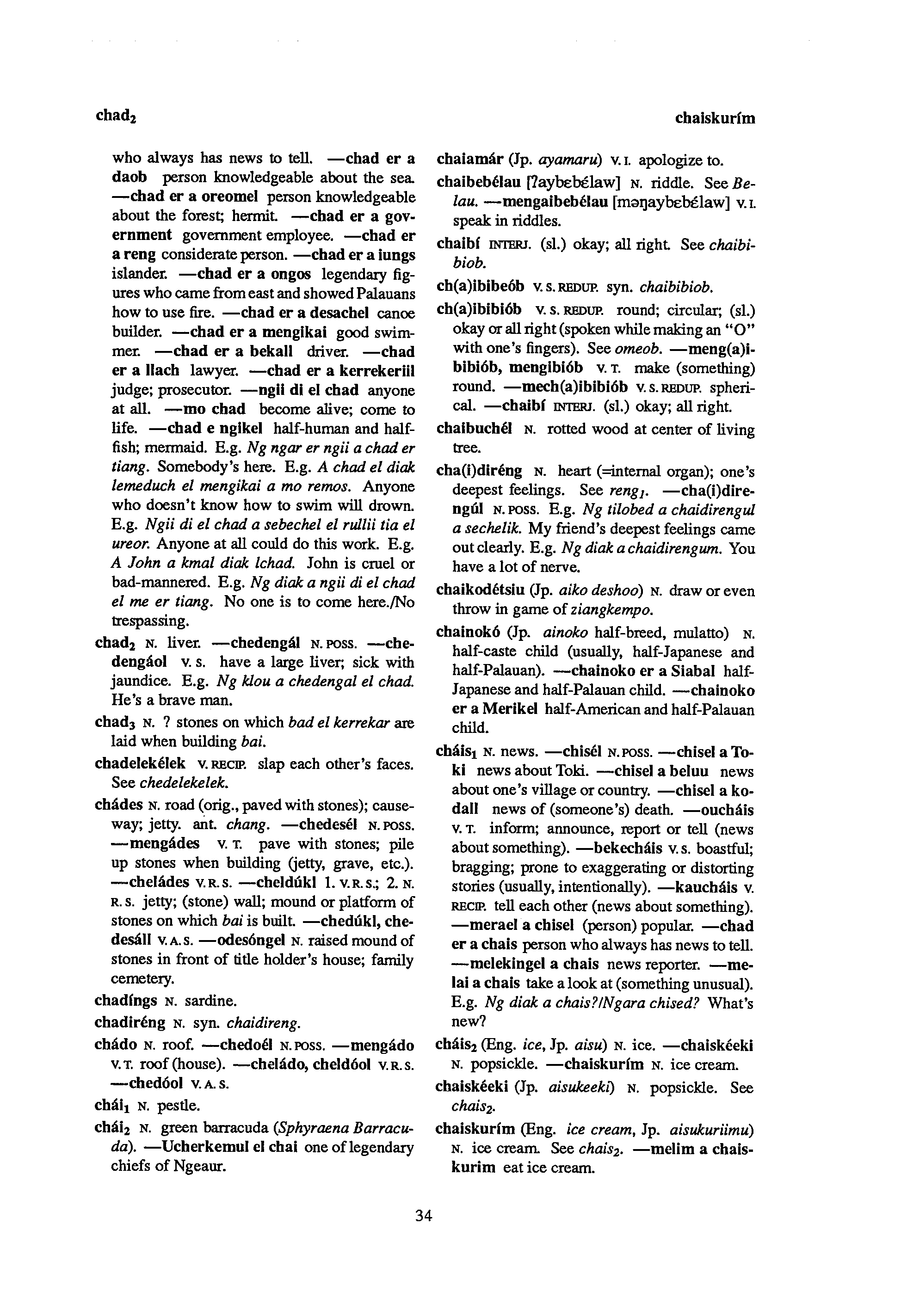
- chai in Lewis S. Josephs; Edwin G. McManus; Masa-aki Emesiochel (1977), Palauan-English Dictionary, University Press of Hawaii, →ISBN, page 34.
Swahili

Etymology
Borrowed from Classical Persian چای (čāy).
Pronunciation
Audio (Kenya): (file)
Noun
chai class IX (plural chai class X)
- tea
- (Tanzania) breakfast
- Synonyms: chakula cha asubuhi, staftahi, (Kenya) kiamsha kinywa, (Tanzania) kifungua kinywa
- (slang, Kenya) tea money, small bribe, petty bribe (likened to the cost, and function, of a cup of tea)
- Synonyms: see Thesaurus:rushwa
Derived terms
Tày
Pronunciation
- (Thạch An – Tràng Định) IPA(key): [caːj˧˧]
- (Trùng Khánh) IPA(key): [caːj˦˥]
Etymology 1
Noun
chai
- bottle
- chai lẩu ― bottle of wine
Etymology 2
Verb
chai
- to fast
- chai tón nâng ― to fast for one meal
Adjective
chai (Nôm form ⿻斋丷)
- vegan, especially in the Buddhist style
- kin chai ― to go vegan
- 否容易𫩒{⿻斋丷}地下
- Bấu doòng dỉ kin chai tỉ giả
- It's not easy to be a vegan on Earth.
- in an ordinary, even lackluster, way
- kin khẩu chai ― to eat plain rice
- old, specifically past something's developmental phase
- mảy khửn chai
- bamboo shoots that grow even when it's too old to grow
References
- Hoàng Văn Ma; Lục Văn Pảo; Hoàng Chí (2006), Từ điển Tày-Nùng-Việt [Tay-Nung-Vietnamese dictionary] (in Vietnamese), Hanoi: Nhà xuất bản Từ điển Bách khoa Hà Nội
- Lương Bèn (2011), Từ điển Tày-Việt [Tay-Vietnamese dictionary][5][6] (in Vietnamese), Thái Nguyên: Nhà Xuất bản Đại học Thái Nguyên
- Dương Nhật Thanh; Hoàng Tuấn Nam (2003), Hoàng Triều Ân, editor, Từ điển chữ Nôm Tày [A Dictionary of (chữ) Nôm Tày][7] (in Tày and Vietnamese), Hanoi: Nhà xuất bản Khoa học xã hội [Social Sciences Publishing House]
Vietnamese
Pronunciation
- (Hà Nội) IPA(key): [t͡ɕaːj˧˧]
- (Huế) IPA(key): [t͡ɕaːj˧˧]
- (Saigon) IPA(key): [caːj˧˧]
- Homophone: trai
Etymology 1
(This etymology is missing or incomplete. Please add to it, or discuss it at the Etymology scriptorium. Particularly: “甀 ?”)
Noun
Derived terms
- chai lọ
- ve chai
Descendants
- → Eastern Mnong: čai
- → Tai Dam: ꪊꪱꪥ
Etymology 2
(This etymology is missing or incomplete. Please add to it, or discuss it at the Etymology scriptorium.)
Adjective
chai • (齋)
- (of skin) callus
- vết chai ― a callus
- bị chai tay ― to have calluses on one's hand
- (of a battery) spent
- pin bị chai rồi ― the battery's no good anymore (won't hold a charge)
Derived terms
Anagrams
Ye'kwana
| ALIV | chai |
|---|---|
| Brazilian standard | chai |
| New Tribes | chai |
Pronunciation
- IPA(key): [t͡ʃaj]
Suffix
chai
- English terms borrowed from Romani
- English terms derived from Romani
- English lemmas
- English nouns
- English countable nouns
- English terms borrowed from Hindustani languages
- English terms derived from Hindustani languages
- English terms derived from Classical Persian
- English terms derived from Turkish
- English terms derived from Sinitic languages
- English doublets
- English 1-syllable words
- English terms with IPA pronunciation
- English terms with audio pronunciation
- English terms with homophones
- Rhymes:English/aɪ
- Rhymes:English/aɪ/1 syllable
- English uncountable nouns
- English ellipses
- English terms with quotations
- Indian English
- English terms borrowed from Hebrew
- English terms derived from Hebrew
- English nouns with unknown or uncertain plurals
- en:Judaism
- English terms borrowed from French
- English terms derived from French
- English terms derived from Occitan
- en:Wine
- English terms borrowed from Russian
- English terms derived from Russian
- English terms with rare senses
- English terms with /x/
- en:Tea
- en:Female people
- en:Spices
- Antigua and Barbuda Creole English lemmas
- Antigua and Barbuda Creole English verbs
- Caló terms derived from Romani
- Caló terms inherited from Romani
- Caló lemmas
- Caló nouns
- Caló feminine nouns
- rmq:Female people
- Cebuano lemmas
- Cebuano nouns
- Cebuano terms with Badlit script
- Cebuano terms spelled with C
- Finnish 1-syllable words
- Finnish terms with IPA pronunciation
- Rhymes:Finnish/ɑi
- Rhymes:Finnish/ɑi/1 syllable
- Finnish lemmas
- Finnish nouns
- Finnish terms spelled with C
- Finnish colloquialisms
- Finnish clippings
- Finnish maa-type nominals
- French terms borrowed from English
- French terms derived from English
- French terms derived from Urdu
- French terms derived from Hindi
- French doublets
- French 1-syllable words
- French terms with IPA pronunciation
- French lemmas
- French nouns
- French countable nouns
- French masculine nouns
- French terms borrowed from Occitan
- French terms derived from Occitan
- French terms derived from Latin
- French terms with homophones
- fr:Horticulture
- fr:Wine
- French terms with usage examples
- French terms with quotations
- fr:Rooms
- fr:Tea
- Chinese lemmas
- Hokkien lemmas
- Chinese verbs
- Hokkien verbs
- Chinese nouns
- Hokkien nouns
- Hokkien pe̍h-ōe-jī forms
- Hanyu Pinyin
- Mandarin non-lemma forms
- Mandarin nonstandard forms
- Maroon Spirit Language terms derived from English
- Maroon Spirit Language lemmas
- Maroon Spirit Language verbs
- Maroon Spirit Language terms with quotations
- Navajo terms with IPA pronunciation
- Navajo lemmas
- Navajo nouns
- nv:Family
- Norman lemmas
- Norman nouns
- Norman feminine nouns
- Continental Norman
- Jersey Norman
- Palauan terms inherited from Proto-Malayo-Polynesian
- Palauan terms derived from Proto-Malayo-Polynesian
- Palauan lemmas
- Palauan nouns
- pau:Fish
- pau:Tools
- Swahili terms derived from Classical Persian
- Swahili terms derived from Old Persian
- Swahili terms derived from Middle Persian
- Swahili terms derived from Proto-Indo-European
- Swahili terms derived from Proto-Indo-Iranian
- Swahili terms derived from Proto-Iranian
- Swahili terms borrowed from Classical Persian
- Swahili terms derived from Chinese
- Swahili terms with audio pronunciation
- Swahili lemmas
- Swahili nouns
- Swahili class IX nouns
- Tanzanian Swahili
- Swahili slang
- Kenyan Swahili
- sw:Beverages
- sw:Meals
- sw:Corruption
- Tày terms with IPA pronunciation
- Tày lemmas
- Tày nouns
- Tày terms with usage examples
- Tày verbs
- Tày adjectives
- Vietnamese terms with IPA pronunciation
- Vietnamese terms with homophones
- Vietnamese lemmas
- Vietnamese nouns
- Vietnamese nouns classified by cái
- Vietnamese terms with usage examples
- Southern Vietnamese
- Vietnamese slang
- Vietnamese adjectives
- vi:Containers
- vi:Skin
- Ye'kwana terms with IPA pronunciation
- Ye'kwana lemmas
- Ye'kwana suffixes