Jean-Paul Marat
Jean-Paul Marat | |
|---|---|
 Portrait by Joseph Boze, 1793 | |
| Member of the National Convention | |
| In office 9 September 1792 – 13 July 1793 | |
| Constituency | Paris |
| Personal details | |
| Born | 24 May 1743 Boudry, Principality of Neuchâtel |
| Died | 13 July 1793 (aged 50) Paris, France |
| Cause of death | Assassination (stab wound) |
| Party | The Mountain |
Other political affiliations |
|
| Spouse |
Simonne Évrard (m. 1792) |
| Parents |
|
| Alma mater | University of St Andrews (MD) |
| Occupation | Journalist, scientist |
| Signature |  |
Jean-Paul Marat (UK: /ˈmærɑː/, US: /məˈrɑː/;[1][2] French: [ʒɑ̃pɔl maʁa]; born Mara; 24 May 1743 – 13 July 1793) was a French scientist, physician, political theorist, journalist, and politician.[3] Before the French Revolution, he pursued a career in medicine and science and spent more than ten years abroad. He published works on subjects including optics, electricity, political theory, and criminal law. During the Revolution he became one of its most prolific, radical and controversial journalists. Through his newspaper L'Ami du peuple (The Friend of the People), Marat responded rapidly to political events but also publicized complaints and grievances brought to him by ordinary citizens, presenting himself as their advocate against officials and others whom he accused of injustice or abuse. Publication reached an extraordinary intensity in 1791, when about 500 issues appeared.[4]
Marat became closely associated with the sans-culottes and the radical politics of Paris. He did not work entirely alone, but received financial and practical assistance from a small circle of devoted supporters, including two sisters, a cook and a typesetter who lived in the same house with him.[5] Unable to find printers willing to publish some of his more controversial writings, he established his own printing press and continued to publish despite repeated attempts by the authorities to suppress his newspaper. He frequently changed his residence and printing arrangements and spent long periods in hiding; he later described having lived underground for seven months. His presses were seized or destroyed on several occasions, but publication resumed. On 23 August 1792, he was allocated four presses from the former royal printing house for his publications.[6]
Marat was elected to the National Convention in September 1792 and aligned with the Montagnards in their struggle against the Girondins. His journalism became notorious for increasingly violent calls for the punishment and sometimes the pre-emptive killing of those he regarded as enemies of the revolution. Marat repeatedly justified such violence as a means of preventing greater bloodshed, at times calculating the number of lives that might be sacrificed in order to save many more. His writings and political activity have consequently remained central to debates about political violence during the Revolution, including the September Massacres.
Early June 1793 he played an active part in the conflict that culminated in the fall of the Girondins.[7] On Saturday evening, 13 July 1793, Marat was assassinated by Charlotte Corday, a Girondin sympathizer, while taking a bath for a debilitating skin condition (possibly dermatitis herpetiformis).[8] Corday held Marat responsible for much of the violence and political disorder in France and believed that killing him would help restore peace.[9]
Marat's assassination dramatically transformed his political image. His body was publicly displayed at the Cordeliers and Jacques-Louis David took a leading role in organizing the funeral ceremonies. On 16 July, a large procession accompanied his body through Paris to the former Cordeliers convent, where he was buried in the garden and a monument was subsequently erected over his grave.[10] Popular societies, the sections of Paris, and the Montagnards increasingly represented him as the murdered Ami du peuple and as a martyr of the Revolution.
Marat's remains were transferred to the Panthéon in September 1794, but during the Thermidorian Reaction his public cult rapidly collapsed and he was removed from the Panthéon in February 1795.
Education and early career
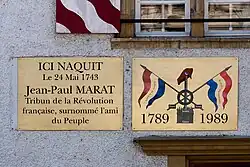
Marat was born in Boudry and baptised on 8 June. His family remained there until 1752, when they moved to Peseux. In 1754 the family, by then with six children, moved to Neuchâtel. Marat received much of his early education at home from his father, who worked as a textile designer and teacher of languages, geography and history. The family's settlement was facilitated by governor George Keith. Marat also studied under Jean-Élie Bertrand, professor of belles-lettres and later a co-founder of the Société typographique de Neuchâtel.[11]
At the age of 17 he applied to join the expedition of Jean-Baptiste Chappe d'Auteroche to Tobolsk to observe the transit of Venus, but was turned down.[12] Marat later portrayed intellectual ambition as a defining feature of his character. In an autobiographical account, he recalled that as a child he had successively wanted to become a schoolmaster, professor, author and, by the age of twenty, a "creative genius". He described the "love of glory" as the one passion that had remained with him throughout his life.[13]
In 1760, Marat moved to Bordeaux, where he spent about two years. Later biographers associated his stay there with the wealthy Nairac family, sometimes describing him as a private tutor, but the details are uncertain. He then moved to Paris, where he continued his studies and pursued medical training without obtaining a formal qualification.[12] He later francized his surname from "Mara" to "Marat".[14]
In 1765, Marat moved to Soho, where he practised medicine despite lacking formal medical qualifications. In London, Marat became a close friend of the Italian painter Antonio Zucchi and Joseph Bonomi the Elder became his patient.[15] According to Joseph Farington's diary, Marat was a frequent guest at Zucchi's house and, being well read in classical literature, regularly suggested subjects for Zucchi's compositions.[16] Zucchi also frequently took Marat with him when visiting Angelica Kauffman at her home in Golden Square.[15]
Political, philosophical, and medical writing
During his years in Britain, Marat pursued medicine alongside philosophical and political writing. Around 1770, Marat wrote a sentimental and political epistolary novel, Les Aventures du jeune comte Potowski, set in Poland before the First Partition (1772). In 1772 he anonymously published An Essay on the Human Soul, followed in 1773 by the expanded two-volume A Philosophical Essay on Man.[17] Around this period he lived in Newcastle upon Tyne, where he became acquainted with British radical politics. His Chains of Slavery, published in London in 1774, examined the means by which rulers could undermine political liberty. Written against the background of the agitation surrounding John Wilkes and the British general election of 1774, it attacked political corruption, restrictions on representation and the use of patronage, standing armies, censorship and other instruments of government power.[18] Marat argued that sovereignty ultimately belonged to the people rather than the monarch, an argument influenced by Jean-Jacques Rousseau.[19]
In 1774, Marat travelled to Amsterdam to arrange the publication of a French version of his philosophical work with the Geneva-born publisher Marc-Michel Rey, Rousseau's principal publisher. During his stay in the Dutch Republic he met the writer and scholar Isaac de Pinto in The Hague, who provided him with a letter of introduction to a young professor in Utrecht, though the introduction appears to have led to little.[20] Rey published the substantially expanded work as the three-volume De l'Homme, ou des principes et des lois de l'influence de l'âme sur le corps et du corps sur l'âme in 1775–76.
De l'Homme brought Marat into conflict with Voltaire. Marat criticized Helvétius and Voltaire in the work; Voltaire responded with a mocking critique of Marat's philosophical arguments. Marat remembered the dispute years later, claiming in 1791 that Voltaire had been angered by the treatment he received in De l'Homme.[21]
Marat also continued to establish himself professionally as a physician. On the recommendation of two medical practitioners, he received an MD from the University of St Andrews in June 1775.[22] He subsequently returned to London, where in November 1775 he published a medical tract on the treatment of gleet, followed by An Enquiry into the Nature, Cause, and Cure of a Singular Disease of the Eyes in January 1776.
His medical reputation and the patronage of the Marquis de l'Aubespine, whose wife was among his patients, led to his appointment in June 1777 as physician to the bodyguard of the Comte d'Artois, the youngest brother of Louis XVI. The post paid 2,000 livres a year plus allowances.[23]
Scientific writing
While serving as a physician among the aristocracy, Marat devoted increasing attention to experimental science. His method was to describe in detail the meticulous series of experiments he had undertaken on a problem, seeking to explore and then exclude all possible conclusions but the one he reached.
He published works on fire and heat, electricity, and light. In 1779, he published a summary of his scientific views and discoveries, Découvertes de M. Marat sur le feu, l'électricité et la lumière (English: Mr Marat's Discoveries on Fire, Electricity and Light). He subsequently published more detailed works expanding on these areas of research.
Recherches Physiques sur le Feu
The first of Marat's large-scale publications detailing his experiments and drawing conclusions from them was Recherches Physiques sur le Feu (English: Research into the Physics of Fire), which was published in 1780 with the approval of the official censors.[24]
This publication describes 166 experiments conducted to demonstrate that fire was not, as was widely held, a material element but an "igneous fluid". He asked the Academy of Sciences to appraise his work, and it appointed a commission to do so, which reported in April 1779. The report avoided endorsing Marat's conclusions but praised his "new, precise and well-executed experiments, appropriately and ingeniously designed". Marat then published his work, with the claim that the Academy approved of its contents. Since the Academy had endorsed his methods but said nothing about his conclusions, this claim drew the ire of Antoine Lavoisier, who demanded that the Academy repudiate it. When the Academy did so, this marked the beginning of worsening relations between Marat and many of its leading members. A number of them, including Lavoisier himself, as well as Condorcet and Laplace, took a strong dislike to Marat. However, Lamarck and Lacépède wrote positively about Marat's experiments and conclusions.[25]
Découvertes sur la Lumière
In Marat's time, Newton's views on light and colour were regarded almost universally as definitive, yet Marat's explicit purpose in his second major work Découvertes sur la Lumière (Discoveries on Light) was to demonstrate that in certain key areas, Newton was wrong.[26]
The focus of Marat's work was the study of how light bends around objects, and his main argument was that while Newton held that white light was broken down into colours by refraction, the colours were actually caused by diffraction. When a beam of sunlight shone through an aperture, passed through a prism and projected colour onto a wall, the splitting of the light into colours took place not in the prism, as Newton maintained, but at the edges of the aperture itself.[27] Marat sought to demonstrate that there are only three primary colours, rather than seven as Newton had argued.[28]
Once again, Marat requested the Academy of Sciences review his work, and it set up a commission to do so. Over a period of seven months, from June 1779 to January 1780, Marat performed his experiments in the presence of the commissioners so that they could appraise his methods and conclusions. The drafting of their final report was assigned to Jean-Baptiste Le Roy. The report was finally produced after many delays in May 1780, and consisted of just three short paragraphs. Significantly, the report concluded that "these experiments are so very numerous...[but]...they do not appear to us to prove what the author believes they establish".[26] The Academy declined to endorse Marat's work.[29] When it was published, Découvertes sur la lumière did not carry the royal approbation. According to the title page, it was printed in London, so that either Marat could not get the official censor to approve it or he did not want to spend the time and effort to do so.
Recherches Physiques sur L'Électricité
Benjamin Franklin corresponded with Marat and attended several of his experiments. In 1779, Marat repeatedly invited Franklin to demonstrations of his experimental work at the residence of the Marquis de l'Aubespine.[30]
In April 1783,[31] he resigned his court appointment and devoted his energies full-time to scientific research. Apart from his major works, during this period Marat published shorter essays on the medical use of electricity (Mémoire sur l'électricité médicale (1783)) and on optics (Notions élémentaires d'optique (1784)). He published a well-received translation of Newton's Opticks (1787) and later a collection of essays on his experimental findings, including a study on the effect of light on soap bubbles in his Mémoires académiques, ou nouvelles découvertes sur la lumière (Academic memoirs, or new discoveries on light, 1788).
Marat also took an interest in the emerging science of ballooning. Following the deaths of Jean-François Pilâtre de Rozier and Pierre Romain during their attempted crossing of the English Channel in June 1785, he published Lettres de l'observateur Bon-Sens [...] sur la fatale catastrophe des infortunés Pilatre de Rosier & Romain, in which he discussed the physical causes of the accident.[32] [33] In Les Charlatans modernes, published in 1791 from material written earlier, Marat attacked the system of academic patronage and government rewards, criticizing prominent scientists and balloonists including Pilâtre de Rozier.[34]
Other pre-Revolutionary writing

In 1780, Marat published his Plan de législation criminelle, a treatise on criminal law and penal reform in Neuchâtel, the city of his youth. Marat's ideas on criminal law were influenced by Jean-Jacques Rousseau and Cesare Beccaria, author of Dei delitti e delle pene.[35] Meanwhile Marat developed a close friendship with Jacques Pierre Brissot, who was himself writing on criminal-law reform.[36] Their surviving correspondence shows that they were on intimate terms.[37] In 1782, Brissot published Marat's complete Plan de législation criminelle in the fifth volume of his Bibliothèque philosophique du législateur.[38]
In July 1790, Marat announced a new edition of the Plan, arguing that its proposals could contribute to the National Assembly's forthcoming work on criminal legislation. The Plan combined penal reform with a broader criticism of social and political institutions. Marat argued that bad government, unjust laws and social inequality could themselves contribute to crime, and that society could expect the poor to obey its laws only if it guaranteed them the means of subsistence, clothing, protection, and care in sickness and old age. He regarded the king as no more than the "first magistrate" of the nation, and argued that punishments should be proportionate to the offence and that capital punishment should be used only rarely, although he retained it for premeditated murder. He also proposed that each town should have an avocat des pauvres and independent criminal tribunals with twelve-member juries to ensure a fair trial.[39]
In the early French Revolution
Estates General and Fall of the Bastille
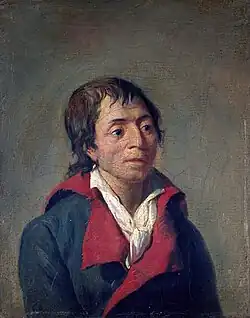
In 1788, the Assembly of Notables advised Louis XVI to assemble the Estates-General for the first time in 175 years. According to Marat, in the latter half of 1788 he had been deathly ill.[40] Upon hearing of the King's decision to call together the Estates General, however, he explains that the "news had a powerful effect on me; my illness suddenly broke and my spirits revived".[41] He strongly desired to contribute his ideas to the coming events and subsequently abandoned his career as a scientist and doctor, taking up his pen on behalf of the Third Estate.[42]
Marat anonymously published his first contribution to the revolution in February 1789, titled Offrande à la Patrie (Offering to the Nation), which touched on some of the same points as the Abbé Sieyès' famous "Qu'est-ce que le Tiers État?" ("What is the Third Estate?").[42] Marat claimed that this work caused a sensation throughout France, though he likely exaggerated its effect as the pamphlet mostly echoed ideas similar to many other pamphlets and cahiers circulating at the time.[43] This was followed by a "Supplément de l'Offrande" in March, where he was less optimistic, expressing displeasure with the King's Lettres Royales of 24 January. In August 1789, he published La Constitution, ou Projet de déclaration des droits de l'homme et du citoyen, intended to influence the drafting of France's new constitution, then being debated in the National Assembly.[42] In this work, he builds his theories upon ideas taken from Montesquieu and Rousseau, claiming that the sovereignty of the nation rests with the people and emphasizing the need for a separation of powers. He argues for a constitutional monarchy, believing that a republic is ineffective in large nations.[44] Marat's work elicited no response from the National Assembly.
On 14 July, three days after Louis XVI dismissed Jacques Necker as his financial advisor, enraged Parisians attacked the Hotel des Invalides and the Bastille, marking the first insurrection of the French Revolution. Marat was not directly involved in the Fall of the Bastille but sought to glorify his role that day by claiming that he had intercepted a group of German soldiers on Pont Neuf. He claims that these soldiers were seeking to crush the revolution in its infancy, and that he had successfully convinced a crowd to force the soldiers to surrender their weapons.[45] Whether or not this event actually occurred is questionable as there are no other known accounts that confirm Marat's story.
L'Ami du peuple

On 12 September 1789, Marat began his own newspaper, entitled Publiciste parisien, before changing its name four days later to L'Ami du peuple ("The People's Friend").[46]: 19 He frequently attacked influential individuals and institutions as conspirators against the Revolution, including the Commune, the Constituent Assembly, ministers, and the Châtelet.[47] In January 1790, the district of the Cordeliers, where Marat lived, resisted an attempt by the Châtelet to arrest him. Marat subsequently left Paris for London, returning in May and resumed publication. The following month he briefly published a second newspaper, Le Junius français, named after the English polemicist Junius. Junius.[46]: 73–76 Counterfeit editions of his newspaper also circulated.[48] Marat appealed to the police, who suppressed the fraudulent issues.[49]: 122
Marat used the newspaper as a means of continuous political intervention, commenting on decisions by the Assembly and the Paris authorities and scrutinizing the conduct of ministers, politicians and other public figures. Recurring subjects included popular sovereignty, the conduct of public officials, war and counter-revolution, social inequality, the assignats and financial speculation. His denunciations frequently identified individuals by name and were accompanied by warnings of conspiracy and calls for popular action, at times including political violence.[50]
In a pamphlet of 26 July 1790, entitled C'en est fait de nous ("We're done for!"), he warned against counter-revolutionaries, writing that "five or six hundred heads cut off would have assured your repose, freedom and happiness."[51]
Political activity, 1791–1792
Following the Champ de Mars massacre of 17 July 1791, after Mayor Bailly had proclaimed martial law and the National Guard under Lafayette fired on the petitioners, a crackdown on the radical press followed.[52] Copies of Marat's newspaper were seized and the printing formes were broken up.[53]
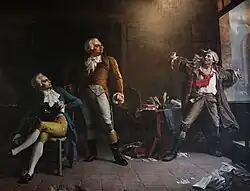
In January 1792, Marat met Maximilien Robespierre for what Robespierre later described as their first and only private meeting. The two disagreed over political tactics: Robespierre criticized Marat's repeated "absurd and violent proposals", while Marat praised Robespierre's integrity and patriotism, calling him "the incorruptible Robespierre" as early as May 1791,[54] but concluded that he lacked "the vision and audacity of a statesman".[55] Shortly before leaving for London, Marat gave the 26-year-old Simonne Évrard, who had supported him financially and sheltered him on several occasions, a written pledge to marry her immediately upon his return.[56] [57]
Meanwhile Marat's former friendship with Jacques Pierre Brissot had turned into bitter political hostility. In June 1792, Marat published Traits destinés au portrait du jésuite Brissot, attacking his former friend over his earlier activities and political connections. Robert Darnton, examining Marat's accusations in the light of Brissot's correspondence, notes that Marat drew on information that only someone close to Brissot was likely to have known.[58]
On 7 August 1792, the Council of Ministers proposed the arrest of Marat, Danton and Robespierre if they appeared at the Jacobin Club.[59] In the tense days preceding the insurrection of 10 August, Marat kept a low public profile.
Committee on Surveillance


After the insurrection of 10 August, the insurrectionary Paris Commune established a Committee of Surveillance, whose membership changed several times during the following weeks. Marat was not among its first members.[60] On 19 August, in no. 680 of L'Ami du peuple, Marat called on the people to go armed to the Abbaye Prison, seize alleged traitors, particularly the imprisoned Swiss officers and their accomplices, and "put them to the sword".[61]
On 2 September, the committee's four administrators—Panis, Sergent, Pierre-Jacques Duplain and Didier Jourdeuil—appointed six administrateurs-adjoints, including Marat, Deforgues, Lenfant, Guermeur, Leclerc and Duffort. The adjuncts were given signing authority under the supervision of the four administrators, who retained responsibility for the committee.[62]
In the afternoon the September Massacres began. During the killings at the Abbaye, an order signed by Panis and Sergent instructed that all the prisoners there be judged, with one specified exception. During the night of 2–3 September, they also ordered the removal and burial of the bodies and the cleaning of the prison.[63]
On 3 September, the Committee of Surveillance sent a circular to the departments describing the killings in Paris as "acts of justice", arguing that terror had been necessary to restrain traitors, and urging its recipients to have the circular printed and forwarded. Marat was among its signatories, and the drafting of the circular has been attributed to him.[64]
In October, in no. 12 of his Journal de la République française, Marat rejected accusations that the Committee of Surveillance had organized the September Massacres. He attributed the violence to the failure of the courts to punish counter-revolutionaries and defended the killings as an unfortunate necessity, while claiming that he and Panis had sought to protect debtors and minor offenders from the violence.[65]
National Convention
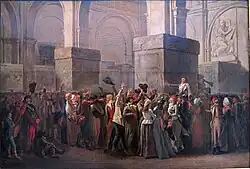
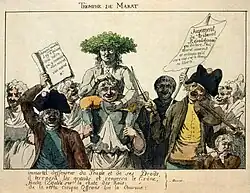

Marat was elected to the National Convention in September 1792 as one of 24 Paris deputies. When France was declared a republic on 22 September, Marat renamed L'Ami du peuple as Le Journal de la République française. The election was not the triumph for the Jacobins that they had anticipated, but during the next nine months they gradually eliminated their opponents and gained control of the Convention.[66]
In his new journal, Marat was a persistent critic of General Dumouriez. He attacked Dumouriez's political conduct in the Austrian Netherlands, which Marat associated with the ambitions of the House of Orléans.[67]
At the same time, Marat's violent political rhetoric was drawing increasing criticism. His writings were attacked in the Convention, while in December members of the Jacobin Club debated whether his more extreme statements should be taken literally. After the execution of Louis XVI, Marat's conflict with the Girondins intensified. During the food crisis in February, Marat denounced hoarders and speculators but opposed demands from the Paris sections for price controls. After food riots broke out in Paris on 25 February, the Girondins accused Marat of having encouraged the violence.[68]
On 10 March, the Convention established the Revolutionary Tribunal to try counter-revolutionary offences. The political crisis deepened in early April when Dumouriez, after attempting to turn his army against the Convention, defected to the Austrians. As president of the Jacobins, Marat had signed a circular on 5 April calling on the departments to defend Paris against a "sacrilegious cabal" within the Convention. The Girondins used the circular to demand his prosecution, and on 13 April the Convention voted to indict him.[69] Marat initially remained out of sight, but surrendered himself to the authorities on 23 April. On 24 April, he became the first representative of the people to be brought before the recently established Revolutionary Tribunal.[70] Marat defended himself without counsel, and the jury acquitted him, finding that his writings expressed a "just indignation". He was acclaimed by the crowd and carried in triumph back to the Convention.[71]
Assassination

Marat played an active role in the insurrection of 31 May–2 June 1793 that brought about the fall of the Girondins. On 1 June, he went to the Hôtel de Ville and urged the people to remain mobilized, and reportedly rang the tocsin.[72] Later that day, when the Committee of Public Safety proposed taking three days to consider the demand for the arrest of the Girondin deputies, Marat demanded a decision within one day.[73] On 2 June, the Convention, surrounded by National Guardsmen under François Hanriot, ordered the arrest of the leading Girondins. Marat, who was presiding over the Convention, took an active part in determining which deputies were to be arrested, removing several names from the proposed list.[74]
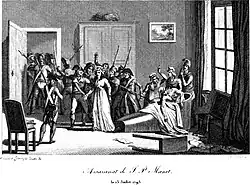
On 13 July, Charlotte Corday, a young woman from Caen, came to Marat's home claiming to have information about the Girondins who had fled to Normandy. Marat, whose illness confined him to a medicinal bath for much of the day, received her there. Corday gave him information about the Girondins in Caen and named several of them. According to her later testimony, Marat told her that they would soon be guillotined in Paris. Corday later stated that these words decided his fate.[75] Corday then drew a kitchen knife concealed in her clothing and stabbed Marat once in the chest. Mortally wounded, he called to Simonne Évrard, "Aidez-moi, ma chère amie!" ("Help me, my dear friend!"), and died shortly afterwards.[35] Corday was a sympathizer of the Girondins and came from a royalist Norman family; two of her brothers had emigrated and joined the royalist armies. She had attended meetings of Girondin deputies who had taken refuge in Caen after their expulsion from the Convention, but during her interrogation she insisted that she had conceived and carried out the assassination herself. Corday held Marat personally responsible for much of the violence and political disorder in France. When asked why she had killed him, she replied that she wanted "to restore peace to my country" (rendre la paix à mon pays), and referred to "the ravages of France" which she regarded as his work (les ravages de la France que je regarde comme son ouvrage).[75]
Marat's assassination heightened the political tensions in France and provoked indignation, anger and calls for vengeance in Paris.[76] Corday was tried before the Revolutionary Tribunal on 17 July 1793. During her interrogation and trial, she maintained that she had acted alone and denied that the Girondins had been involved in a conspiracy to assassinate Marat.[77] She was convicted of the murder and guillotined later that day. According to Sanson's account, Corday remained remarkably calm during the journey to the scaffold and faced her execution with composure and courage.[78]
Memory in the Revolution
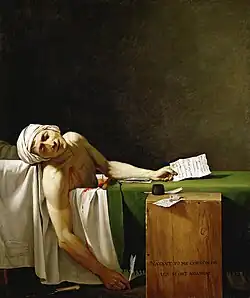


Marat's assassination was followed by an elaborate public cult. The National Convention commissioned Jacques-Louis David to organize his funeral, which took place in the late afternoon on 16 July 1793.[79] Marat's body was displayed before being carried in procession to the former Cordeliers Convent, where he was buried beneath the trees in the convent garden. A funerary monument designed by the sculptor Jean-François Martin was subsequently erected there. David also commemorated Marat in The Death of Marat, which became one of the best-known images of the Revolution.
In the months following his death, Marat was commemorated as a revolutionary martyr in festivals, monuments and political imagery, while streets and public places were renamed in his honour. The former rue des Cordeliers, where he had lived and been assassinated, was renamed rue Marat. The Section du Théâtre-Français, which included the Cordeliers district where Marat had lived and worked, also took his name.[80] His widow, Simone Évrard, who had been the tenant of the apartment, continued to use no. 30 as a printing and subscription address.
In November 1793, the port city of Le Havre likewise changed its name to Havre-Marat, a name it retained until January 1795.[81] Busts, portraits and medallions of Marat proliferated, and ceremonies in his honour were organized by Parisian sections and popular societies. His commemoration acquired features of a secular martyr cult, which developed alongside the dechristianization movement and the Cult of Reason. Marat's remains were transferred to the Panthéon on 21 September 1794.[82]
The Thermidorian Reaction brought a rapid reversal of Marat's official cult. Le Havre abandoned the name Havre-Marat in January 1795, while busts and other representations of Marat were publicly removed or destroyed. On 2 February 1795, his remains were removed from the Panthéon. Le Moniteur Universel reported that busts of Marat had been torn from their pedestals and that one was carried through the streets before being thrown into a sewer in the rue Montmartre to cries of « Marat, voilà ton Panthéon ! ».[83] His remains were reinterred in the former Sainte-Geneviève cemetery, near the church of Saint-Étienne-du-Mont.
A bronze sculpture of Marat was removed from Parc des Buttes Chaumont and was melted down during the Nazi occupation of Paris.[84] Another was created in 2013 for the Musée de la Révolution française. In his birthplace of Boudry, a square is named Place Marat after him.
He continued to be held in high regard in the Soviet Union. Marat became a common name, and Marat Fjord in Severnaya Zemlya was named after him. Russian battleship Petropavlovsk (Russian: Петропавловск) was renamed Marat in 1921.[85] A street in the centre of Sevastopol was named after Marat (Russian: Улица Марата) on 3 January 1921, shortly after the Bolsheviks took over the city.[86]
Skin disease
Marat suffered from a chronic and increasingly debilitating skin disease, the nature of which has been the subject of several retrospective diagnoses. In 1979, dermatologist Josef E. Jelinek described the condition as intensely itchy and blistering, beginning in the perianal region and eventually being associated with severe weight loss. He considered dermatitis herpetiformis the most likely diagnosis.[8]
Marat sought relief by taking medicinal baths, particularly as his condition worsened during the last months of his life. Various substances were added to the bath, and he reportedly wore a cloth soaked in vinegar around his head.[87]
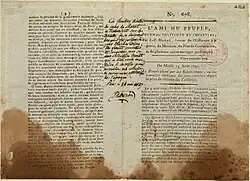
A 2020 metagenomic study analysed DNA recovered from a bloodstained newspaper associated with Marat's assassination. The researchers found no evidence for several infectious agents previously proposed as causes of his illness and suggested that a fungal infection, possibly seborrhoeic dermatitis, was a plausible explanation.[88]
Tub

The Musée Grévin in Paris displays a copper bathtub which it identifies as the tub in which Marat was assassinated. Its documented provenance, however, does not extend back to Marat. In 1804, Marie-Joseph-André-Augustin Capriol de Saint-Hilaire brought the tub to the Château de Beauchamp at Taverny, having previously acquired it from a scrap-metal dealer in Paris. After the deaths of Saint-Hilaire and his wife in 1849–1850, it passed to their daughter Marie-Adélaïde-André-Augustine. On her death in 1861, she left her possessions to the abbé Joseph Rio, with whom she had been living. Rio subsequently moved several times, taking the tub with him; after his death in 1876 it passed to the bishopric of Vannes and subsequently to the abbé Le Cosse.[89]
The tub attracted wider attention after Le Figaro published an article about it in July 1885. Its identification as Marat's bathtub was already disputed at the time: the detailed inventory made of Marat's possessions after his death apparently did not mention a bathtub, and the Musée Carnavalet declined to acquire it because of the absence of documentary proof of its provenance. The Musée Grévin acquired the tub in 1886 and incorporated it into its reconstruction of Marat's assassination, where it remains on display.[90]
The tub is a copper baignoire sabot, a high-backed type designed to reduce the amount of water required for bathing. Such copper tubs could also be rented in eighteenth-century Paris.[91]
Works
- A Philosophical Essay on Man (1773) (in English)
- The Chains of Slavery (1774) (in English)
- An Essay on Gleets &c. (1775) (in English)
- Enquiry into the Nature, Cause, and Cure of a Singular Disease of the Eyes (1776) (in English)
- De l'Homme (1776) (translation of his 1773 English work)
- Découvertes de M. Marat sur le feu, l'électricité et la lumière (1779)
- Plan de Législation Criminelle (1780)
- Recherches physiques sur le feu (1780)
- Découvertes de M. Marat sur la lumière, constatées par une suite d'expériences nouvelles (1780)
- Recherches physiques sur l'électricité, &c (1782)
- Mémoire sur l'électricité médicale (1783)
- Notions élémentaires d'optique (1784)
- Lettres de l'observateur Bon Sens à M. de M sur la fatale catastrophe des infortunés Pilatre de Rozier et Ronzain, les aéronautes et l'aérostation (1785)
- Observations de M. l'amateur Avec à M. l'abbé Sans . . . &c., (1785)
- Éloge de Montesquieu : présenté à l'Académie de Bordeaux, le 28 mars 1785 / par J.-P. Maratz; publié avec une introduction, par Arthur de Brézetz,...Éloge de Montesquieu (1785) (provincial Academy competition entry first published 1883 by M. de Bresetz)
- Optique de Newton (1787)
- Mémoires académiques (1788)
- Offrande à la Patrie (1789) (pamphlet)
- Constitution, ou projet de déclaration des Droits de l'Homme et du Citoyen (1789) (pamphlet)
- Les Charlatans modernes, ou lettres sur le charlatanisme académique (L'Ami du Peuple, 1791) (pamphlet)
- Les chaînes de l'Esclavage (1792) Archived 15 June 2025 at the Wayback Machine (translation of his 1774 English work)
- Les Aventures du jeune comte Potowski (unpublished manuscript first published in 1847 by Paul Lacroix)
- Lettres polonaises (unpublished manuscript first printed in English in 1905; recently translated into French but authenticity disputed)
- La Correspondance de Marat (published in 1908 by Charles Vellay)
References
- ↑ Wells, John C. (2008). Longman Pronunciation Dictionary (3rd ed.). Harlow: Pearson Education. ISBN 978-1-4058-8118-0.
- ↑ Jones, Daniel (2011). Roach, Peter; Setter, Jane; Esling, John (eds.). Cambridge English Pronouncing Dictionary (18th ed.). Cambridge University Press. ISBN 978-0-521-15255-6.
- ↑ Isaac Asimov's Biographical Encyclopedia of Science and Technology – Second Revised Edition, 1982, p. 334.
- ↑ "Les journaux de Marat". ARTFL Project. University of Chicago. Retrieved 1 September 2026.
- ↑ Ernest Belfort Bax (1900) Jean-Paul Marat The People’s Friend Chapter IX Marat’s Assassination
- ↑ "Marat, Jean-Paul (1743-1793)". Catalogue général. Bibliothèque nationale de France. Retrieved 1 September 2026.
- ↑ Davidson, Ian (2016). The French Revolution: From Enlightenment to Tyranny, pp. 161–162.
- 1 2 Jelinek, J.E. (1979). "Jean-Paul Marat: The differential diagnosis of his skin disease". American Journal of Dermatopathology. 1 (3): 251–52. doi:10.1097/00000372-197900130-00010. PMID 396805.
- ↑ "Instruction préparatoire : interrogatoire de l'accusée". Procès criminel de Marie-Anne Charlotte Corday d'Armont. Retrieved 1 September 2026.
- ↑ "Tombeau de Jean-Paul Marat dans le jardin des Cordeliers, juillet 1793". Paris Musées Collections. Musée Carnavalet. Retrieved 1 September 2026.
- ↑ « JEAN-PAUL MARAT ET SA FAMILLE : UN QUART DE SIECLE EN PAYS NEUCHATELOIS »
- 1 2 Gillispie, Charles Coulston (2009). Science and Polity in France: The End of the Old Regime. Princeton University Press. p. 292. ISBN 978-1-4008-2461-8.
- ↑ Autobiographie de Jean-Paul Marat
- ↑ Robert, Adolphe; Cougny, Gaston (1891). Dictionnaire des parlementaires français (in French). Paris. p. 252.
{{cite book}}: CS1 maint: location missing publisher (link) - 1 2 McHale, Katherine (2017). "Adam and the Academicians: The Contributions of Leading Italian Artists" (PDF). The Georgian Group Journal. 25: 167–180.
- ↑ Farington, Joseph (1978). Garlick, Kenneth; Macintyre, Angus (eds.). The Diary of Joseph Farington. Vol. 1. New Haven and London: Yale University Press. p. 108.
- ↑ Cock, J. de & Goetz, C., Œuvres de Jean-Paul Marat, 10 volumes, Éditions Pôle Nord, Brussels, 1995.
- ↑ Rachel Hammersley, “Jean-Paul Marat's The Chains of Slavery in Britain and France, 1774–1833”, The Historical Journal 48, no. 3 (2005).
- ↑ Gottschalk, pp. 19–22.
- ↑ Jeremy D. Popkin, "Marat en Hollande. Un témoignage inconnu", Dix-huitième Siècle, no. 22 (1990), pp. 291–293.
- ↑ Voltaire, "Observations sur le livre intitulé De l'Homme, ou des Principes et des lois, de l'influence de l'âme sur le corps ... par J.-P. Marat, docteur en médecine", in: Œuvres complètes de Voltaire.
- ↑ Conner (1999), p. 33.
- ↑ Conner (1999), p. 35.
- ↑ Conner (1999), p. 71
- ↑ Conner (1999), pp. 77–79
- 1 2 Baillon, Jean-François (2009). "Two Eighteenth-Century Translators of Newton's Opticks: Pierre Coste and Jean-Paul Marat" (PDF). Enlightenment and Dissent. 25: 1–28. Archived from the original (PDF) on 7 November 2018. Retrieved 6 November 2018.
- ↑ Conner (1999), pp. 89–95
- ↑ Conner (1999), pp. 105–106
- ↑ Conner (1999), pp. 94–95
- ↑ "Jean-Paul Marat to Benjamin Franklin, 29 March 1779". Founders Online. National Archives.
- ↑ Conner (1999), p. 35.
- ↑ Par Marat, d'après M. Quérard
- ↑ Marat Inconnu
- ↑ Les Pamphlets de Marat
- 1 2 "Jean-Paul Marat | Biography, Death, Painting, Writings, & Facts | Britannica". www.britannica.com. Retrieved 18 March 2023.
- ↑ Ellery, Eloise (1915). Brissot de Warville: A Study in the History of the French Revolution (PDF). Boston and New York: Houghton Mifflin Company. p. 17.
- ↑ Darnton, Robert. 1968. The grub street style of revolution: J.-P. Brissot, police spy. Journal of Modern History 40(3): 301-327
- ↑ "Collection de François Chèvremont" (PDF). p. 99. Retrieved 12 September 2026.
- ↑ Jean-Paul Marat, Plan de législation criminelle, Paris, 1790
- ↑ The life and radicalization of Jean-Paul Marat by Keith Baker
- ↑ Conner (2012), p. 32
- 1 2 3 Bianchi, Serge (2017). Marat. "L'Ami du peuple". Humensis. ISBN 978-2-410-00662-9.
- ↑ Gottschalk, pp. 38–39
- ↑ Gottschalk, pp. 45–47
- ↑ Conner (2012), pp. 39–40
- 1 2 De Cock, Jacques (2013). Un journal dans la Révolution: "L'Ami du Peuple". fantasques éditions. ISBN 978-2-913846-30-2.
- ↑ Albert, Pierre (19 January 1999). "Ami du Peuple l'". universalis.fr. Encyclopædia Universalis. Retrieved 23 May 2018.
- ↑ Belfort Bax, p. 70
- ↑ Massin, Jean (1988). Marat. Aix en Provence: Éditions Alinéa. ISBN 2-904631-58-5.
- ↑ The formation of a revolutionary journalist: Jean-Paul Marat (Voltaire Foundation)
- ↑ Fremont-Barnes, Gregory (2007). Encyclopedia of the age of political revolutions and new ideologies, 1760–1815: vol 1. Greenwood. pp. 450–451. ISBN 978-0313334450.
- ↑ Lewis, Thomas Tandy (2024) Marat
- ↑ Albert Mathiez, Le Club des Cordeliers pendant la crise de Varennes et le massacre du Champ de Mars, Paris, Honoré Champion, 1910, p. 173.
- ↑ L'Ami du peuple, no. 458, 14 May 1791, p. 3, ARTFL.
- ↑ Olivier Coquard, "Marat et Robespierre : la rencontre de deux politiques révolutionnaires", in Robespierre. De la Nation artésienne à la République et aux Nations, Lille, Publications de l’Institut de recherches historiques du Septentrion, 1994, pp. 157–166.
- ↑ Marat, Albertine (1793). Réponse aux détracteurs de l'Ami du Peuple (in French). Paris: Imprimerie de Marat. p. 6.
- ↑ Belfort Bax, p. 191.
- ↑ Darnton, Robert. 1968. The grub street style of revolution: J.-P. Brissot, police spy. Journal of Modern History 40(3): 310-312
- ↑ R. Cobb, p. 150.
- ↑ Louis Blanc, Histoire de la Révolution française, nouvelle édition, vol. VIII (Paris: Librairie Internationale, A. Lacroix et Cie, 1878), p. 213.
- ↑ Jean-Paul Marat, L'Ami du peuple, no. 680, 19 August 1792, ARTFL, University of Chicago; see also Blanc, Histoire de la Révolution française, vol. VIII, p. 244.
- ↑ Arrêté du Comité de police et de surveillance, 2 September 1792, Archives de la Préfecture de police, dossier des massacres de septembre, 1re liasse, reproduced in Adolphe Granier de Cassagnac, Histoire des Girondins et des massacres de septembre, vol. II (Paris, 1860), pp. 109–110; Michel Vovelle, "Marat Jean-Paul", in Albert Soboul (ed.), Dictionnaire historique de la Révolution française (Paris: PUF, 1989), pp. 709–713.
- ↑ Pierre Caron, Les Massacres de Septembre (Paris: Maison du livre français, 1935), pp. 94–99, 101–102.
- ↑ Frédéric Bluche, Septembre 1792. Logiques d'un massacre (Paris: Robert Laffont, 1986), p. 170; Caron, Les Massacres de Septembre, p. 296; Blanc, Histoire de la Révolution française, vol. VIII, p. 295.
- ↑ Jean-Paul Marat, Journal de la République française, no. 12, 6 October 1792, cited in Adolphe Granier de Cassagnac, Histoire des Girondins et des massacres de septembre, vol. II (Paris, 1860); see also Blanc, Histoire de la Révolution française, vol. VIII, p. 308.
- ↑ Cobban, Alfred (1946). "The Political Ideas of Maximilien Robespierre during the Period of the Convention". The English Historical Review. 61 (239): 45–80. doi:10.1093/ehr/LXI.CCXXXIX.45. JSTOR 554837.
- ↑ Jean-Paul Marat, Journal de la République française, no. 85, 27 December 1792, pp. 277–278; Journal de la République française, 3 February 1793, p. 100.
- ↑ Doyle, William (2002). The Oxford History of the French Revolution (2nd ed.). Oxford University Press. p. 223.
- ↑ Doyle, William (2002). The Oxford History of the French Revolution (2nd ed.). Oxford University Press. p. 228.
- ↑ H.-C. Sanson, Sept générations d'exécuteurs, 1688–1847, vol. 3 (Paris, 1879), p. 445.
- ↑ Hervé Leuwers, La Révolution française (Paris: Presses Universitaires de France, 2020), pp. 186–187.
- ↑ Alphonse Aulard, Histoire politique de la Révolution française: Origines et développement de la démocratie et de la République (1789–1804), 4th ed. (Paris, 1910), p. 110.
- ↑ Gazette nationale ou le Moniteur universel, 4 & 5 juin 1793
- ↑ Jonathan Israel, Revolutionary Ideas: An Intellectual History of the French Revolution from The Rights of Man to Robespierre (Princeton, 2014), pp. 446–447.
- 1 2 H.-C. Sanson, Sept générations d'exécuteurs, 1688–1847, vol. 3 (Paris, 1879), pp. 434–436.
- ↑ Hervé Leuwers, La Révolution française (Paris: Presses Universitaires de France, 2020), pp. 196–199.
- ↑ H.-C. Sanson, Sept générations d'exécuteurs, 1688–1847, vol. 3 (Paris, 1879), pp. 434–440.
- ↑ H.-C. Sanson, Sept générations d'exécuteurs, 1688–1847, (Paris, 1879), pp. 439–440.
- ↑ Schama, Simon (1989). Citizens: A Chronicle of the French Revolution. Knopf Doubleday Publishing. pp. 742–744. ISBN 0-679-72610-1.
- ↑ Doyle, William (2002). The Oxford History of the French Revolution (2nd ed.). Oxford University Press. p. 269. ISBN 978-0-19-925298-5.
- ↑ « La Révolution », Archives municipales du Havre.
- ↑ Conner (2012), p. 149.
- ↑ Buchez, Philippe-Joseph-Benjamin (1838), Histoire parlementaire de la Révolution française, vol. 36, p. 230.
- ↑ "Where the Statues of Paris were sent to Die". messynessychic.com. 7 January 2016. Retrieved 20 November 2016.
- ↑ McLaughlin, Stephen (2003). Russian & Soviet Battleships. Annapolis, MD: Naval Institute Press, p. 321.
- ↑ "Улица Марата:: Улицы Севастополя [Streets of Sevastopol – Marat Street]". www.sevastopol.info.
- ↑ Loomis, p. 42.
- ↑ Lalueza-Fox, Carles; et al. (2020). "Metagenomic analysis of a blood stain from the French revolutionary Jean-Paul Marat (1743–1793)". Infection, Genetics and Evolution. 80. doi:10.1016/j.meegid.2020.104209. PMC 7615110. PMID 32004756.
- ↑ "La baignoire de Marat". Ville de Taverny. Retrieved 11 September 2026.
- ↑ "Une sortie entre amis à Paris". Musée Grévin. Retrieved 11 September 2026.
- ↑ Alfred Franklin, La vie privée d'autrefois : les soins de toilette, Paris, 1887, p. 119.
Cited sources
- Andress, David (2005). The Terror: The Merciless War for Freedom in Revolutionary France. New York: SFG Books. ISBN 978-0374530730.
- Belfort Bax, Ernest (1901). Jean-Paul Marat; The People's Friend, A Biographical Sketch. Vogt Press; Read Books (2008). ISBN 978-1-4437-2362-6.
{{cite book}}: ISBN / Date incompatibility (help) - Conner, Clifford D. (1999). Jean Paul Marat: scientist and revolutionary. Amherst, New York: Humanity Books. ISBN 978-1573926072.
- Conner, Clifford D. (2012). Jean-Paul Marat: Tribune of the French Revolution. Pluto Press. ISBN 978-1849646802.
- Gottschalk, Louis Reichenthal (1927). Jean Paul Marat: a study in radicalism. University of Chicago Press. ISBN 978-0226305325.
{{cite book}}: ISBN / Date incompatibility (help) - Lefebvre, Georges (2001). The French Revolution: From its Origins to 1793. Routledge. ISBN 978-0415253932.
- Loomis, Stanley (1990). Paris in the Terror. Dorset House Publishing Co Inc. ISBN 978-0880294010.
Further reading
- Baker, Keith Michael, Jean-Paul Marat: Prophet of Terror, Chicago, University of Chicago Press, 2025, 952 pp., ISBN 978-0-226-82092-7.
- Conner, Clifford D. Jean Paul Marat: Scientist and Revolutionary (2nd ed. 2012) online review from H-France 2013; excerpt and text search
- Fishman, W. J. "Jean-Paul Marat", History Today (1971) 21#5, pp. 329–337; his life before 1789
- Hunt, Lynn, "Counting Heads" (review of Keith Michael Baker, Jean-Paul Marat: Prophet of Terror, University of Chicago Press, 930 pp.; and Thomas Crow, Murder in the Rue Marat: A Case of Art in Revolution, Princeton University Press, 166 pp.), The New York Review of Books, vol. LXXIII, no. 9 (28 May 2026), pp. 19–20.
- Palmer, R.R. Twelve Who Ruled: The Year of the Terror in the French Revolution (1941) excerpt and text search
- 1989–1995: Jean-Paul Marat, Œuvres Politiques (ten volumes 1789–1793 – Text: 6.600 p. – Guide: 2.200 p.)
- 2001: Marat en famille – La saga des Mara(t) (2 volumes) – New approach of Marat's family.
- 2006: Plume de Marat – Plumes sur Marat (2 volumes): Bibliography (3.000 references of books and articles of and on Marat)
- The Correspondance de Marat has been edited with notes by Charles Vellay (1908)
External links


- Works by Jean-Paul Marat at Project Gutenberg
- "Jean-Paul Marat" in German, French and Italian in the online Historical Dictionary of Switzerland.
- Marat's (1784) Notions élémentaires d'optique Archived 17 July 2015 at the Wayback Machine – digital facsimile from the Linda Hall Library
- review Archived 7 December 2020 at the Wayback Machine of Conner's biography
| |||||||||||||||||||||||||
| |||||||||||||||||||||||||
| |||||||||||||||||||||||||
| |||||||||||||||||||||||||
| |||||||||||||||||||||||||
| |||||||||||||||||||||||||
| |||||||||||||||||||||||||




- 1743 births
- 1793 deaths
- People from the Principality of Neuchâtel
- 18th-century French medical doctors
- Alumni of the University of St Andrews
- Assassinated French journalists
- Assassinated French politicians
- Burials at the Panthéon, Paris
- Deaths by stabbing in France
- French newspaper founders
- French radicals
- Newspaper publishers (people) of the French Revolution
- Newspaper editors of the French Revolution
- French people of Spanish descent
- French people of Italian descent
- Montagnards
- People from Boudry
- People murdered in Paris
- People of the Reign of Terror
- People on the Committee of General Security
- Regicides of Louis XVI
- English-language French writers
- 18th-century French journalists
- 18th-century French male non-fiction writers
- People murdered in 1793
- Politicians assassinated in the 18th century
- Assassinated revolutionaries