Maxwell–Boltzmann statistics can be used to derive the Maxwell–Boltzmann distribution of particle speeds in an ideal gas. Shown: distribution of speeds for 106 oxygen molecules at -100°C, 20°C, and 600°C.
In statistical mechanics, Maxwell–Boltzmann statistics describes the distribution of classical material particles over various energy states in thermal equilibrium. It is applicable when the temperature is high enough or the particle density is low enough to render quantum effects negligible.
The expected number of particles with energy for Maxwell–Boltzmann statistics is
where:
is the average number of particles in the set of states with energy ,
is the degeneracy of energy level i, that is, the number of states with energy which may nevertheless be distinguished from each other by some other means,
Equivalently, the number of particles is sometimes expressed as
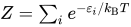
where the index i now specifies a particular state rather than the set of all states with energy , and .
Hidden categories:
Articles with short description
Short description matches Wikidata
Use American English from January 2019
All Wikipedia articles written in American English