kitthe
Middle English
The spelling of this entry has been normalized according to the principles established by Wiktionary's editor community or recent spelling standards of the language. This particular spelling is unattested.
Alternative forms
- kiththe, kiþ, kiþþe, kyȝth, kyth, kythe, kyþe
- cuððe, cuhðe, cyððe, kuððe (Early Middle English)
- keþþe (Kent); cithe, kidh, kiyth, kyght, kyghte, kytht (Northern); cuþþe, cuþþhe, kutthe, kuþþe, kuythe (Southern, Southwest Midland)
Etymology
Inherited from Old English cȳþþ, cȳþþu, from Proto-West Germanic *kunþiþu.
Pronunciation
- IPA(key): /ˈkiθ(ə)/
- IPA(key): /ˈkɛθ(ə)/ (Kent)
- IPA(key): /ˈkyθ(ə)/ (Southern, Southwest Midland)
Noun
kitthe (plural kitthes)
- One's homeland or birthplace; the country one belongs to.
- One's kinsmen or relations; the people one belongs to.
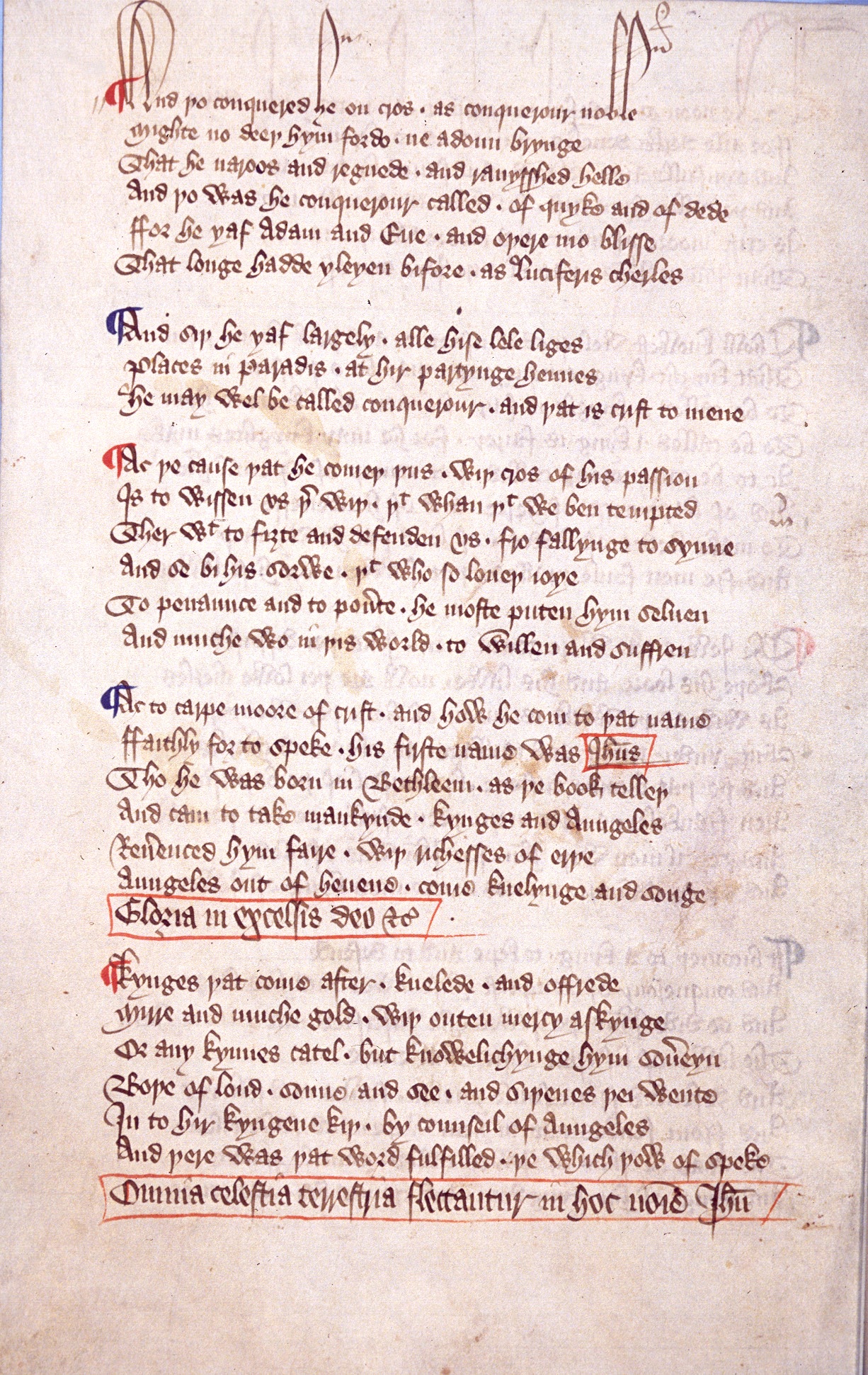
- c. 1378-9, [William Langland], “Paſſus xıx᷒ et explıcıt Dobet // et ımplıcıt Dobeſt”, in [Piers Plowman, A Treatise on Sin] (W, B-text), London, published c. 1400, →OCLC, folio 116, verso; republished as Thorlac Turville-Petre, Hoyt N. Duggan, editors, Cambridge, Trinity College, MS B.15.17 (The Piers Plowman Electronic Archive; 2), SEENET, 2014, →ISBN:
- ¶ Kynges þat come after. knelede. and offrede / Mırre and muche gold. Wıþ outen mercy aſkynge / Or any kynnes catel. but knowelıchynge hym sou͛eyn / Boþe of lond. sonne and see. and sıþenes þeı wente / In to hır kyngene kıþ. by counseıl of Aungeles
- Then kings came next, kneeling and offering / myrrh and plenty of gold, without asking for favour / or any kind of wealth, but instead acknowledging him as sovereign / of the land, sun, and sea; then they went / back to the kings' people using instructions from angels.
- (rare) Relation, heritage; ethnic or familial connection.
- (rare) A descendant or offspring; someone descending from oneself.
- (rare) Knowledge, facts (especially customary)
- (rare) Acquaintance; the state of knowing someone.
Descendants
References
- “kitthe, n.”, in MED Online, Ann Arbor, Mich.: University of Michigan, 2007, retrieved 22 May 2018.
Categories:
- Middle English terms inherited from Old English
- Middle English terms derived from Old English
- Middle English terms inherited from Proto-West Germanic
- Middle English terms derived from Proto-West Germanic
- Middle English terms with IPA pronunciation
- Middle English lemmas
- Middle English nouns
- Middle English terms with quotations
- Middle English terms with rare senses
- enm:Family