feld
Middle English
Etymology 1
Inherited from Old English feld, from Proto-West Germanic *felþu, from Proto-Germanic *felþuz.
Alternative forms
- feelde, feeld, felde, field
- field (Gower); veld (Kent, Southern, Southwest Midland); feold (Laȝamon's Brut)
- feild, fild (Northern); ffylde, fylde (North Midland)
Pronunciation
- IPA(key): /feːld/
Noun
feld (plural feldes, dative singular felde)
- A plain (flat, open country):
- A field (such land used for agriculture)
- c. 1378-9, [William Langland], “Paſſus quıntus de vıſıone vt supͣ”, in [Piers Plowman, A Treatise on Sin] (W, B-text), London, published c. 1400, →OCLC, folio 37, verso; republished as Thorlac Turville-Petre, Hoyt N. Duggan, editors, Cambridge, Trinity College, MS B.15.17 (The Piers Plowman Electronic Archive; 2), SEENET, 2014, →ISBN:
- To kepe kyen in þe feld. þe coꝛn fro þe beeſtes / Dıken oꝛ deluen. or dyngen vp on sheues / Oꝛ helpe make moꝛter. oꝛ bere Muk a feld
- […] to keep cows in the field, grain from the animals, to ditch, dig, or beat on sheaves, / help make mortar, or deliver manure to the field.
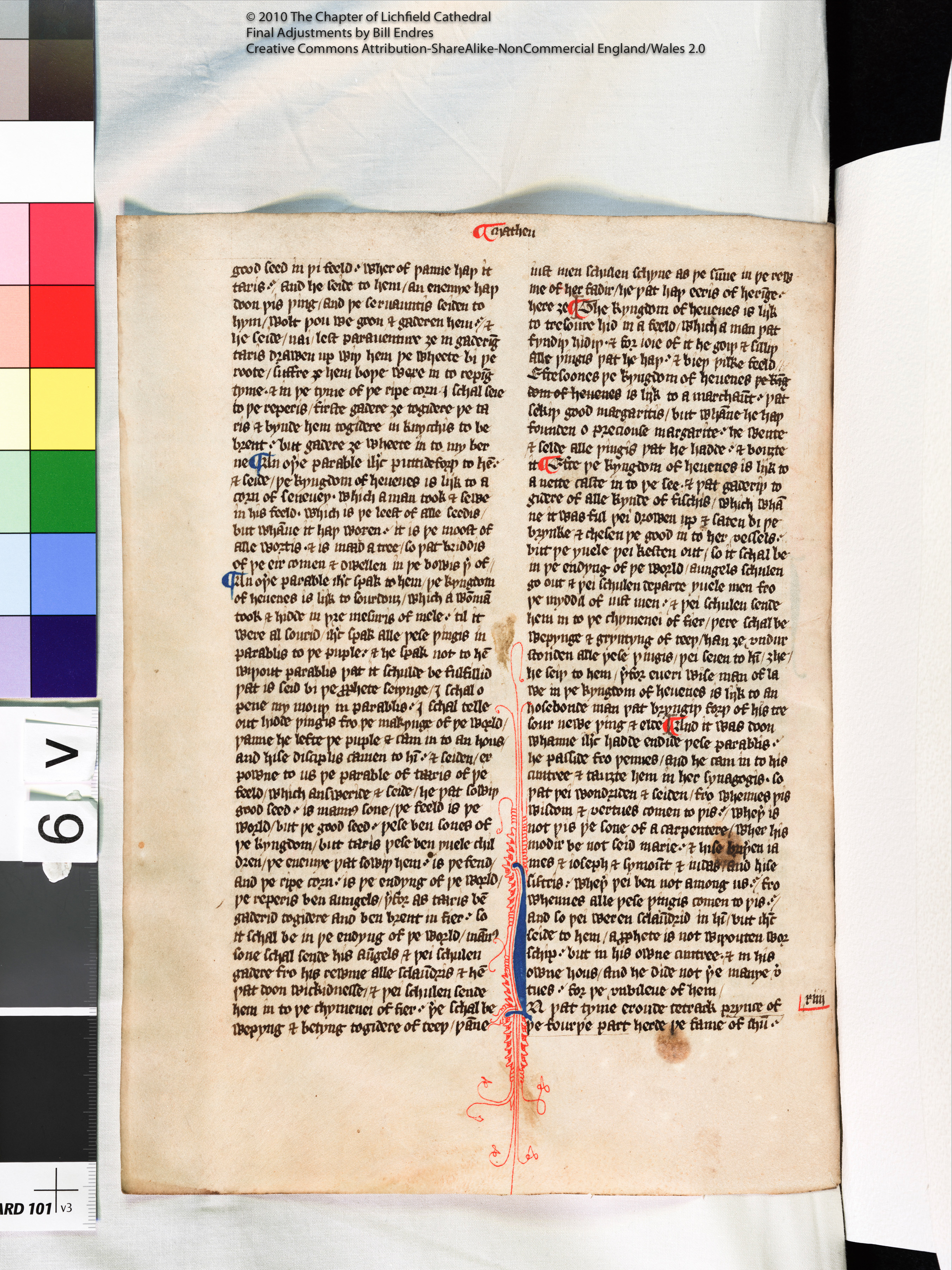
- c. 1395, John Wycliffe, John Purvey [et al.], transl., Bible (Wycliffite Bible (later version), MS Lich 10.)[1], published c. 1410, Matheu 13:31-32, folio 6, verso, column 1; republished as Wycliffe's translation of the New Testament, Lichfield: Bill Endres, 2010:
- An oþer parable iheſus puttide foꝛþ to hem. / ⁊ ſeide / þe kyngdom of heuenes is lijk to a coꝛn of ſeneuey · which a man took ⁊ ſewe in his feeld · / which is þe leeſt of alle ſeedis / but whanne it haþ woxen .· it is the mooſt of alle woꝛtis · ⁊ is maad a tre / ſo þe bꝛiddis of þe eir comen ⁊ dwellen in þe bowis þerof.
- Jesus put another parable forwards to them, saying: "The Kingdom of Heaven is like a mustard seed that a person took and sowed in their field; / it is the smallest of all seeds, but when it has grown, it is the largest of all plants; it becomes a tree, so the birds of the air come and nest in its branches."
- Wild or uncultivated land.
- A battlefield or battleground.
- A field (such land used for agriculture)
- The countryside; unbuilt land.
- The Earth's ground or surface.
- An army ready for battle.
- (heraldry) A field (background of a shield).
- (figurative, rare) A field (realm of operation).

Related terms
Descendants
References
- “fẹ̄ld, n.”, in MED Online, Ann Arbor, Mich.: University of Michigan, 2007, retrieved 12 October 2018.
- “field, n.”, in OED Online
 , Oxford: Oxford University Press, launched 2000.
Etymology 2
Verb
feld
- first/third-person singular past indicative of folden
- (later) second-person singular past indicative of folden
Old Dutch
Noun
feld n
- alternative spelling of felt
Old English
Alternative forms
Etymology
From Proto-West Germanic *felþu, from Proto-Germanic *felþuz. Cognate with Old Frisian feld, Old Saxon feld, Old High German feld.
Pronunciation
- IPA(key): /feld/, [feɫd]
Noun
feld m
Usage notes
- Originally a u-stem, both u-stem and a-stem declensions occur.
Declension
Strong u-stem/a-stem:
| singular | plural | |
|---|---|---|
| nominative | feld | felda, feldas |
| accusative | feld | felda, feldas |
| genitive | felda, feldes | felda |
| dative | felda, felde | feldum |
Hyponyms
Derived terms
Related terms
Descendants
- Middle English: feld
Old Frisian
Etymology
From Proto-West Germanic *felþu, from Proto-Germanic *felþą, from Proto-Indo-European *pelth₂-. Cognates include Old English feld, Old Saxon feld and Old Dutch felt.
Pronunciation
- IPA(key): /ˈfeld/
Noun
feld m
Descendants
References
- Bremmer, Rolf H. (2009), An Introduction to Old Frisian: History, Grammar, Reader, Glossary, Amsterdam: John Benjamins Publishing Company, →ISBN
Categories:
- Middle English terms derived from Proto-Indo-European
- Middle English terms derived from Proto-West Germanic
- Middle English terms inherited from Proto-West Germanic
- Middle English terms inherited from Proto-Germanic
- Middle English terms derived from Old English
- Middle English terms derived from Proto-Germanic
- Middle English terms inherited from Old English
- Middle English terms with IPA pronunciation
- Middle English lemmas
- Middle English nouns
- Middle English terms with quotations
- enm:Heraldry
- Middle English terms with rare senses
- Middle English non-lemma forms
- Middle English verb forms
- Middle English first/third-person singular past forms
- Middle English second-person singular past forms
- enm:Earth
- enm:Landforms
- enm:Military
- enm:War
- Old Dutch lemmas
- Old Dutch nouns
- Old Dutch neuter nouns
- Old English terms derived from Proto-Germanic
- Old English terms inherited from Proto-Germanic
- Old English terms derived from Proto-Indo-European
- Old English terms derived from Proto-West Germanic
- Old English terms inherited from Proto-West Germanic
- Old English terms with IPA pronunciation
- Old English lemmas
- Old English nouns
- Old English masculine nouns
- Old English u-stem nouns
- Old English masculine a-stem nouns
- Old Frisian terms inherited from Proto-West Germanic
- Old Frisian terms derived from Proto-West Germanic
- Old Frisian terms inherited from Proto-Germanic
- Old Frisian terms derived from Proto-Germanic
- Old Frisian terms inherited from Proto-Indo-European
- Old Frisian terms derived from Proto-Indo-European
- Old Frisian terms with IPA pronunciation
- Old Frisian lemmas
- Old Frisian nouns
- Old Frisian masculine nouns