cousa
Asturian
Pronunciation
- IPA(key): /ˈkou̯sa/ [ˈkou̯.sa]
- Rhymes: -ou̯sa
- Syllabification: cou‧sa
Noun
cousa f (plural cousas)
Galician
Etymology 1
From Old Galician-Portuguese cousa, from Latin causa. Doublet of causa, a borrowing. Cognate with Portuguese coisa and Spanish cosa.
Pronunciation
- IPA(key): /ˈkowsa/ [ˈkow.s̺ɐ]
- Rhymes: -owsa
Noun
cousa f (plural cousas)
- thing
- nothing (in negative sentences)
- Diso que me di non sei cousa. ― I know nothing about what you're asking.
- event
- swear word; abusive or insulting epithet
- Estaban aló no medio da praza chamándose cousas. ― They were both in the middle of the square calling each other names.
Derived terms
- algunha cousa
- calquera cousa
Related terms
References
- Seoane, Ernesto Xosé González; Granja, María Álvarez de la; Agrelo, Ana Isabel Boullón (2006–2022), “cousa”, in Dicionario de Dicionarios do galego medieval [Dictionary of dictionaries of Medieval Galician] (in Galician), Santiago de Compostela: Instituto da Lingua Galega
- Barreiro, Xavier Varela; Guinovart, Xavier Gómez (2006–2018), “cousa”, in Corpus Xelmírez: corpus lingüístico da Galicia medieval [Corpus Xelmírez: linguistic corpus of Medieval Galicia] (in Galician), Santiago de Compostela: Instituto da Lingua Galega
- Antón Santamarina, editor (2006–2013), “cousa”, in Dicionario de Dicionarios da lingua galega [Dictionary of Dictionaries of the Galician language] (in Galician), Santiago de Compostela: Instituto da Lingua Galega
- Antón Santamarina, Ernesto X. González Seoane, María Álvarez de la Granja, editors (2003–2018), “cousa”, in Tesouro informatizado da lingua galega (in Galician), Santiago de Compostela: Instituto da Lingua Galega
- Rosario Álvarez Blanco, editor (2014–2024), “cousa”, in Tesouro do léxico patrimonial galego e portugués (in Galician), Santiago de Compostela: Instituto da Lingua Galega, →ISSN
Etymology 2
Verb
cousa
- inflection of cousir:
- first/third-person singular present subjunctive
- third-person singular imperative
Latin
Participle
coūsa
- inflection of coūsus:
- nominative/vocative feminine singular
- nominative/accusative/vocative neuter plural
Participle
coūsā
- ablative feminine singular of coūsus
Mirandese
Noun
cousa f (plural cousas)
Old Galician-Portuguese
Etymology
Inherited from Latin causa (“cause, reason”). Cognate with Old Spanish cosa and Old French chose.
Pronunciation
- IPA(key): /ˈkow.z̺a/
Noun
cousa f (plural cousas)
- thing
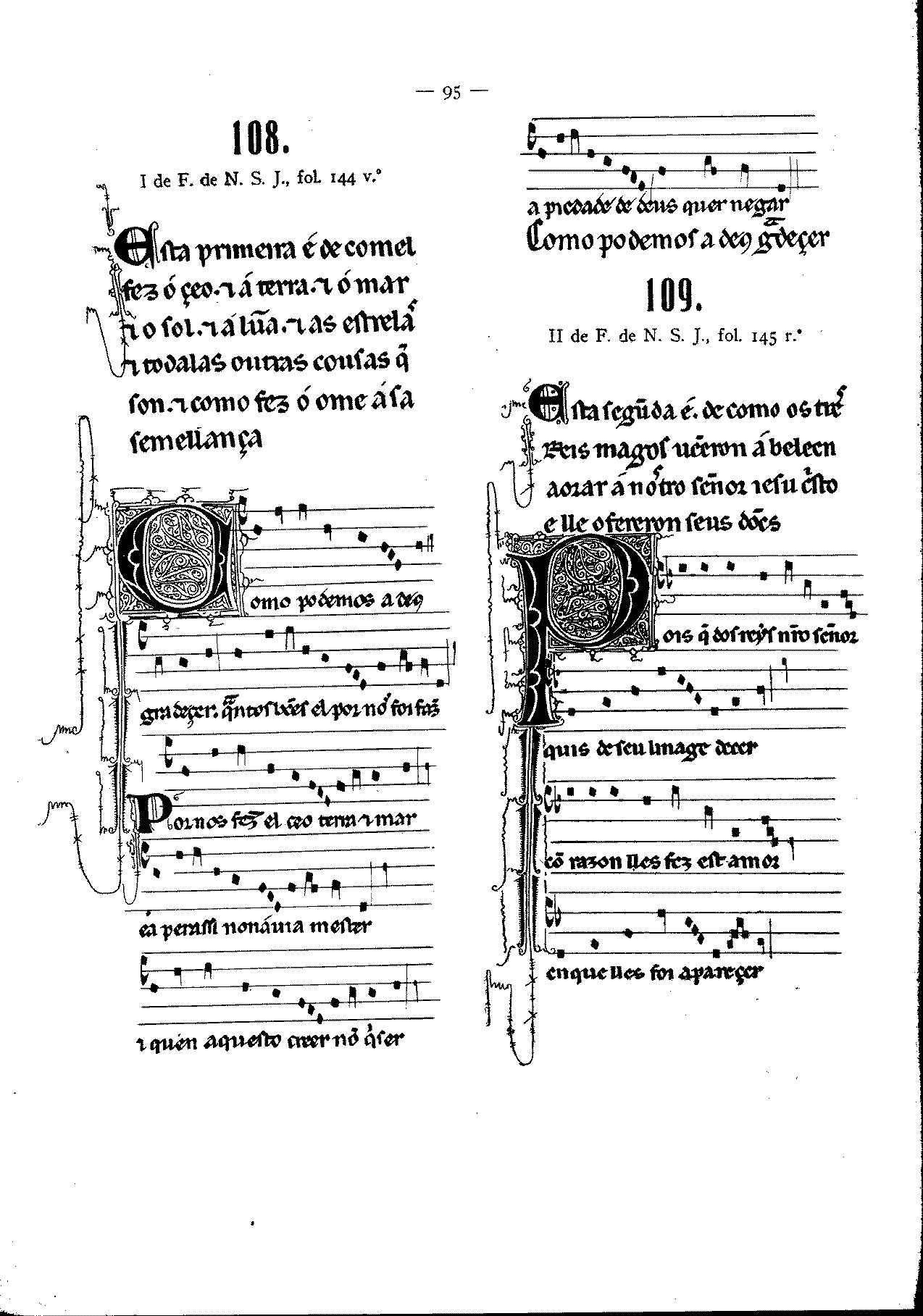
-
- Eſta primeira é de comel fez ó çeo. ⁊ á terra. ⁊ ó mar ⁊ o ſol. ⁊ á lũa. ⁊ as eſtrelas ⁊ todalas outras couſas q̇ ſon. ⁊ como fez ó ome áſa ſemellança
- This first one is (about) how He made the heaven, and the earth, and the sea, and the sun, and the moon, and the stars, and everything else that exists. And how (He) made man in His own likeness.
-
Descendants
- Fala: coixa, coixha
- Galician: cousa
- Portuguese: coisa, cousa (dated), coysa (obsolete) (see there for further descendants)
Further reading
- Universo Cantigas - "cousa"
- Seoane, Ernesto Xosé González; Granja, María Álvarez de la; Agrelo, Ana Isabel Boullón (2006–2022), “cousa”, in Dicionario de Dicionarios do galego medieval [Dictionary of dictionaries of Medieval Galician] (in Galician), Santiago de Compostela: Instituto da Lingua Galega
- Barreiro, Xavier Varela; Guinovart, Xavier Gómez (2006–2018), “cousa”, in Corpus Xelmírez: corpus lingüístico da Galicia medieval [Corpus Xelmírez: linguistic corpus of Medieval Galicia] (in Galician), Santiago de Compostela: Instituto da Lingua Galega
Portuguese
Etymology
Etymology tree
Inherited from Old Galician-Portuguese cousa, from Latin causa (“cause, reason”).
Pronunciation
- (Brazil) IPA(key): /ˈko(w).zɐ/ [ˈko(ʊ̯).zɐ]
- (Portugal) IPA(key): /ˈko(w).zɐ/
- (Northern Portugal) IPA(key): /ˈkow.zɐ/
- (Southern Portugal) IPA(key): /ˈko.zɐ/
Noun
cousa f (plural cousas)
- dated form of coisa
- 1595, Luís Vaz de Camões, Rimas, “Transforma-se o amador na cousa amada”:
- Transforma-se o amador na cousa amada
- The lover becomes the thing he loves
- 1595, Luís Vaz de Camões, Rimas, “Transforma-se o amador na cousa amada”:
Further reading
- “cousa”, in Dicionário Aulete Digital (in Portuguese), Rio de Janeiro: Lexikon Editora Digital, 2008–2026
- “cousa”, in Dicionário Priberam da Língua Portuguesa (in Portuguese), Lisbon: Priberam, 2008–2026
Categories:
- Asturian terms with IPA pronunciation
- Rhymes:Asturian/ou̯sa
- Rhymes:Asturian/ou̯sa/2 syllables
- Asturian lemmas
- Asturian nouns
- Asturian feminine nouns
- Western Asturian
- Asturian dialectal terms
- Galician terms inherited from Old Galician-Portuguese
- Galician terms derived from Old Galician-Portuguese
- Galician terms inherited from Latin
- Galician terms derived from Latin
- Galician doublets
- Galician terms with IPA pronunciation
- Rhymes:Galician/owsa
- Rhymes:Galician/owsa/2 syllables
- Galician lemmas
- Galician nouns
- Galician countable nouns
- Galician feminine nouns
- Galician terms with usage examples
- Galician non-lemma forms
- Galician verb forms
- Latin non-lemma forms
- Latin participle forms
- Mirandese lemmas
- Mirandese nouns
- Mirandese countable nouns
- Mirandese feminine nouns
- Old Galician-Portuguese terms inherited from Latin
- Old Galician-Portuguese terms derived from Latin
- Old Galician-Portuguese terms with IPA pronunciation
- Old Galician-Portuguese lemmas
- Old Galician-Portuguese nouns
- Old Galician-Portuguese feminine nouns
- Old Galician-Portuguese terms with quotations
- Portuguese terms derived from Old Latin
- Portuguese terms inherited from Old Latin
- Portuguese terms derived from Proto-Italic
- Portuguese terms derived from Latin
- Portuguese terms inherited from Old Galician-Portuguese
- Portuguese terms inherited from Latin
- Portuguese terms inherited from Proto-Italic
- Portuguese terms derived from Old Galician-Portuguese
- Portuguese 2-syllable words
- Portuguese terms with IPA pronunciation
- Portuguese terms with homophones
- Rhymes:Portuguese/owzɐ
- Rhymes:Portuguese/owzɐ/2 syllables
- Rhymes:Portuguese/ozɐ
- Rhymes:Portuguese/ozɐ/2 syllables
- Portuguese lemmas
- Portuguese nouns
- Portuguese countable nouns
- Portuguese feminine nouns
- Portuguese dated forms
- Portuguese terms with quotations