camara
Javanese
Romanization
camara
- romanization of ꦕꦩꦫ
Latin
Etymology 1
A collateral form of camera (noun), closer to their shared etymon, the Ancient Greek κᾰμᾰ́ρᾱ (kămắrā). Although often associated with Vulgar Latin, it could also be found in some Classical Latin authors' works, as a learned variant of the more usual camera.
Pronunciation
- (Classical Latin) IPA(key): [ˈka.ma.ra]
- (modern Italianate Ecclesiastical) IPA(key): [ˈkaː.ma.ra]
Noun
camara f (genitive camarae); first declension
- alternative form of camera
Declension
First-declension noun.
| singular | plural | |
|---|---|---|
| nominative | camara | camarae |
| genitive | camarae | camarārum |
| dative | camarae | camarīs |
| accusative | camaram | camarās |
| ablative | camarā | camarīs |
| vocative | camara | camarae |
References
- “camara”, in Charlton T. Lewis and Charles Short (1879), A Latin Dictionary, Oxford: Clarendon Press
- “camara”, in Charlton T. Lewis (1891), An Elementary Latin Dictionary, New York: Harper & Brothers
- "camara", in Charles du Fresne du Cange, Glossarium Mediæ et Infimæ Latinitatis (augmented edition with additions by D. P. Carpenterius, Adelungius and others, edited by Léopold Favre, 1883–1887)
- “cămăra”, in Gaffiot, Félix (1934), Dictionnaire illustré latin-français, Hachette, page 249/2.
- “camara”, in Harry Thurston Peck, editor (1898), Harper’s Dictionary of Classical Antiquities, New York: Harper & Brothers
- “camara”, in William Smith, editor (1854, 1857), A Dictionary of Greek and Roman Geography, volume 1 & 2, London: Walton and Maberly
- “camara”, in William Smith et al., editor (1890), A Dictionary of Greek and Roman Antiquities, London: William Wayte. G. E. Marindin
- “camara” on page 262 of the Oxford Latin Dictionary (1st ed., 1968–82)
- Niermeyer, Jan Frederik (1976), “camara”, in Mediae Latinitatis Lexicon Minus, Leiden, Boston: E. J. Brill, page 117/1
Etymology 2
A regularly conjugated form of camarō (verb).
Pronunciation
- (Classical Latin) IPA(key): [ˈka.ma.raː]
- (modern Italianate Ecclesiastical) IPA(key): [ˈkaː.ma.ra]
Verb
camarā
- second-person singular present active imperative of camarō
Old Galician-Portuguese
Alternative forms
Etymology
From Vulgar Latin camara, from Latin camera, from Ancient Greek καμάρα (kamára).
Pronunciation
- IPA(key): /ˈka.ma.ɾa/
- Rhymes: -amaɾa
- Hyphenation: ca‧ma‧ra
Noun
cámara f (plural cámaras)
- room, chamber
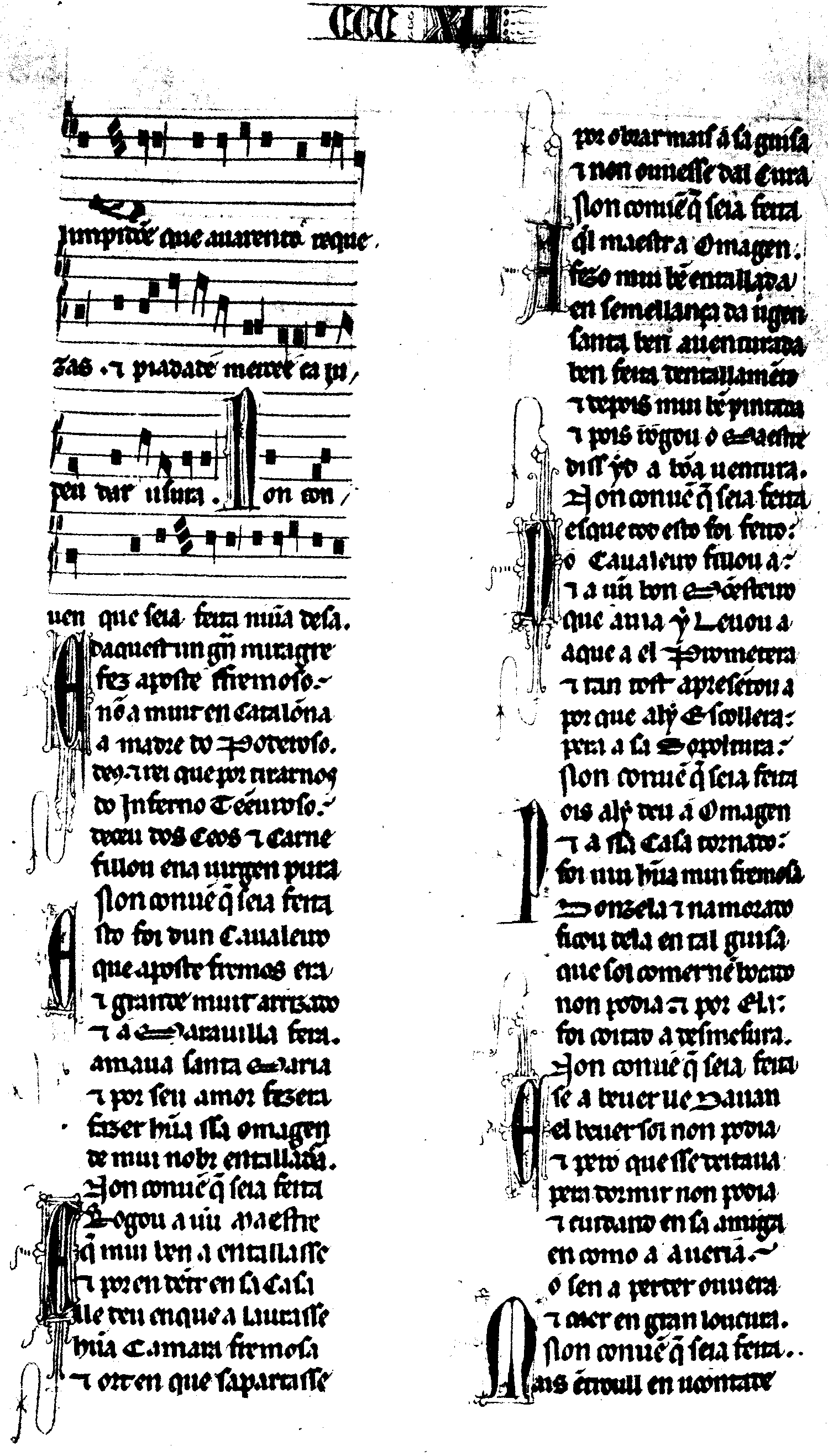
- a. 1284, Alfonso X of Castile, Cantigas de Santa Maria, Códice de los músicos, cantiga 312 (facsimile):
- ⁊ poren dẽtr en ſa Caſa lle deu en que a lauraſſe / hũa Camara fremoſa
- and for this reason he gave him a beautiful chamber inside his house in which to carve it
- c. 1450, A. López Ferreiro, editor, Historia de la Santa A. M. Iglesia de Santiago de Compostela, VII, p. 136:
- ítem mando que dentro enas ditas casas de miña morada seja apartadamente outra Cámara de libraría en que sejan postos todos meus libros en rroda et almarios
- Item, I order that, inside my houses where I reside, they build another chamber for library, and that they place in it all my books around in shelves
Descendants
References
- Barreiro, Xavier Varela; Guinovart, Xavier Gómez (2006–2018), “camara”, in Corpus Xelmírez: corpus lingüístico da Galicia medieval [Corpus Xelmírez: linguistic corpus of Medieval Galicia] (in Galician), Santiago de Compostela: Instituto da Lingua Galega
- Cunha, Antônio Geraldo da (2020–2026), “câmera”, in Vocabulário histórico-cronológico do português medieval [Historical and chronological vocabulary of Medieval Portuguese] (in Portuguese), Rio de Janeiro: Fundação Casa de Rui Barbosa
- Seoane, Ernesto Xosé González; Granja, María Álvarez de la; Agrelo, Ana Isabel Boullón (2006–2022), “camara”, in Dicionario de Dicionarios do galego medieval [Dictionary of dictionaries of Medieval Galician] (in Galician), Santiago de Compostela: Instituto da Lingua Galega
Old Javanese
Etymology
Borrowed from Sanskrit चमर (camara, “yak”).
Pronunciation
Noun
camara
Descendants
Further reading
- "camara" in P.J. Zoetmulder with the collaboration of S.O. Robson, Old Javanese-English Dictionary. 's-Gravenhage: M. Nijhoff, 1982.
Portuguese
Noun
camara f (plural camaras)
- pre-reform spelling (used until 1943 in Brazil and 1911 in Portugal) of câmara
Scottish Gaelic
Etymology
From English camera, from Latin camera (“chamber”), from Ancient Greek καμάρα (kamára, “vault”), of Old Iranian origin.
Pronunciation
- IPA(key): /ˈkʰamaɾˠa/
Noun
camara m (nominative plural camarathan)
- camera (device for taking still or moving pictures or photographs)
Mutation
Categories:
- Javanese non-lemma forms
- Javanese romanizations
- Latin terms derived from Ancient Greek
- Latin 3-syllable words
- Latin terms with IPA pronunciation
- Latin lemmas
- Latin nouns
- Latin first declension nouns
- Latin feminine nouns in the first declension
- Latin feminine nouns
- Latin non-lemma forms
- Latin verb forms
- Old Galician-Portuguese terms derived from Proto-Iranian
- Old Galician-Portuguese terms derived from Proto-Indo-Iranian
- Old Galician-Portuguese terms derived from Ancient Greek
- Old Galician-Portuguese terms derived from Latin
- Old Galician-Portuguese terms derived from the Proto-Indo-European root *kh₂em-
- Old Galician-Portuguese terms inherited from Latin
- Old Galician-Portuguese terms derived from Proto-Indo-European
- Old Galician-Portuguese terms inherited from Vulgar Latin
- Old Galician-Portuguese terms derived from Vulgar Latin
- Old Galician-Portuguese terms with IPA pronunciation
- Rhymes:Old Galician-Portuguese/amaɾa
- Rhymes:Old Galician-Portuguese/amaɾa/3 syllables
- Old Galician-Portuguese lemmas
- Old Galician-Portuguese nouns
- Old Galician-Portuguese feminine nouns
- Old Galician-Portuguese terms with quotations
- Old Javanese terms borrowed from Sanskrit
- Old Javanese terms derived from Sanskrit
- Old Javanese terms with IPA pronunciation
- Rhymes:Old Javanese/ra
- Rhymes:Old Javanese/ra/3 syllables
- Old Javanese terms with homophones
- Old Javanese lemmas
- Old Javanese nouns
- Portuguese lemmas
- Portuguese nouns
- Portuguese countable nouns
- Portuguese feminine nouns
- Portuguese forms superseded in 1943
- Portuguese forms superseded in 1911
- Scottish Gaelic terms derived from Proto-Indo-European
- Scottish Gaelic terms derived from the Proto-Indo-European root *kh₂em-
- Scottish Gaelic terms borrowed from English
- Scottish Gaelic terms derived from English
- Scottish Gaelic terms derived from Latin
- Scottish Gaelic terms derived from Ancient Greek
- Scottish Gaelic terms derived from Old Iranian languages
- Scottish Gaelic terms with IPA pronunciation
- Scottish Gaelic lemmas
- Scottish Gaelic nouns
- Scottish Gaelic countable nouns
- Scottish Gaelic masculine nouns
- gd:Photography
- gd:Tools