𦉼
| ||||||||
Translingual
Han character
𦉼 (Kangxi radical 122, 网+3, 8 strokes, composition ⿱罒大)
Derived characters
References
- Kangxi Dictionary: page 947, character 3
- Dai Kanwa Jiten: character 28220
- Hanyu Da Zidian (first edition): volume 4, page 2913, character 12
- Unihan data for U+2627C
Chinese
Etymology 1
| For pronunciation and definitions of 𦉼 – see 軍 (“armed forces; army; troops; corps; army; etc.”). (This character is a variant form of 軍). |
Etymology 2
| For pronunciation and definitions of 𦉼 – see 𬙜. (This character is a variant form of 𬙜). |
Etymology 3
| For pronunciation and definitions of 𦉼 – see 哭 (“to weep; to cry; to wail”). (This character is a variant form of 哭). |
Japanese
Kanji
𦉼
- alternative form of 軍
Readings
References
Vietnamese

Han character
𦉼: Hán Việt readings: la[1]
𦉼: Nôm readings: là[1], lạ[1], ra[1], khóc
Glyph origin 1
Simplified from 羅. See also 𱺵 and 𬙛 for similar variants.
Etymology 1
Verb
𦉼 • (là)
- chữ Nôm form of là (“to be”)
- late 17th - early 18th c., 天南語籙外紀 [Thiên Nam ngữ lục ngoại kỷ, Peripheral Records of Excerpts from Thiên Nam][1], page 89b:
- 𠸜𦉼穆慎課初
𠊛圭網瑞跷𤤰制湖- Tên là Mục Thận thuở xưa,
Người quê Võng Thuỵ theo vua chơi hồ. - His name was Mục Thận in ancient times.
He came from Võng Thuỵ and followed the emperor on a trip to the lake.
- Tên là Mục Thận thuở xưa,
- 1815, 周易解義演歌 [Chu dịch giải nghĩa diễn ca, Versified Explanation of the Meanings of the Zhou Yi][2], volume 2, page 55b:
- 蔑𠇮挭特渃茹
和𫜵主祭實𦉼可𠸦- Một mình gánh được nước nhà,
Hoà làm chủ tế, thật là khá khen. - He takes responsibility on his own for his nation,
And officiates sacrificial rites, which is truly praiseworthy.
- Một mình gánh được nước nhà,
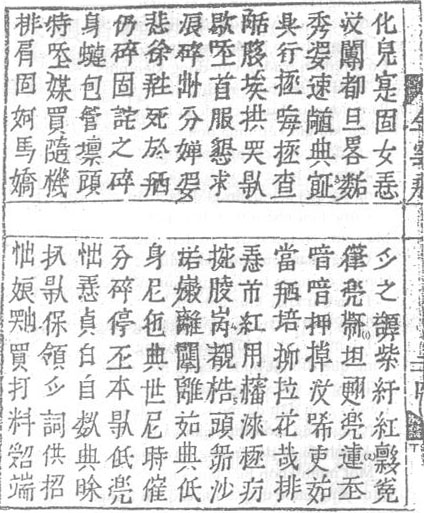
- 1820, 阮攸 [Nguyễn Du], compiled by 柳文堂 [Liễu Văn Đường], 金雲翹新傳 [Kim Vân Kiều tân truyện, New Story of Jin Yun Qiao][3], published 1866, page 24b:
- 𦧘䏧埃拱𦉼𠊛
𢚸𱜢紅用𧺀淶拯𤴬- Thịt da ai cũng là người,
Lòng nào hồng rụng, thắm rời chẳng đau. - Whose flesh and skin is not that of a human being.
Which rose when torn and shattered does not feel pain.
- Thịt da ai cũng là người,
Etymology 2
Verb
𦉼 • (ra)
- chữ Nôm form of ra (“to go out; to leave”)
- late 17th - early 18th c., 天南語籙外紀 [Thiên Nam ngữ lục ngoại kỷ, Peripheral Records of Excerpts from Thiên Nam][4], page 99a:
- 𨍦油𦉼胣多端
㐌甘所罪碎昆奸𡚶- Sau dầu ra dạ đa đoan,
Đã cam thửa tội tôi con gian vòng. - Even if I later expose my changeable heart,
I already endure the offenses of a treacherous servant.
- Sau dầu ra dạ đa đoan,
Glyph origin 2
Variant form of 哭.
Verb
𦉼 • (khóc)
- chữ Nôm form of khóc (“to cry; to weep”)
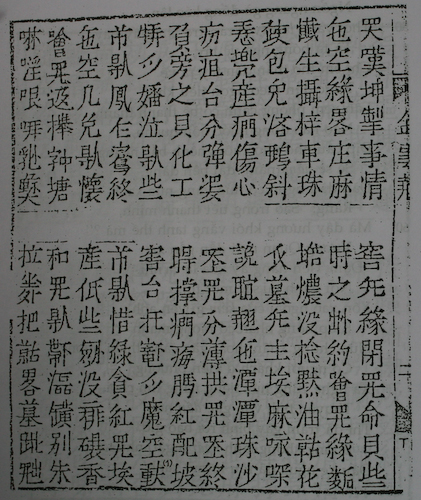
- 1820, 阮攸 [Nguyễn Du], compiled by 柳文堂 [Liễu Văn Đường], 金雲翹新傳 [Kim Vân Kiều tân truyện, New Story of Jin Yun Qiao][5], published 1866, page 2b:
- 𦉼嘆坤掣亊情
窖𱍺緣閉𱺵命貝些- Khóc than khôn xiết sự tình,
Khéo vô duyên bây là mình với ta. - The man shed tears and cried:
How regretful that we are not destined for each other.
- Khóc than khôn xiết sự tình,
References
Categories:
- CJK Unified Ideographs Extension B block
- Han script characters
- Translingual lemmas
- Translingual symbols
- Elementary Mandarin
- Chinese lemmas
- Mandarin lemmas
- Sichuanese lemmas
- Dungan lemmas
- Cantonese lemmas
- Taishanese lemmas
- Gan lemmas
- Hakka lemmas
- Jin lemmas
- Northern Min lemmas
- Eastern Min lemmas
- Hokkien lemmas
- Teochew lemmas
- Leizhou Min lemmas
- Puxian Min lemmas
- Southern Pinghua lemmas
- Wu lemmas
- Xiang lemmas
- Middle Chinese lemmas
- Old Chinese lemmas
- Chinese hanzi
- Mandarin hanzi
- Sichuanese hanzi
- Dungan hanzi
- Cantonese hanzi
- Taishanese hanzi
- Gan hanzi
- Hakka hanzi
- Jin hanzi
- Northern Min hanzi
- Eastern Min hanzi
- Hokkien hanzi
- Teochew hanzi
- Leizhou Min hanzi
- Puxian Min hanzi
- Southern Pinghua hanzi
- Wu hanzi
- Xiang hanzi
- Middle Chinese hanzi
- Old Chinese hanzi
- Chinese nouns
- Mandarin nouns
- Sichuanese nouns
- Dungan nouns
- Cantonese nouns
- Taishanese nouns
- Gan nouns
- Hakka nouns
- Jin nouns
- Northern Min nouns
- Eastern Min nouns
- Hokkien nouns
- Teochew nouns
- Leizhou Min nouns
- Puxian Min nouns
- Southern Pinghua nouns
- Wu nouns
- Xiang nouns
- Middle Chinese nouns
- Old Chinese nouns
- Chinese terms spelled with 𦉼
- Chinese variant forms
- Beginning Mandarin
- Chinese verbs
- Mandarin verbs
- Sichuanese verbs
- Dungan verbs
- Cantonese verbs
- Taishanese verbs
- Gan verbs
- Hakka verbs
- Jin verbs
- Northern Min verbs
- Eastern Min verbs
- Hokkien verbs
- Teochew verbs
- Leizhou Min verbs
- Puxian Min verbs
- Wu verbs
- Xiang verbs
- Middle Chinese verbs
- Old Chinese verbs
- Japanese kanji
- Japanese hyōgai kanji
- Japanese kanji with on reading ぐん
- Vietnamese Chữ Hán
- Vietnamese lemmas
- Vietnamese Han characters
- Vietnamese Nom
- Vietnamese verbs
- Vietnamese verbs in Han script
- Vietnamese terms with quotations
- Vietnamese variant characters