河馬
See also: 河马
Chinese
| river | horse; surname | ||
|---|---|---|---|
| trad. (河馬) | 河 | 馬 | |
| simp. (河马) | 河 | 马 | |
| anagram | 馬河/马河 | ||
Pronunciation
- Mandarin
- Cantonese
- Hakka (Sixian, PFS): hò-mâ
- Southern Min (Hokkien, POJ): hô-bé / hô-bée
- Wu (Shanghai, Wugniu): 6wu-mo
- Mandarin
- (Standard Chinese)
- Hanyu Pinyin: hémǎ
- Zhuyin: ㄏㄜˊ ㄇㄚˇ
- Tongyong Pinyin: hémǎ
- Wade–Giles: ho2-ma3
- Yale: hé-mǎ
- Gwoyeu Romatzyh: hermaa
- Palladius: хэма (xɛma)
- Sinological IPA (key): /xɤ³⁵ mä²¹⁴⁻²¹⁽⁴⁾/
- Homophones:
河馬 / 河马
荷馬 / 荷马
- (Standard Chinese)
- Cantonese
- (Standard Cantonese, Guangzhou–Hong Kong)
- Jyutping: ho4 maa5
- Yale: hòh máh
- Cantonese Pinyin: ho4 maa5
- Guangdong Romanization: ho4 ma5
- Sinological IPA (key): /hɔː²¹ maː¹³/
- Homophones:
河馬 / 河马
荷馬 / 荷马
- (Taishanese, Taicheng)
- Wiktionary: ho3 ma4
- Sinological IPA (key): /hᵘɔ²² ᵐba²¹/
- (Standard Cantonese, Guangzhou–Hong Kong)
- Hakka
- (Sixian, incl. Miaoli and Neipu)
- Pha̍k-fa-sṳ: hò-mâ
- Hakka Romanization System: hoˇ maˊ
- Hagfa Pinyim: ho2 ma1
- Sinological IPA: /ho¹¹ ma²⁴/
- (Sixian, incl. Miaoli and Neipu)
- Southern Min
- (Hokkien: General Taiwanese, Xiamen, Singapore)
- Pe̍h-ōe-jī: hô-bé
- Tâi-lô: hô-bé
- Phofsit Daibuun: hoi'bea
- Sinological IPA (Singapore): /ho²⁴⁻²¹ be⁴²/
- Sinological IPA (Taipei): /ho²⁴⁻¹¹ be⁵³/
- Sinological IPA (Xiamen): /ho²⁴⁻²² be⁵³/
- Sinological IPA (Kaohsiung): /hɤ²³⁻³³ be⁴¹/
- (Hokkien: Penang)
- Pe̍h-ōe-jī: hô-bée
- Tâi-lô: hô-bée
- Sinological IPA (Penang): /ho²³⁻²¹ bɛ⁴⁴⁵/
- (Hokkien: General Taiwanese, Xiamen, Singapore)
- Wu
Noun
河馬
Derived terms
Descendants
Japanese

| Kanji in this term | |
|---|---|
| 河 | 馬 |
| か Grade: 5 |
ば Grade: 2 |
| on'yomi | |
Etymology
Sources are agreed that the Japanese term is a calque from Dutch, but disagree on the source term. The leading theories:
- Calque of Dutch revierpaard, obsolete form of rivierpaard (literally “river horse”), itself a calque of Ancient Greek ἱπποπόταμος (hippopótamos), attested in the Doeff-Halma Dictionary, mainly edited in 1816-1817 and published in 1833 (scan available here).
- Calque of Dutch nijlpaard (literally “Nile horse”), where Dutch nijl refers to the Nile as a metonym for the sense of river, ostensibly as included in the Doeff-Halma Dictionary.[1]. However, that dictionary seems to have no entries at all starting with nij-, as we see none using either English collation rules (treating the ij digraph as two letters, with j coming alphabetically after i and before k) as seen here, or using Dutch collation rules (treating the ij digraph as a single letter, coming alphabetically after x and before y) as seen here.
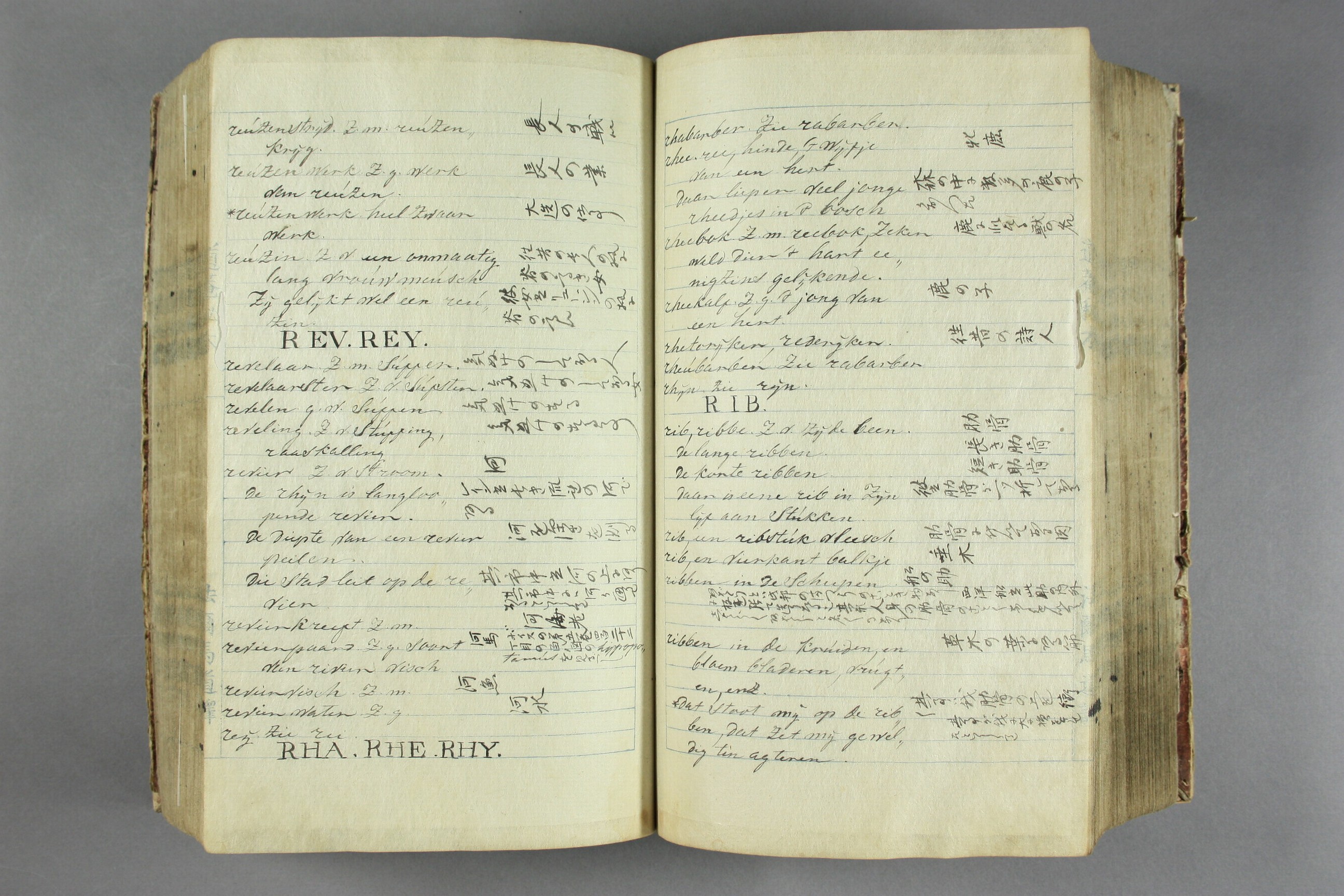


- Japanese sources also mention an 1855-58 re-edition of the Doeff-Halma Dutch-Japanese dictionary, reworked for a Japanese-language audience, that also glosses Japanese 河馬 as Dutch nijlpaard.[1]
Either way, the spelling 河馬 first appears in the Doeff-Halma dictionary in roughly 1816. The reading is not attested in the earliest sources, until an 1869 Japanese-English dictionary used furigana to indicate a kun'yomi reading of kawamuma (see also the now-obsolete muma reading for 馬). This reading appears to have fallen by the wayside; that same 1869 bilingual dictionary also listed the modern on'yomi reading of kaba, and monolingual Japanese references list the kaba reading from 1907.[1]
Pronunciation
Noun
河馬 • (kaba)
- [from 1816] a hippopotamus
Usage notes
- As with many terms that name organisms, this term is often spelled in katakana, especially in biological contexts (where katakana is customary), as カバ (kaba).
Derived terms
- 小人河馬 (kobitokaba, “pygmy hippopotamus (Choeropsis liberiensis)”)
References
- ↑ 1.0 1.1 1.2 “河馬”, in 日本国語大辞典 [Nihon Kokugo Daijiten][1] (in Japanese), concise edition, Tokyo: Shogakukan, 2006
- ^ NHK Broadcasting Culture Research Institute, editor (1998), NHK日本語発音アクセント辞典 [NHK Japanese Pronunciation Accent Dictionary] (in Japanese), Tokyo: NHK Publishing, Inc., →ISBN
- ^ Matsumura, Akira, editor (2006), 大辞林 [Daijirin] (in Japanese), Third edition, Tokyo: Sanseidō, →ISBN
- ^ Kindaichi, Kyōsuke et al., editors (1997), 新明解国語辞典 [Shin Meikai Kokugo Jiten] (in Japanese), Fifth edition, Tokyo: Sanseidō, →ISBN
- “河馬”, in 漢字ぺディア [Kanjipedia][2] (in Japanese), The Japan Kanji Aptitude Testing Foundation, 2015–2026
Korean
| Hanja in this term | |
|---|---|
| 河 | 馬 |
Noun
河馬 • (hama) (hangeul 하마)
Vietnamese
| chữ Hán Nôm in this term | |
|---|---|
| 河 | 馬 |
Noun
河馬
- chữ Hán form of hà mã (“hippopotamus”)
Categories:
- Mandarin terms with homophones
- Cantonese terms with homophones
- Chinese lemmas
- Mandarin lemmas
- Cantonese lemmas
- Taishanese lemmas
- Hakka lemmas
- Hokkien lemmas
- Wu lemmas
- Chinese nouns
- Mandarin nouns
- Cantonese nouns
- Taishanese nouns
- Hakka nouns
- Hokkien nouns
- Wu nouns
- Chinese terms with IPA pronunciation
- Chinese terms spelled with 河
- Chinese terms spelled with 馬
- zh:Even-toed ungulates
- Japanese terms spelled with 河 read as か
- Japanese terms spelled with 馬 read as ば
- Japanese terms read with on'yomi
- Japanese terms calqued from Dutch
- Japanese terms derived from Dutch
- Japanese terms derived from Ancient Greek
- Japanese terms with IPA pronunciation
- Japanese terms with Atamadaka pitch accent (Tōkyō)
- Japanese terms with IPA pronunciation with pitch accent
- Japanese lemmas
- Japanese nouns
- Japanese terms spelled with fifth grade kanji
- Japanese terms spelled with second grade kanji
- Japanese terms with 2 kanji
- ja:Even-toed ungulates
- Korean lemmas
- Korean nouns
- Korean nouns in Han script
- Korean hanja forms
- Vietnamese lemmas
- Vietnamese nouns
- Vietnamese nouns in Han script
- Vietnamese Chữ Hán