ẏ
See also: Appendix:Variations of "y"
| ||||||||||
Translingual
Letter
ẏ (lower case, upper case Ẏ)
- (international standards) Transliterates Bengali-Assamese য়, Odia ୟ.
- (mathematics) The differential of y, using Newtonian calculus notation; the y-component of the velocity.
Cornish
Letter
ẏ (lower case, upper case Ẏ)
- (archaic) A letter of the Cornish alphabet.
- An ôst an tshei ameꝺ an dzhẏi: Pe 'ntra venta guîl ᵹen an ôst antshei? ẏbma maᵹen ostez nei ha yẏꝿk eu hei: mar menta guellaz an ôst an tshei, kî ꝺa 'n ᵹeᵹen, ha enna ti an kâv.
- The host of the house said: What wouldst thou do with the host of the house? Here is the hostess with us, and young she is: but if you will see the host of the house, go into the kitchen, and there you'll find him.
Middle English
Letter
ẏ
- alternative form of y
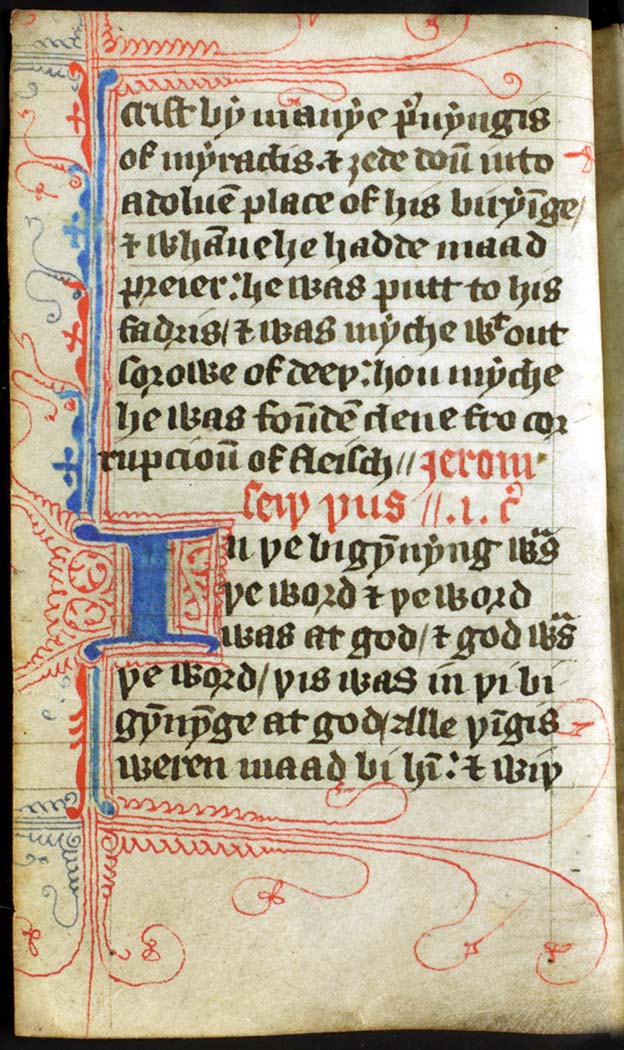
- c. 1395, John Wycliffe, John Purvey [et al.], transl., Bible (Wycliffe’s Bible, MS Hunter 191.)[1], published late 14th century, Joon 1:1, page 2v:
- In þe bıgỹnẏng wsᷓ þe word ⁊ þe word was at god / ⁊ god wsᷓ þe word
- In the beginning was the Word, and the Word was with God, and the Word was God. (New International Version)
- 1387–1400, [Geoffrey] Chaucer, “Here Bygynneth the Book of the Tales of Caunt́burẏ”, in The Tales of Caunt́bury (Hengwrt Chaucer; Peniarth Manuscript 392D), Aberystwyth, Ceredigion: National Library of Wales, published [c. 1400–1410], →OCLC, folio 2, recto:
Article
ẏ
Old English
Letter
ẏ (lower case, upper case Ẏ)
- alternative form of y
- c. 1000, Beowulf (Cotton MS Vitellius A XV)[2], page 132r, lines 4–6:
- oꝼꞇ ꞅcẏlꝺ ꞅceꝼınᵹ ꞅceaþen[a] þꞃeaꞇum moneᵹū mæᵹþum meoꝺo ꞅeꞇla oꝼ ꞇeah eᵹꞅoꝺe eoꞃl sẏððan æꞃeꞅꞇ ƿeaꞃð ꝼea ꞅceaꝼꞇ ꝼunꝺen
- oft scẏld scefing sceaþen[a] þreatum monegū mægþum meodo setla of teah egsode eorl sẏððan ærest wearð fea sceaft funden
- Oft did Scyld the son of Scéf tear the mead-thrones away from the hosts of his foes, from many tribes; the earl terrified them, after he first was found an out-cast.
Descendants
- Middle English: ẏ
Welsh
Letter
ẏ (lower case, upper case Ẏ)
- (archaic) a letter of the Welsh alphabet
- (Can we date this quote?), (Please provide the book title or journal name):
- Osp y tŷ meꝺant hûy: Pa bêꞇ a vynd di uneyd ag osp y tŷ? ymma ymae gennyn nî † ẏspes, ag ivaꝿk yu hi: os myn di uiled osp y ty; di kerꝺ i'r gegin di ai kei.
- The host of the house said: What wouldst thou do with the host of the house? Here is the hostess with us, and young she is: but if you will see the host of the house, go into the kitchen, and there you'll find him.
Categories:
- Latin Extended Additional block
- Latin script characters
- Character boxes with compositions
- Translingual lemmas
- Translingual letters
- Translingual nouns
- Translingual terms spelled with ◌̇
- mul:Mathematics
- Cornish lemmas
- Cornish letters
- Cornish nouns
- Cornish terms with archaic senses
- Middle English variant lemmas
- Middle English terms with quotations
- Middle English lemmas
- Middle English articles
- Middle English terms spelled with ◌̇
- Old English lemmas
- Old English letters
- Old English nouns
- Old English terms spelled with ◌̇
- Old English terms with quotations
- Welsh lemmas
- Welsh letters
- Welsh nouns
- Welsh terms spelled with ◌̇
- Welsh terms with archaic senses
- Welsh terms with quotations