Vogel–Fulcher–Tammann equation
The Vogel–Fulcher–Tammann equation, also known as Vogel–Fulcher–Tammann–Hesse equation or Vogel–Fulcher equation (abbreviated: VFT equation), is used to describe the viscosity of liquids as a function of temperature, especially supercooled liquids approaching the glass transition. Glass-forming liquids can stay in a liquid-like state of disorder below their usual melting point if crystallization is prevented, but the viscosity of such a supercooled liquid increases strongly with decreasing temperature.
The VFT equation gives the temperature dependence of the viscosity of a liquid as

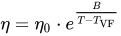
where is the viscosity in the limit where and is an energy barrier. Both values are empirical material-dependent parameters. is also an empirical fitting parameter, and typically lies about 50 °C below the glass transition temperature. These three parameters are normally used as adjustable parameters to fit the VFT equation to experimental data of specific systems. However, some experimental evidence has indicated statistical correlations between these fitting parameters.


An important metric from this equation is the strength parameter , which can relate to fragility of the glass.

This equation is equivalent to the Williams-Landel-Ferry equation which relates viscosity to the fraction of free volume, if free volume decreases linearly with decreasing temperature.