Tarski–Seidenberg theorem
In mathematics, the Tarski–Seidenberg theorem is a theorem on semialgebraic sets, that is, subsets of real coordinate spaces that can be defined by a finite set of polynomial equations and polynomial inequalities. This theorem was proved by Alfred Tarski in 1930 in view of his proof that the theory of real closed fields is complete (every formula can be proved either as true or as false) and admits quantifier elimination. The theorem was later discovered indepedently by Abraham Seidenberg in the context of constructive mathematics.
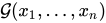
The theorem states that, given a set S in the (n + 1)-dimensional space, which is defined by polynomial equations and inequalities involving (n + 1) variables, the projection eliminating one of the variables can be defined similarly. In other words, if is the formula defining S, there exists a formula that define the same set as .


Although the original proof of the theorem was constructive, the resulting algorithm is galactic, that is, it has a computational complexity that is far too high for using the method on a computer. George E. Collins introduced the algorithm of cylindrical algebraic decomposition, which allows quantifier elimination over the reals in double exponential time. This complexity is optimal, as there are examples where the output has a double exponential number of connected components. Collins's algorithm is therefore fundamental and widely used in computational algebraic geometry.