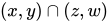
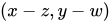
Scheme-theoretic intersection
In algebraic geometry, the scheme-theoretic intersection of closed subschemes X, Y of a scheme W is , the fiber product of the closed immersions . It is denoted by .



Locally, W is given as for some ring R and X, Y as for some ideals I, J. Thus, locally, the intersection is given as



Here, we used (for this identity, see tensor product of modules#Examples.)

Example: Let be a projective variety with the homogeneous coordinate ring S/I, where S is a polynomial ring. If is a hypersurface defined by some homogeneous polynomial f in S, then



If f is linear (deg = 1), it is called a hyperplane section. See also: Bertini's theorem.
Now, a scheme-theoretic intersection may not be a correct intersection, say, from the point of view of intersection theory. For example, let be the affine 4-space and X, Y closed subschemes defined by the ideals and . Since X is the union of two planes, each intersecting with Y at the origin with multiplicity one, by the linearity of intersection multiplicity, we expect X and Y intersect at the origin with multiplicity two. On the other hand, one sees the scheme-theoretic intersection consists of the origin with multiplicity three. That is, a scheme-theoretic multiplicity of an intersection may differ from an intersection-theoretic multiplicity, the latter given by Serre's Tor formula. Solving this disparity is one of the starting points for derived algebraic geometry, which aims to introduce the notion of derived intersection.