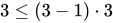
The matchings, the 3 sets of hyperedges colored blue, red, and yellow, are sets of edges such that each vertex appears in at most one of the edges in its set. The largest size of a matching in a hypergraph H is denoted by .
The transversals, the 3 sets of vertices colored light gray, gray, and dark gray, are sets of vertices such that each hyperedge contains at least one of the vertices in its set. The smallest size of a transversal in a hypergraph H is denoted by .
Ryser's conjecture states that for any r-uniform and r-partite hypergraph, . In the graph shown, which is 3-uniform and 3-partite, evaluates to , so the conjecture holds.