Attributable fraction for the population

In epidemiology, attributable fraction for the population (AFp) is the proportion of incidents in the population that are attributable to the risk factor. The term "attributable risk percent for the population" is used if the fraction is expressed as a percentage. It is calculated as , where is the incidence in the population, and is the incidence in the unexposed group.



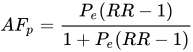
Equivalently it can be calculated as , where is the exposed proportion of the population and is the relative risk not adjusted for confounders.


It is used when an exposure increases the risk, as opposed to reducing it, in which case its symmetrical notion is preventable fraction for the population.